Automotive seat heater wire is the core consumable in resistance wire heating pads and is one of the most technically demanding components in the heated seat supply chain. Selecting the correct wire specification and a qualified supplier is foundational to pad performance and long-term reliability.
1. Resistance Wire Alloy Selection
The two primary alloys used in automotive seat heater wire are nickel-chromium (NiCr) and iron-chromium-aluminum (FeCrAl). NiCr wire offers stable resistance over temperature, excellent oxidation resistance, and a long service history in automotive heating applications.
FeCrAl wire achieves higher maximum operating temperature and is preferred for high watt density applications.
For most automotive seat heater programs, NiCr wire is the standard specification.
2. Wire Gauge and Resistance Specification
Seat heater wire is specified by gauge (diameter in mm) and resistance per unit length (ohms per meter). The combination of these two parameters, along with the total wire length in the pad, determines the watt output at 12V.
Wire suppliers must provide resistance tolerance specifications, typically plus or minus 5 percent, and lot-to-lot consistency data to support pad manufacturing process control.
3. Insulation Material and Temperature Rating
Seat heater wire is coated with a thin insulating layer to prevent element-to-element shorts within the pad. The insulation must withstand the operating temperature of the element, the flex cycling of occupant use, and automotive chemical exposure. PTFE and modified polyimide coatings are most common in OEM-grade wire.
4. Flex Life Requirements
The wire must maintain electrical continuity and resistance stability after a minimum of 100,000 flex cycles without conductor fracture or insulation cracking. This requirement eliminates hard-drawn wire in favor of multi-strand or fine-strand conductors in heavy-flex locations. Request flex life test data from wire suppliers before qualifying a new source.
5. IATF 16949 Compliance in the Wire Supply Chain
For OEM seat programs, the resistance wire supplier is a tier-2 component of the final vehicle. The pad manufacturer must include the wire specification in their approved material list and control the incoming wire quality through documented inspection procedures. Lucky Driver Inc.
uses qualified resistance wire suppliers with documented process capability.
6. Sourcing and Supply Chain Considerations
Resistance wire for automotive seat heaters is produced by a small number of specialty wire manufacturers. Lead times for specialty resistance wire can extend to 8 to 12 weeks for non-standard specifications. Confirm availability before finalizing a pad design that requires a non-standard wire gauge.
Working with Lucky Driver Inc.
Lucky Driver Inc. manufactures automotive seat heating pads using IATF 16949-qualified resistance wire. Contact us to discuss heating pad programs that require custom wire specifications or high-volume supply capacity.
Wire Specification Documentation and Change Control
Once a resistance wire specification is established for a heating pad production program, it must be locked and controlled through a formal engineering change process.
Substituting a different wire alloy, gauge, or insulation type without going through the change process can alter element resistance, thermal performance, and flex life — all without being visible in a standard incoming inspection.
OEM-grade heating pad manufacturers maintain an approved material list for all wire specifications and require formal approval before accepting any wire substitution from their suppliers. Lucky Driver Inc. maintains strict material change control for all resistance wire specifications used in our heating pad manufacturing programs.
Module Programming and Software Configuration for Replacement Controllers
Modern automotive seat heater controllers often require software programming after replacement to match the vehicle configuration. This programming sets the temperature control curve, thermistor compensation parameters, and interface protocol for the specific vehicle model.
In some vehicle architectures, the seat heater module receives its configuration parameters from the body control module via LIN or CAN bus during initial startup — in these cases, simply replacing the module and reconnecting it causes the vehicle to program it automatically.
In other architectures, the module must be programmed via a diagnostic tool using vehicle-specific software. Confirm the programming requirement for the specific vehicle model before ordering a replacement module to ensure you have the necessary diagnostic tool access.
Power Supply Architecture: Relay-Switched vs. Direct Module Control
Seat heater controller modules use different power supply architectures depending on system design. In simpler designs, the controller switches the heating element directly using internal power transistors — all current flows through the module PCB.
In higher-current designs, the module drives external relays that switch the element power, keeping high current out of the module.
The power supply architecture determines the failure modes: direct-switched designs are vulnerable to transistor failure when element resistance decreases due to partial short; relay-switched designs are vulnerable to relay contact welding or failure.
Understanding the architecture before diagnosis prevents misdiagnosis — a relay-switched module with a welded relay will show continuous full-power heating regardless of the control input.
Replacement Module Sourcing: OEM vs. Aftermarket Options
Seat heater controller modules are available from three sourcing channels: OEM dealer parts (original equipment, highest cost, fastest availability for current models), Tier 1 supplier aftermarket (functionally equivalent to OEM, lower cost), and generic aftermarket (variable quality, lowest cost).
For luxury vehicles where the seat heater integrates with other comfort systems via bus communication, OEM or Tier 1 supplier modules are strongly preferred because aftermarket generic modules frequently do not implement the bus protocol correctly.
For simpler standalone seat heater systems, quality aftermarket modules are often cost-effective alternatives to OEM parts. Lucky Driver Inc. supplies seat heater control modules compatible with common automotive applications at competitive pricing compared to OEM dealer parts.
Warranty Considerations and Extended Coverage Options
Seat heater controller modules are typically covered under the vehicle manufacturer’s limited warranty for defects in materials or workmanship.
If the module fails within the warranty period due to a component defect (not damage from electrical system faults or water intrusion), the vehicle manufacturer or a third-party extended warranty provider may cover the replacement cost.
When filing a warranty claim for a seat heater module, document the fault codes, the diagnostic steps taken, and the module part number.
Extended warranty providers often have specific requirements for pre-authorization before replacement — check coverage terms before ordering parts. For out-of-warranty repairs, Lucky Driver Inc. offers competitively priced replacement modules with a 12-month warranty on the replacement part.
Frequently Asked Questions: Automotive Seat Heater Wire
What wire gauge should I use for the seat heater power supply lead?
The power supply lead from the fuse panel to the seat heater controller must be sized for the maximum current draw of the system.
For a standard dual-zone heated seat system drawing up to 10 amps, 18 AWG wire provides adequate capacity with minimal voltage drop over the typical harness length.
For higher-wattage systems or long harness runs exceeding 2 meters, 16 AWG is preferred to limit resistive voltage drop. Always fuse the supply lead at the source using a fuse rated 10 to 15 percent above the maximum system current draw.
Can standard household extension cord wire be used for seat heater harness repair?
No. Household wire uses PVC insulation rated for stationary indoor use.
Automotive applications require wire with cross-linked polyethylene (XLPE) or equivalent insulation rated for continuous 85 to 105 degrees C and the automotive environmental exposure including thermal cycling, vibration, and chemical resistance.
Using household wire in automotive applications risks insulation cracking and potential short circuits under normal operating conditions.
How do I splice a broken seat heater wire?
Use a heat-shrink solder sleeve connector for field repairs — these provide a mechanically and electrically reliable splice that is also environmentally sealed.
Strip the wire ends to expose 15 to 20mm of conductor, insert into the solder sleeve, apply heat to activate the solder core and adhesive-lined heat shrink simultaneously.
Avoid using uninsulated butt connectors or electrical tape for automotive wiring repairs, as these do not provide adequate environmental sealing for the under-seat environment.
Order Seat Heater Wiring Components from Lucky Driver Inc.
Lucky Driver Inc. supplies complete wiring harness assemblies for heated seat kits and individual wiring components for repair and custom applications. Our wiring components use automotive-grade XLPE-insulated wire with crimped and sealed terminals and locked automotive connectors.
Contact us for complete heated seat kits with pre-built harnesses, or for individual wiring components to support custom installations and repair applications.
Summary: Automotive Seat Heater Wire and Harness Selection
The wiring harness is the foundation of a reliable seat heater installation. Using automotive-grade wire with appropriate insulation, correctly sized for the current load, routed to accommodate seat articulation, and terminated with environmental-grade connectors determines whether the installation performs reliably over the vehicle service life.
Lucky Driver Inc. supplies complete pre-built wiring harness assemblies with all seat heater kit products and can support custom harness programs for OEM and commercial vehicle applications. Contact us for product specifications and harness supply options for your seat heater program.
Seat heater wire and harness quality is most apparent over the long term — a correctly built harness performs reliably for the vehicle service life, while a harness built with substandard materials degrades progressively and causes intermittent faults that are difficult and expensive to diagnose years after installation.
Specifying the correct wire and connector materials from the start is far less expensive than field repairs years later.
Automotive Seat Heater Wire: Specification Summary
Selecting the correct automotive seat heater wire comes down to four material decisions: resistance alloy, wire gauge, insulation type, and flex life target.
An automotive seat heater wire that passes initial continuity checks can still fail prematurely if the insulation degrades under seat-compression heat cycles or if the conductor strands break from repeated flexion at fold points.
Lucky Driver Inc. sources automotive seat heater wire from IATF-certified wire manufacturers and can provide material certifications and sample spools for evaluation by seat heater pad manufacturers integrating wire into new element designs.
Further Reading
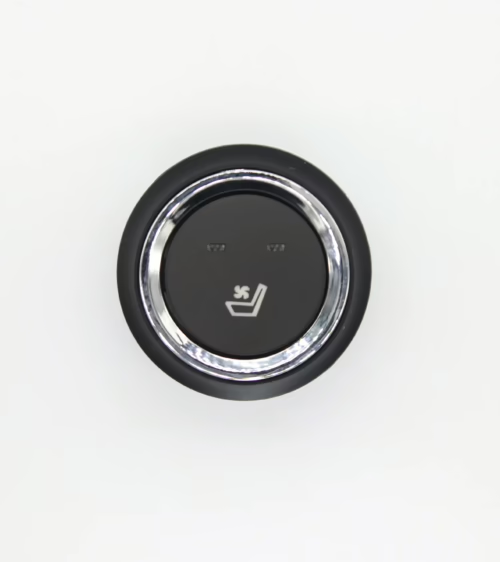
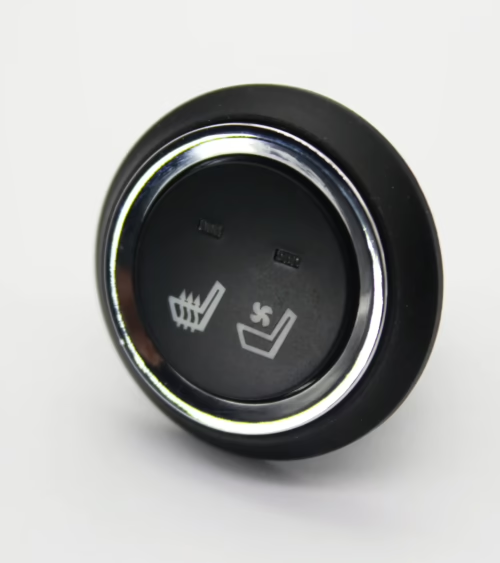
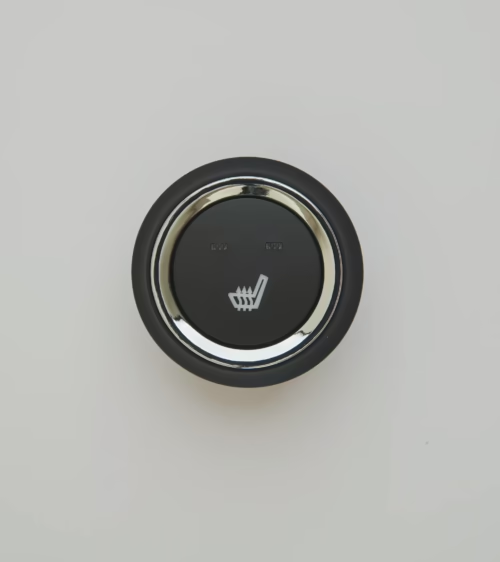
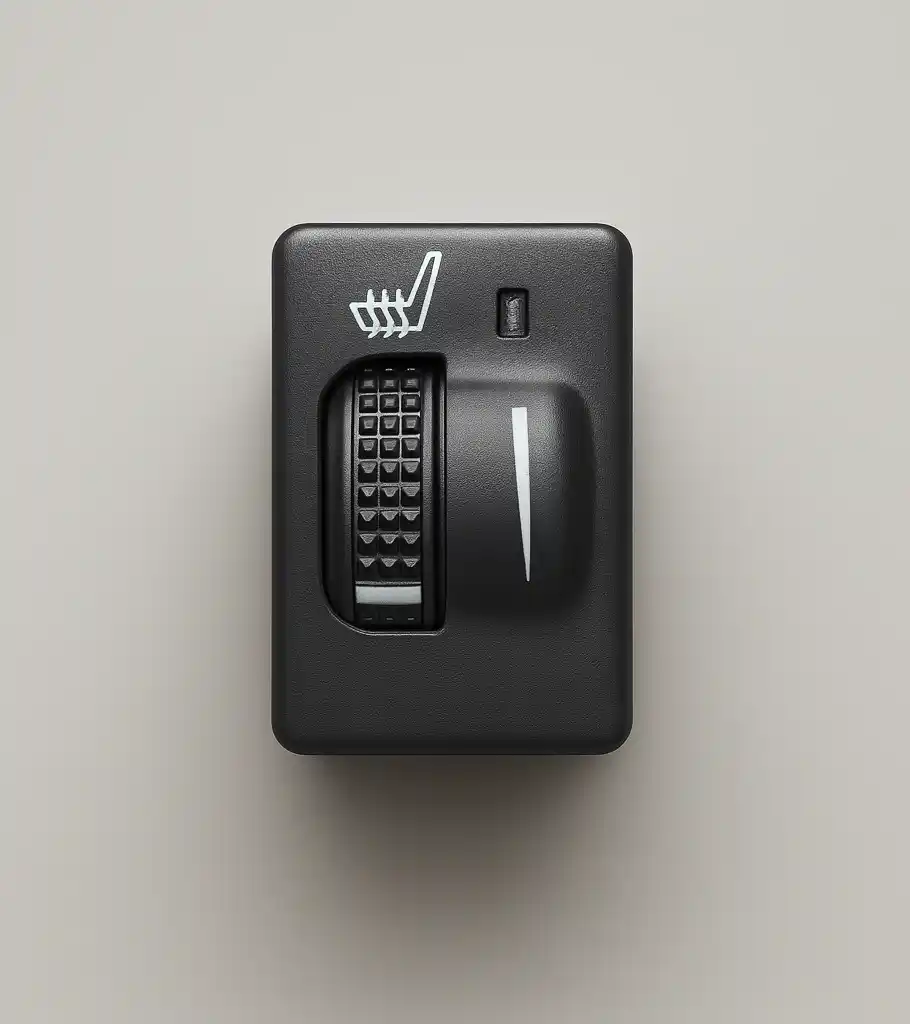
Our seat heater switches in stock covers rocker, rotary, and round designs.
For background on components and system design, read our complete seat heater guide.
Related Articles
- Car Seat Heating Pad OEM Guide
- 12V Seat Heater Element Guide
- NTC Thermistor Seat Heater Guide
- Custom Heated Seat Pads Guide
For more information about seat heater components, installation best practices, and OEM supply programs, contact Lucky Driver Inc. Our team supports customers from component selection through production, with IATF 16949-certified manufacturing and dedicated engineering support available for all program types and volumes.
More About Seat Heater Switch
When sourcing seat heater switch for a production or aftermarket seat program, the most important selection criteria are electrical compatibility, material certification, and supplier quality documentation. Reliable seat heater switch components from a qualified supplier reduce warranty risk and simplify the qualification process for both OEM and aftermarket programs.
Lucky Driver Inc. maintains North American inventory of seat heater switch in standard and custom configurations, with same-week shipping for evaluation orders and engineering support for new program development.
Whether your application requires a drop-in replacement seat heater switch or a custom-specified solution, Lucky Driver has the stock and technical resources to support your requirements. Contact Lucky Driver Inc. today to request samples or pricing for seat heater switch.
Seat Heater Switch: Quick Reference Guide
This quick reference summarizes the most important facts about seat heater switch for buyers and engineers evaluating options for a production or retrofit program. Every seat heater switch program begins with a specification review — confirm the electrical interface, connector format, and temperature rating before requesting samples.
seat heater switch components from Lucky Driver Inc. are tested to OEM standards and ship with full documentation. Whether you need a single evaluation unit or a production quantity of seat heater switch assemblies, the Lucky Driver team can quote within one business day.
Common questions from buyers sourcing seat heater switch for the first time: What certifications apply? What is the lead time? Can the seat heater switch be customized for a specific vehicle platform? The answers depend on the exact configuration — contact Lucky Driver Inc.
with your application details to get a precise answer for your seat heater switch requirement.
For aftermarket installers, seat heater switch from Lucky Driver includes all mounting hardware and a wiring diagram. For OEM programs, seat heater switch can be supplied with a custom connector, custom labeling, and a PPAP-ready quality package. Contact Lucky Driver Inc.
to request seat heater switch samples or pricing today.
Seat Heater Switch Buying Guide
Choosing the right seat heater switch for your application starts with three questions: What is the operating voltage of the vehicle? What connector format does the existing harness use? And what certifications are required for the program?
Answering these before requesting quotes for seat heater switch saves weeks of back-and-forth with suppliers and avoids costly sample iterations that do not fit the production design.
The seat heater switch market includes both direct OEM manufacturers and distributors. OEM manufacturers of seat heater switch typically require minimum order quantities of 500 to 1,000 units and lead times of 6 to 10 weeks for custom configurations.
Distributors of seat heater switch stock standard configurations and can ship within one to five business days, making them the practical choice for prototype builds, replacement parts, and low-volume aftermarket programs.
When comparing seat heater switch options across suppliers, request the following documentation with each sample submission: a material compliance declaration confirming RoHS and REACH compliance, a dimensional report confirming the part meets the approved drawing, and a functional test report demonstrating correct operation across the full operating voltage range.
Suppliers that cannot provide this documentation for their seat heater switch should be deprioritized regardless of unit price, since missing documentation creates compliance risk at the OEM customer level.
Lucky Driver Inc. maintains North American inventory of seat heater switch and can provide all required qualification documentation for OEM programs.
Whether you need a single sample of seat heater switch for a prototype build or a production quantity with full PPAP documentation, Lucky Driver has the stock, the paperwork, and the engineering support to close your seat heater switch requirement efficiently.
Contact Lucky Driver Inc. to request seat heater switch samples, pricing, or technical specifications today.
Frequently Asked Questions About automotive seat heater wire
Procurement engineers evaluating automotive seat heater wire for OEM programs regularly ask the following questions. Answers cover specification, compatibility, certification, and sourcing for automotive seat heater wire requirements.
What voltage ratings are available for automotive seat heater wire?
Standard automotive seat heater wire configurations support 12 V DC for passenger vehicles and 24 V DC for commercial trucks. Selecting the correct automotive seat heater wire voltage at the design stage eliminates harness rework later. Lucky Driver maintains automotive seat heater wire inventory in both ratings for same-week shipment.
Which certifications apply to automotive seat heater wire production?
automotive seat heater wire assemblies entering OEM programs typically require UL recognition, REACH compliance, and RoHS documentation. Lucky Driver holds certification records for every automotive seat heater wire variant and includes copies with sample and production shipments.
How is watt density specified for automotive seat heater wire?
Watt density for automotive seat heater wire is expressed in W/cm² and ranges from 0.04 to 0.12 depending on heat-up time requirements. Lower watt density automotive seat heater wire designs improve element longevity, while higher values suit cold-climate applications.
Lucky Driver’s engineering team reviews automotive seat heater wire requirements and recommends watt density based on your seat platform.
What connector families are used with automotive seat heater wire?
automotive seat heater wire harnesses are available with Molex, TE Connectivity, and Delphi connector families. Matching the automotive seat heater wire connector to the vehicle harness reduces assembly time and eliminates adapter cables. Specify your harness format when requesting a automotive seat heater wire quote from Lucky Driver.
What is the lead time for automotive seat heater wire samples?
automotive seat heater wire samples from Lucky Driver’s North American warehouse ship within 3 to 5 business days for standard configurations. Custom automotive seat heater wire variants with modified pad geometry or connector pinouts require 4 to 6 weeks.
Contact Lucky Driver to confirm automotive seat heater wire availability before submitting your engineering schedule.