The carbon fiber vs wire seat heater question comes up in almost every sourcing conversation we have with seat manufacturers and aftermarket distributors. Both technologies convert 12 V electrical current into cabin comfort, and both have been installed in millions of vehicles.
Yet they behave very differently in heat-up time, flex life, failure mode, and cost. This guide walks through seven practical differences so you can specify the right heating element for your seat program, your repair business, or your product line.
How Each Seat Heater Type Generates Heat
Both heater styles rely on the same physical principle. When current flows through a conductor with electrical resistance, part of the energy is released as heat, a process known as Joule heating. The difference lies in what that conductor is and how it is laid out inside the pad.
A wire seat heater uses a continuous length of resistance alloy wire, typically a copper-nickel or nickel-chromium alloy with a thin enamel or PVC insulation. The wire is stitched or bonded in a serpentine pattern onto a nonwoven or felt carrier.
Heat is produced along the entire wire path, so the pad warms as a network of thin hot lines that spread outward through the foam and trim cover.
A carbon fiber seat heater replaces the metal wire with bundles of carbon filaments, either woven into a fabric, laid as parallel tows, or printed as a carbon-loaded ink. Copper bus bars run along two edges and feed current across the carbon in parallel.
Because the conductive area is spread over a wide surface rather than concentrated in one wire, the pad produces a lower-intensity, more distributed heat, with a larger share released as far-infrared radiation.
Difference 1: Heat-Up Time and Heat Distribution
Carbon fiber pads are usually perceived as warming faster. The carbon element has low thermal mass and sits closer to the occupant across a broad area, so the trim surface reaches a comfortable temperature within one to two minutes on a high setting.
Wire pads must first heat the wire itself, then conduct through foam and cover, which produces a slightly slower ramp and a noticeable pattern of warm stripes during the first minutes.
Distribution follows the same logic. Wire heaters concentrate heat along the wire path, and the spacing between wire runs, often 10 to 15 mm, defines how even the seat feels. Carbon fiber heaters are more uniform across the heated zone because current flows through the whole element.
For premium seating programs where customers rate comfort in the first minute, this is the strongest argument for carbon fiber.
Wire heaters are not at a disadvantage in steady state. Once the foam has absorbed heat, the stripe effect disappears, and a well-designed wire layout can meet the same surface temperature targets, typically 38 to 45 °C on the cover surface for the high setting.
Difference 2: Flex Life and Durability
Seat cushions flex tens of thousands of times over a vehicle’s life, and every entry and exit drags the occupant across the bolster. This is where the two technologies diverge most sharply.
- Wire heaters fail by fatigue at the point of highest bending stress. Common locations are the crossings over hog ring wires, the bolster transition, and the lead-out where the wire meets the harness. Once the wire fractures, the entire circuit opens and the pad stops heating.
- Carbon fiber heaters tolerate repeated flexing far better because the element is a bundle of thousands of filaments. A few broken filaments barely change resistance.
- The weak point moves to the bus bar joint, where copper meets carbon; a poor crimp or adhesive bond can loosen and raise contact resistance over years of thermal cycling.
In accelerated flex testing, quality carbon fiber pads routinely exceed wire pads by a wide margin. Wire pads remain competitive when the layout avoids sharp bends, uses stranded rather than solid conductor, and is anchored so it does not migrate on the foam.
Difference 3: Power Draw and Electrical Behavior
A typical front seat heater draws 40 to 60 W per seat at 12 V, split between cushion and backrest, regardless of element type. The difference is in how resistance behaves with temperature.
Resistance alloy wire has a positive temperature coefficient: resistance rises as the wire heats, which naturally reduces current draw. This mild self-limiting effect is a safety advantage and makes wire heaters forgiving with simple bimetal thermostats.
Carbon fiber has a near-zero or slightly negative temperature coefficient. Its current draw stays flat or creeps upward as the element warms, so the pad does not self-limit.
That is acceptable in a properly controlled system, but it means a carbon fiber pad should almost always be paired with a temperature sensor and an electronic controller rather than left on a plain switch and thermostat.
Inrush behavior also differs. Carbon elements reach operating temperature quickly and have very low inductance, which keeps PWM (pulse width modulation) control clean. Wire elements have slightly more inductance from the long serpentine path, though at automotive PWM frequencies this is rarely a concern.
Difference 4: Failure Modes and Repairability
Understanding how a pad fails matters for warranty planning and for the repair market.
- Wire pad failure is almost always an open circuit. The seat goes cold, the fault is easy to find with a multimeter, and a skilled technician can splice the break with a butt connector and heat shrink.
- The risk case is a partial break that arcs intermittently and chars the foam.
- Carbon fiber pad failure is usually gradual. Output drops as bus bar contact degrades, and customers report the seat feels weaker rather than dead. Localized damage, such as a cut from a seat repair tool, can create a hot spot where current crowds around the damaged area.
- Field repair of the carbon element itself is not practical; the pad is replaced as a unit.
For a distributor serving repair shops, wire pads are the easier product to support because technicians already know how to diagnose and splice them. For an OEM targeting a long warranty with minimal service events, carbon fiber’s gradual and rare failure profile is attractive.
Difference 5: Cost, Manufacturing, and Control Integration
Wire pads are the lower-cost option. The materials are commodity alloy wire and nonwoven scrim, the stitching process is mature, and tooling for a new seat shape is inexpensive.
Carbon fiber pads cost more per unit because of the carbon material, the bus bar assembly, and tighter process control on the copper-to-carbon joint. The gap has narrowed over the past decade but has not closed.
Control hardware follows the element. A wire pad works acceptably with a two-position switch and an in-pad bimetal thermostat, which keeps the bill of materials short. A carbon fiber pad should be specified with an NTC temperature sensor and an electronic control module that can regulate through PWM.
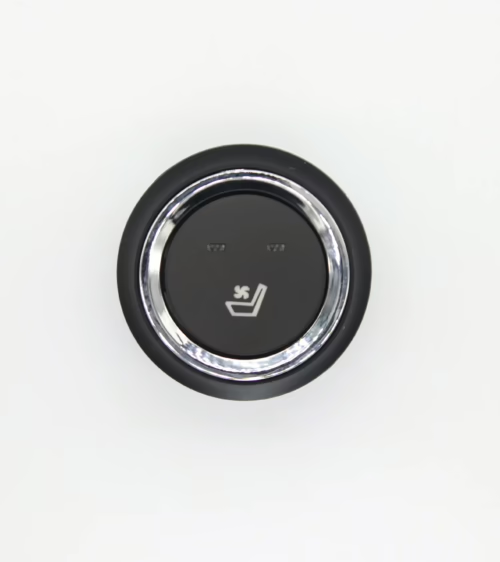
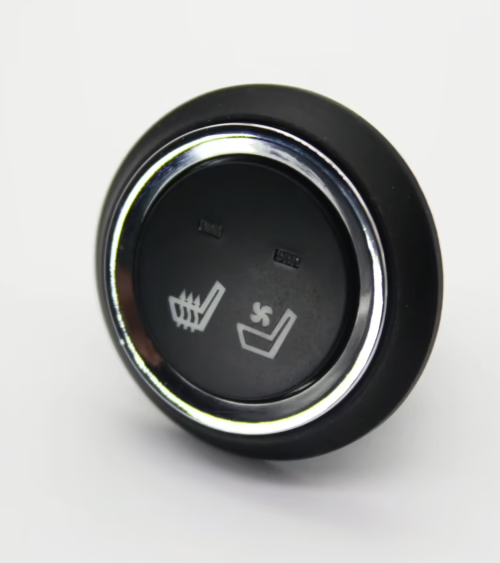
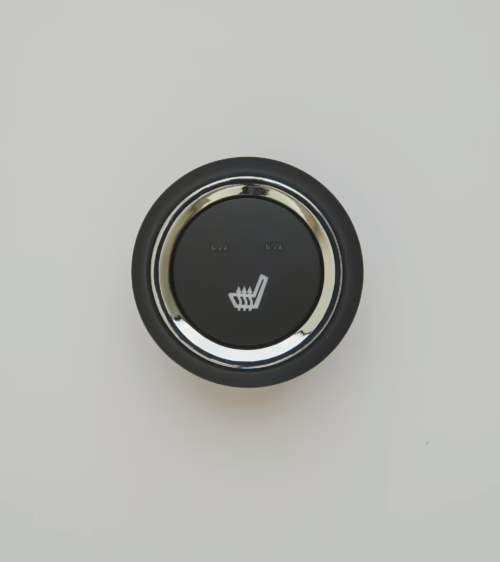
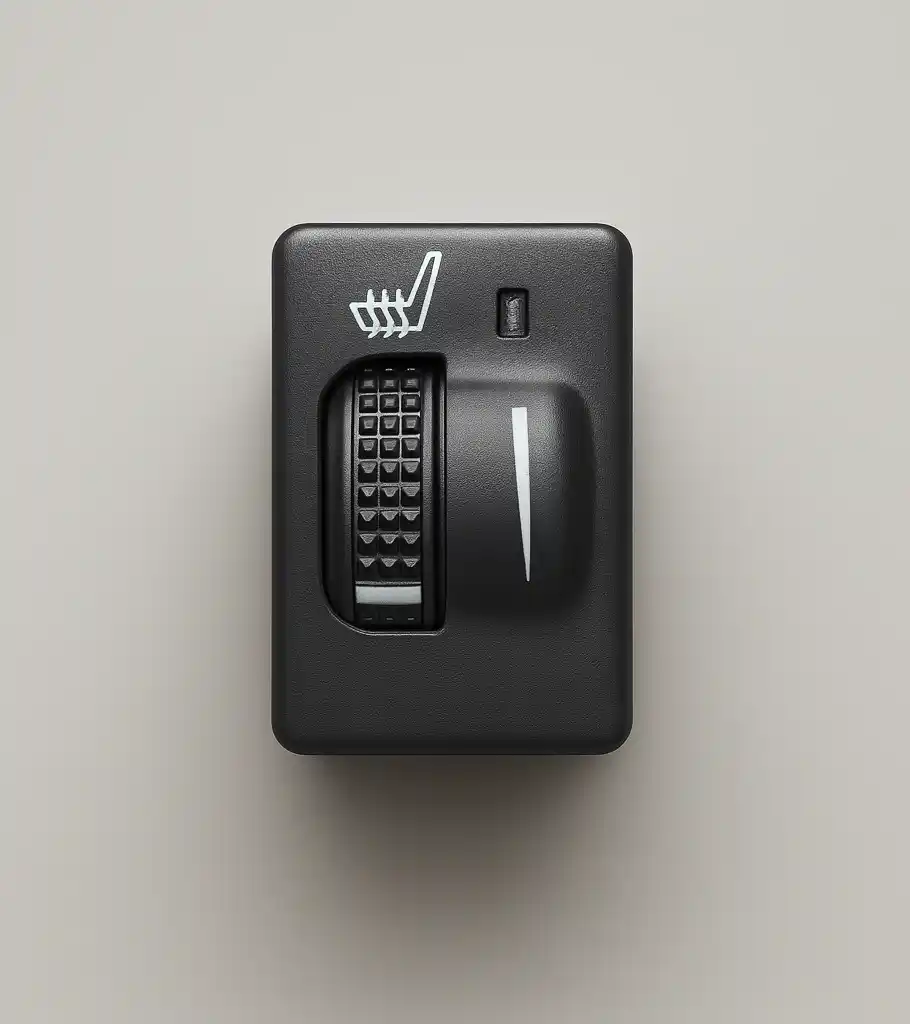
Both configurations use the same class of operator interface, and you can compare rocker, push-button, and rotary options in our seat heater switch catalog to match the control strategy you choose.
On the assembly line, carbon fiber pads are thinner and drape more easily over contoured foam, which some seat makers value for slim sport seats. Wire pads are stiffer but more tolerant of aggressive hog ring attachment and trim cover tension.
Which Seat Heater Type Should You Choose?
There is no universal winner in the carbon fiber vs wire seat heater comparison. The right choice depends on where the pad will be used and who will service it.
- Choose wire for cost-sensitive programs, aftermarket kits sold to installers, fleet vehicles, and any application where field repair is expected. Wire pads are also the safer choice when the control system is a simple switch and thermostat.
- Choose carbon fiber for premium seating, sport seats with thin foam, high-flex bolsters, and programs that already include an electronic seat control module with temperature feedback. The faster, more even warmth is a tangible comfort upgrade that customers notice.
- Run both if you supply multiple segments. Many distributors stock wire pads for universal repair kits and carbon fiber pads for vehicle-specific premium replacements.
Whichever direction you take, insist on documented flex-life testing, a defined surface temperature target, and a clear overtemperature strategy. Those three items separate a reliable pad from one that will generate warranty claims.
If you want to see how the two element types are specified side by side, you can browse our full range of seat heating products and compare pad construction, sensor options, and control modules.
FAQ: Carbon Fiber vs Wire Seat Heater
Is a carbon fiber seat heater safer than a wire seat heater?
Neither is inherently unsafe when properly controlled. Wire heaters self-limit slightly because their resistance rises with temperature, so they are more forgiving with basic thermostats. Carbon fiber heaters do not self-limit and should be paired with a temperature sensor and electronic controller.
With correct control, both meet the same surface temperature limits and burn-prevention guidelines.
Can I replace a wire seat heater pad with a carbon fiber pad?
Yes, as long as the new pad matches the seat’s voltage, wattage, and connector, and the control system is compatible.
If the original seat used a bimetal thermostat inside the wire pad, confirm that the carbon fiber replacement includes its own thermal protection or sensor, because the vehicle’s switch alone will not regulate temperature.
Which type lasts longer in daily use?
Carbon fiber pads generally survive more flex cycles because the element is a bundle of filaments rather than a single conductor. Wire pads can still last the life of the vehicle if the layout avoids sharp bends and hog ring crossings.
In both cases, the lead-out and connector are common failure points and deserve strain relief.
Lucky Driver Inc. supplies seat heating pads, seat heater switches, control modules, and seat ventilation systems to OEM seat manufacturers and aftermarket distributors across North America. If you are evaluating heating elements for a new seat program or building out a replacement product line, contact Lucky Driver Inc.
for specifications, samples, and volume pricing tailored to your application.
Related Articles
- Seat Heater Temperature Sensor: 7 Facts Every Buyer Needs (2026)
- Heated Seat Thermostat Replacement: 7 Steps (2026 Guide)
- Seat Heater Pad Replacement: 8 Steps for a Lasting Fix (2026)
- Seat Heater Element Repair: 7 Steps to Fix a Dead Pad (2026)
- Heated Seat Wiring Diagram: 7 Circuits Explained (2026 Guide)
Frequently Asked Questions About carbon fiber vs wire seat heater
Procurement engineers evaluating carbon fiber vs wire seat heater for OEM programs regularly ask the following questions. Answers cover specification, compatibility, certification, and sourcing for carbon fiber vs wire seat heater requirements.
What voltage ratings are available for carbon fiber vs wire seat heater?
Standard carbon fiber vs wire seat heater configurations support 12 V DC for passenger vehicles and 24 V DC for commercial trucks. Selecting the correct carbon fiber vs wire seat heater voltage at the design stage eliminates harness rework later.
Lucky Driver maintains carbon fiber vs wire seat heater inventory in both ratings for same-week shipment.
Which certifications apply to carbon fiber vs wire seat heater production?
carbon fiber vs wire seat heater assemblies entering OEM programs typically require UL recognition, REACH compliance, and RoHS documentation. Lucky Driver holds certification records for every carbon fiber vs wire seat heater variant and includes copies with sample and production shipments.
How is watt density specified for carbon fiber vs wire seat heater?
Watt density for carbon fiber vs wire seat heater is expressed in W/cm² and ranges from 0.04 to 0.12 depending on heat-up time requirements. Lower watt density carbon fiber vs wire seat heater designs improve element longevity, while higher values suit cold-climate applications.
Lucky Driver engineering reviews carbon fiber vs wire seat heater requirements and recommends watt density based on your seat platform.
What connector families are used with carbon fiber vs wire seat heater?
carbon fiber vs wire seat heater harnesses are available with Molex, TE Connectivity, and Delphi connector families. Matching the carbon fiber vs wire seat heater connector to the vehicle harness reduces assembly time and eliminates adapter cables.
Specify your harness format when requesting a carbon fiber vs wire seat heater quote from Lucky Driver.
What is the lead time for carbon fiber vs wire seat heater samples?
carbon fiber vs wire seat heater samples from Lucky Driver’s North American warehouse ship within 3 to 5 business days for standard configurations. Custom carbon fiber vs wire seat heater variants with modified pad geometry or connector pinouts require 4 to 6 weeks.
Contact Lucky Driver to confirm carbon fiber vs wire seat heater availability before submitting your engineering schedule.