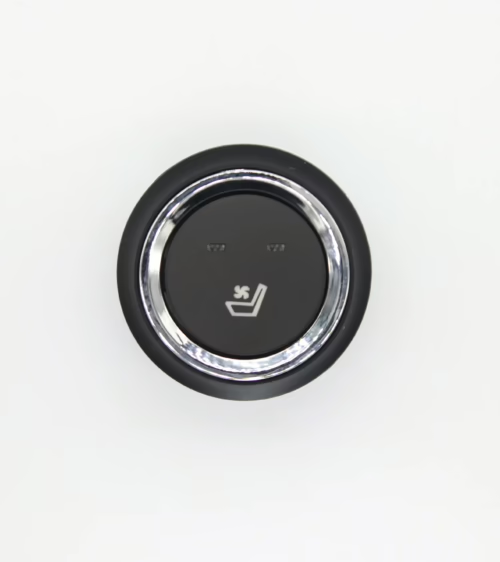
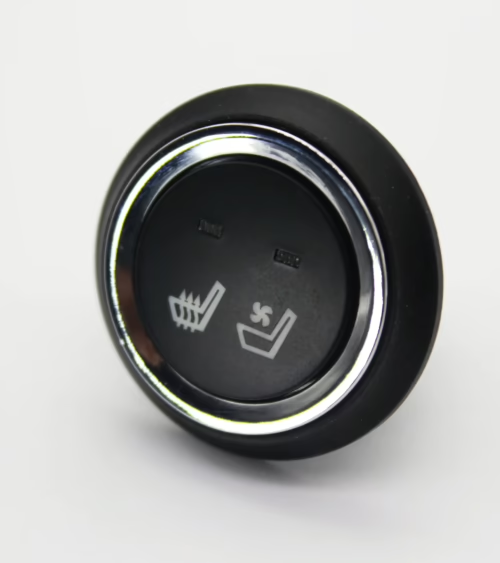
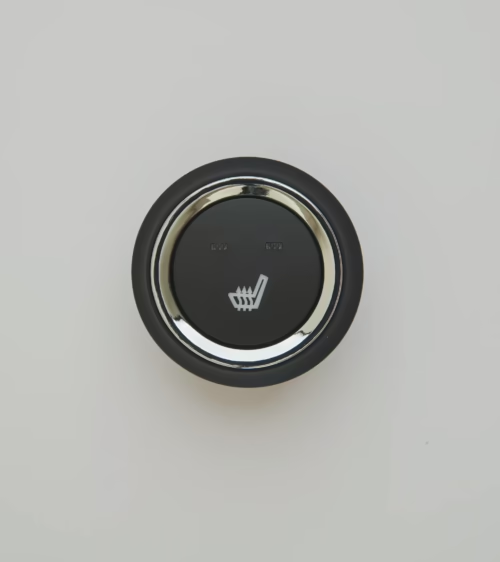
When buyers compare ventilated seats vs cooled seats, they are usually comparing two genuinely different pieces of hardware that happen to produce a similar sensation on a hot day. A ventilated seat moves cabin air through a perforated trim surface using small blower fans.
A cooled seat actively removes heat from that airflow — most often with a thermoelectric cooler — before it reaches your back and thighs. The marketing language blurs the two, but the wiring, the current draw, the duct architecture, and the failure modes are not interchangeable.
For OEM seat manufacturers, aftermarket distributors, and technicians diagnosing a no-airflow complaint, knowing which system is in the seat determines which parts you order and which tests actually mean something.
1. What a Ventilated Seat Actually Does
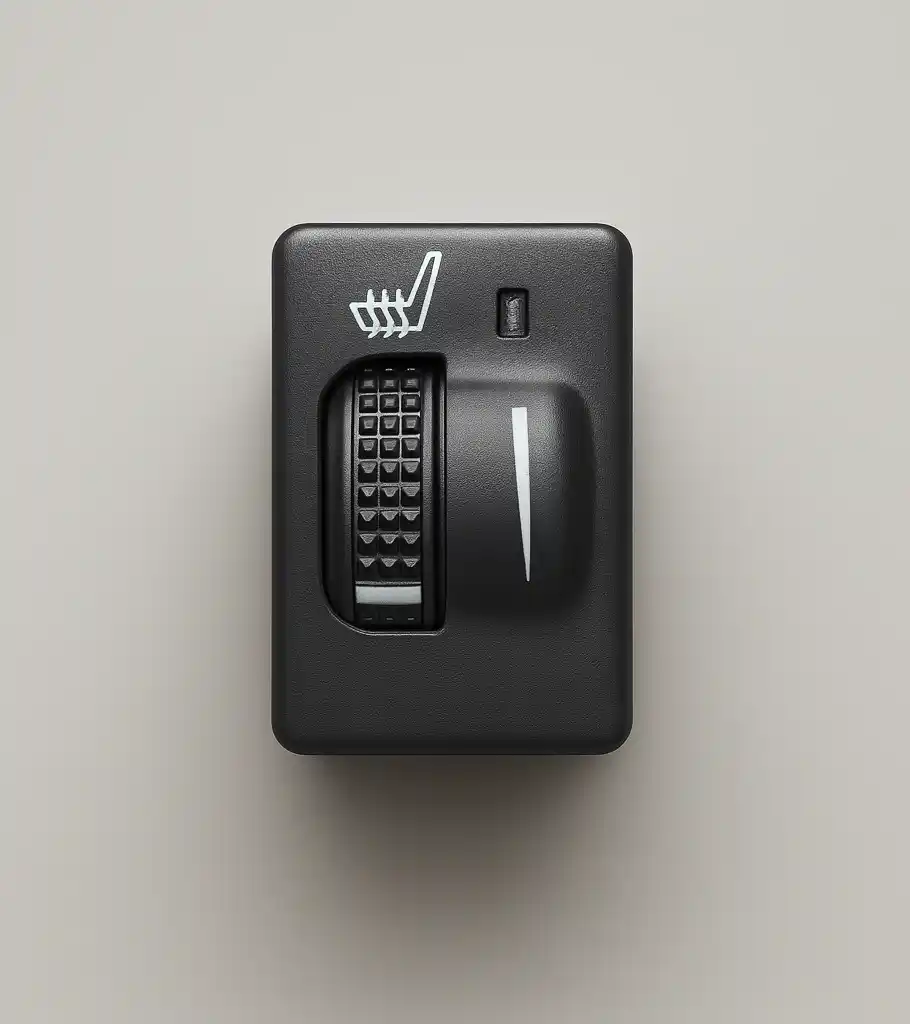
A ventilated seat is a forced-convection device.
One or two DC blower fans — typically 12V radial or axial units rated between 1.5W and 8W each — pull air from the cabin, push it through a distribution layer bonded into the seat cushion and backrest, and exhaust it through perforations in the leather or vinyl trim.
There is no refrigeration stage anywhere in the circuit. The air that reaches the occupant is at cabin temperature.
The cooling effect is real but indirect. Ventilation works by stripping away the stagnant, humid boundary layer that forms between skin and upholstery, which accelerates evaporative cooling and sweat transport.
On a 95°F day with the HVAC running, the ventilated seat is distributing already-conditioned cabin air, so the perceived benefit is substantial. With the HVAC off, a ventilated seat moving 95°F air provides only modest relief — it dries you rather than chills you.
Key components in a ventilated seat assembly:
- Blower fans — usually 2 per seat (one cushion, one backrest), sometimes 4 in premium applications
- Spacer fabric or 3D mesh distribution layer — creates a plenum so air spreads evenly instead of jetting from one hole
- Perforated trim cover — hole pattern and density are engineered, not decorative
- Control module or integrated driver — PWM speed control across 2 to 3 levels
- Switch and HMI — physical rocker, capacitive panel, or touchscreen command
2. What a Cooled Seat Adds on Top
A true cooled seat is a ventilated seat plus an active heat-removal stage. In almost every production implementation, that stage is a thermoelectric device (TED) built around the Peltier effect:
- apply DC current across a junction of dissimilar semiconductors and heat is pumped from one side to the other. The cold side chills the air stream heading to the occupant
- the hot side dumps waste heat into a secondary air path routed under the seat.
This architecture is what makes cooled seats mechanically more complex. You now have two air paths instead of one, a heat sink that must be kept clear, and a module capable of reversing polarity so the same TED can supply heated air in winter.
The thermoelectric cooling principle is well documented, and its two practical constraints apply directly to automotive seats:
- coefficient of performance is low compared with a vapor-compression system
- the hot side must be adequately ventilated or the cold-side delta collapses within minutes.
A well-designed TED seat module delivers air roughly 10°F to 18°F below cabin temperature at the trim surface. That is a genuine temperature drop you can feel immediately, independent of whether you are sweating.
3. Power Draw and Electrical Load Differences
This is where the two systems diverge most sharply, and where retrofit projects most often go wrong.
- Ventilated seat: roughly 0.3A to 1.2A per seat at 12V on the highest setting. Two fans plus control overhead rarely exceeds 15W. A standard 10A circuit handles both front seats comfortably.
- Cooled seat with TED: 4A to 8A per seat is typical, and peak draw during initial pull-down can exceed 10A. Thermoelectric modules are current-hungry by nature — COP below 1.0 means you spend more electrical power than the thermal power you move.
The practical consequences:
- cooled seats need heavier gauge wiring
- dedicated high-current relays or solid-state drivers
- are frequently load-shed by the body control module during engine cranking or low-battery states. Ventilated seats can often share a circuit with the existing heated-seat harness. If you are planning a retrofit and your donor harness was sized for ventilation
- do not assume it will carry a thermoelectric module.
4. Control Logic, Switching, and HMI
Ventilated seats generally use open-loop control. The switch selects a PWM duty cycle, the fans spin at that rate, and nothing measures the result. Some implementations add a timeout to prevent indefinite operation.
Cooled seats require closed-loop control. A thermistor on the cold-side air path, and often a second one on the heat sink, feeds a module that modulates TED current to hit a target temperature while protecting the device from thermal runaway.
That module also handles polarity reversal for heating mode, over-temperature shutdown, and diagnostic trouble codes reported over LIN or CAN.
Because of this, switch interchangeability is limited. A three-level ventilation rocker that simply grounds three resistive legs will not drive a TED module expecting a serial command.
When sourcing controls for either architecture, confirm the signaling protocol before ordering — our seat heater switch catalog lists the pinout and signal type for each part so you can match the module rather than guess from the bezel shape.
5. Comfort Performance in Real Conditions
Which system feels better depends heavily on ambient humidity and whether the HVAC is running.
- Hot and humid, HVAC running: both perform well. Ventilation moves cold, dehumidified cabin air; the cooled seat’s advantage narrows because the cabin air is already cold.
- Hot and humid, HVAC off or recirculating stale air: the cooled seat wins clearly. Ventilation alone circulates saturated air that cannot absorb much more moisture.
- Hot and dry: ventilation performs surprisingly well because evaporative cooling is highly effective at low humidity. The cost and complexity gap narrows considerably.
- Immediately after a heat-soaked park: cooled seats provide faster relief; ventilation initially blows 130°F trapped air until the cabin flushes.
- Long highway drives: ventilation’s continuous moisture management often rates higher in owner satisfaction than raw temperature drop.
One underrated factor: ventilated seats also help in cold weather by clearing moisture from heavy winter clothing, and many systems run ventilation simultaneously with heating elements for exactly that reason.
6. Failure Modes and Diagnostic Approach
The two architectures fail differently, and the diagnostic sequence should reflect that.
Ventilated seat failures:
- seized or noisy blower fans from ingested debris and pet hair
- clogged perforations after years of upholstery conditioner buildup
- chafed harness at the seat-track flex point
- failed switch contacts. Diagnosis is straightforward — confirm 12V at the fan connector
- confirm the fan spins
- confirm air exits the trim surface. A fan that spins with no airflow at the surface means a blocked distribution layer or a disconnected duct
- not an electrical fault.
Cooled seat failures:
- degraded TED performance from solder fatigue inside the module after thermal cycling
- blocked hot-side exhaust causing thermal shutdown within 2 to 5 minutes of activation
- thermistor drift producing incorrect modulation
- module communication faults setting codes with no obvious symptom. The signature complaint — cools briefly then stops — almost always points to hot-side airflow obstruction rather than a failed TED.
Practical rule: if the seat blows room-temperature air, you likely have ventilation working as designed, not a broken cooler. Verify the vehicle’s actual build specification before quoting a thermoelectric module.
7. Cost, Retrofit Feasibility, and Parts Availability
Ventilation retrofits are tractable. Fan kits, spacer fabric, and perforated covers are widely available, the current draw is manageable, and integration with an existing heated-seat switch is often a wiring exercise rather than a software one. Expect component costs in the low hundreds per seat.
Cooled-seat retrofits are a different proposition. You need the TED module, both air paths, matched thermistors, a compatible control module, and sufficient under-seat volume for the heat sink — which many non-cooled seat frames simply do not provide.
Costs commonly run three to five times a ventilation retrofit, and factory-integrated systems often tie into the BCM in ways that resist aftermarket substitution.
For fleet operators and distributors, the pragmatic position is that ventilation covers the majority of real-world comfort complaints at a fraction of the cost and with far better parts availability.
If you are scoping a program, it is worth reviewing the available seat heating and ventilation components before locking a specification — you can browse our full range of seat heating products to compare fan assemblies, modules, and switches side by side.
Frequently Asked Questions
Are ventilated seats and cooled seats the same thing? No, though manufacturers use the terms loosely. Ventilated seats circulate cabin-temperature air through perforated trim. Cooled seats add a thermoelectric module that actively lowers air temperature before it reaches the occupant.
Check the window sticker or build sheet language — “ventilated” or “climate control seats” usually means ventilation only, while a system advertising a specific temperature drop is likely thermoelectric.
Can I add cooling to seats that already have ventilation fans? Rarely without major modification. Thermoelectric modules need a hot-side exhaust path, a heat sink with physical clearance under the cushion, thermistor feedback, and 4A to 8A of current capacity that a ventilation-sized harness will not supply.
Adding a second ventilation fan or upgrading the distribution layer usually delivers better value than attempting a thermoelectric conversion.
Why do my cooled seats stop working after a few minutes? That symptom almost always indicates a blocked hot-side exhaust. The thermoelectric module pumps heat to its back side; if that heat cannot escape, cold-side temperature rises until the controller triggers over-temperature protection.
Inspect the under-seat exhaust duct and heat sink for debris, carpet compression, or cargo blocking airflow before condemning the module.
Source Seat Comfort Components with Confidence
Lucky Driver Inc. supplies seat heating pads, seat ventilation fan assemblies, control modules, and switches to OEM seat manufacturers and aftermarket distributors across North America.
Whether your program calls for straightforward ventilation or a full climate-controlled seat build, our team can help you match current draw, signaling protocol, and physical packaging to your platform — and keep the parts flowing at production volume. Contact Lucky Driver Inc. to discuss specifications, samples, or OEM program pricing.
Related Articles
- Seat Ventilation Fan Replacement: 7 Steps (2026 Guide)
- Ventilated Seat Retrofit: 7 Steps to Plan It Right (2026)
- Seat Heater Timer Module: 7 Specs to Check (2026 Guide)
- Heated Seat Module Replacement: 7 Steps (2026 Guide)
- Seat Heater Switch Replacement Cost: 5 Factors (2026 Guide)
Frequently Asked Questions About ventilated seats vs cooled seats
Procurement engineers evaluating ventilated seats vs cooled seats for OEM programs regularly ask the following questions. Answers cover specification, compatibility, certification, and sourcing for ventilated seats vs cooled seats requirements.
What voltage ratings are available for ventilated seats vs cooled seats?
Standard ventilated seats vs cooled seats configurations support 12 V DC for passenger vehicles and 24 V DC for commercial trucks. Selecting the correct ventilated seats vs cooled seats voltage at the design stage eliminates harness rework later.
Lucky Driver maintains ventilated seats vs cooled seats inventory in both ratings for same-week shipment.
Which certifications apply to ventilated seats vs cooled seats production?
ventilated seats vs cooled seats assemblies entering OEM programs typically require UL recognition, REACH compliance, and RoHS documentation. Lucky Driver holds certification records for every ventilated seats vs cooled seats variant and includes copies with sample and production shipments.
How is watt density specified for ventilated seats vs cooled seats?
Watt density for ventilated seats vs cooled seats is expressed in W/cm² and ranges from 0.04 to 0.12 depending on heat-up time requirements. Lower watt density ventilated seats vs cooled seats designs improve element longevity, while higher values suit cold-climate applications.
Lucky Driver engineering reviews ventilated seats vs cooled seats requirements and recommends watt density based on your seat platform.
What connector families are used with ventilated seats vs cooled seats?
ventilated seats vs cooled seats harnesses are available with Molex, TE Connectivity, and Delphi connector families. Matching the ventilated seats vs cooled seats connector to the vehicle harness reduces assembly time and eliminates adapter cables.
Specify your harness format when requesting a ventilated seats vs cooled seats quote from Lucky Driver.
What is the lead time for ventilated seats vs cooled seats samples?
ventilated seats vs cooled seats samples from Lucky Driver’s North American warehouse ship within 3 to 5 business days for standard configurations. Custom ventilated seats vs cooled seats variants with modified pad geometry or connector pinouts require 4 to 6 weeks.
Contact Lucky Driver to confirm ventilated seats vs cooled seats availability before submitting your engineering schedule.