Choosing the right seat heater manufacturer USA buyers can qualify for production is less about catalog price and more about whether the supplier controls the four things that actually fail in the field:
- the heating element
- the thermal sensor
- the control module
- the connector interface. A seat heating assembly looks simple — a non-woven carrier pad with a resistive circuit bonded or sewn to it — but it sits under a trim surface in direct contact with an occupant
- draws 5 to 10 amps per seat
- has to survive a decade of compression cycles
- humidity
- thermal shock. The eight factors below are the ones that separate a supplier who can ship a drop-in replacement from one who can support an OEM seat program.
1. What Is Actually Inside a Seat Heater Assembly
Before comparing suppliers, it helps to break the system into its real components, because different manufacturers control different subsets of them:
- Heating pads — typically two per seat, one for the cushion and one for the backrest, each built on a polyester non-woven or glass-fiber carrier with adhesive or sewn attachment points.
- Temperature sensor — usually an NTC thermistor placed in the hottest zone of the cushion pad, or a bimetallic thermostat on lower-cost designs.
- Control module — the electronics that regulate duty cycle, enforce the temperature ceiling, and report faults.
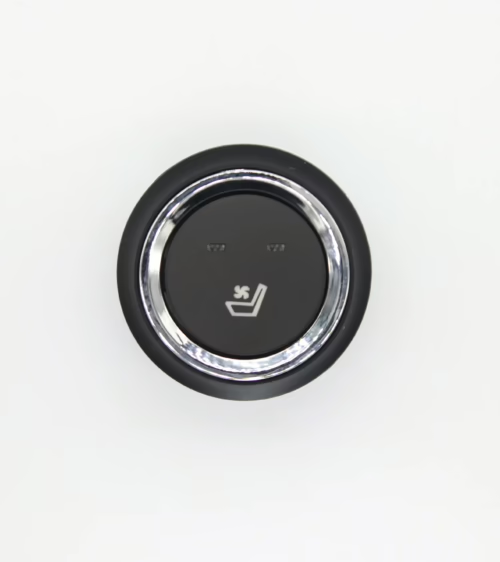
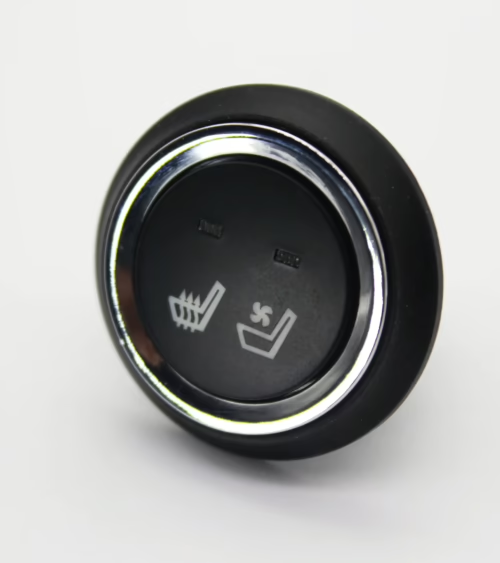
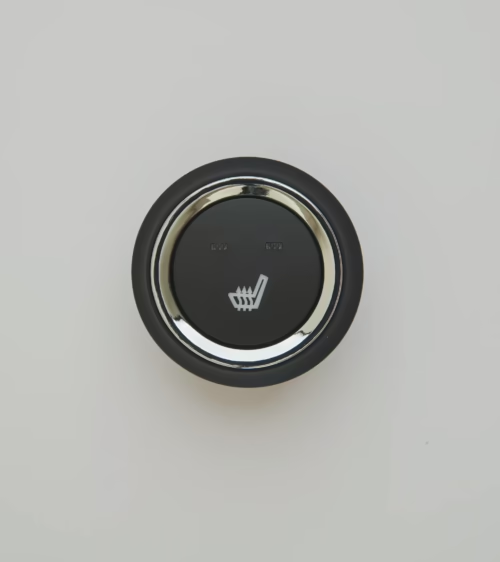
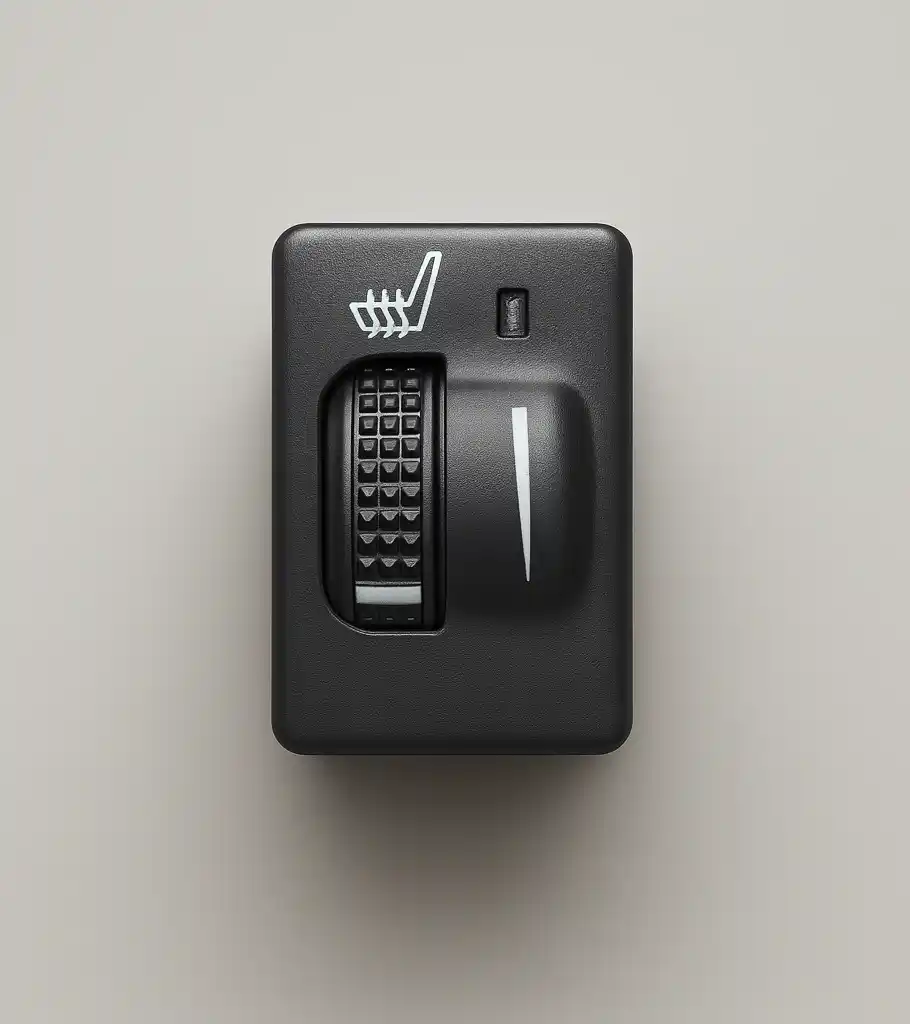
- Switch and indicator — the occupant interface, with level feedback via LEDs or an icon display.
- Harness and connectors — the part that most often determines whether a kit is genuinely vehicle-specific or requires splicing.
A supplier who only stamps out heating pads and buys everything else on the open market cannot guarantee that the thermal cutoff point matches the module’s control curve. That mismatch is the root cause of most “heats too slowly” and “shuts off too early” complaints.
2. Heating Element Type: Alloy Resistance Wire vs. Carbon Fiber
Two element technologies dominate automotive seat heating, and a credible manufacturer should be able to justify which one it uses for a given application.
Alloy resistance wire uses fine copper-nickel or nickel-chromium conductor, commonly in the 0.2 to 0.35 mm range, laid in a serpentine pattern and stitched or taped to the carrier.
Its advantages are precise, zone-by-zone control of heat distribution — you can concentrate watts in the thigh bolsters and thin out coverage where the occupant does not sit — plus lower material cost and easier field repair at a break point.
Carbon fiber elements use bundled filaments and deliver more uniform surface temperature with excellent flex fatigue resistance, which matters for aggressively bolstered or frequently folded seats. The trade-off is that carbon elements are harder to tune for asymmetric patterns and effectively non-repairable once damaged.
For 12 V systems, the practical outcome either way is a pad resistance in roughly the 1.2 to 3.0 ohm range per circuit. If a supplier cannot state the nominal resistance and tolerance of a pad, they are reselling rather than manufacturing.
3. Power Density, Current Draw, and Surface Temperature Ceilings
Seat heating is a thermal comfort problem bounded by a safety limit.
A typical cushion-plus-backrest pair consumes 70 to 130 W combined at 13.5 V, which is 5 to 10 A per seat and 10 to 20 A for a front row — enough that fuse sizing, relay selection, and wire gauge all need to be specified, not assumed.
The limit that matters most is trim-surface temperature. Industry practice caps the contact surface in the low 40 °C range, because sustained skin contact above that threshold risks low-temperature burns, particularly for occupants with reduced sensation.
Achieving that cap requires the NTC thermistor to be physically located where the pad actually runs hottest, not simply in the geometric center. Ask any prospective supplier two questions:
- what is the measured steady-state surface temperature on the highest setting
- where is the sensor placed relative to the hottest circuit? Vague answers here are a reliable disqualifier.
4. Control Modules: Open-Loop Timers vs. Closed-Loop PWM
Control strategy is where cheap kits and OEM-grade systems diverge sharply.
Open-loop designs apply full battery voltage for a fixed interval, then cycle off on a timer or a bimetallic thermostat. They are inexpensive and have very few components, but surface temperature varies with ambient conditions, occupant mass, and trim material.
Closed-loop PWM modules read the thermistor continuously and modulate the element duty cycle to hold a setpoint.
Switching frequency is normally kept in the low hundreds of hertz — high enough to stay out of the audible range and avoid visible load flicker, low enough to limit radiated emissions from the pad wiring, which effectively acts as a loop antenna.
A good module also implements open-circuit and short-circuit detection, an ignition-run interlock so the heater cannot drain the battery, and a graceful fallback to off if the sensor signal goes out of range.
Three discrete setpoints remain the market convention, usually mapped to roughly 100%, 65%, and 40% effective duty after warm-up. Modules that communicate over LIN or CAN rather than discrete wiring are increasingly common on newer platforms and require the supplier to supply a matching message specification.
5. Switch Design and Harness Compatibility
The switch is the only part of the system the customer touches, and it is the component most often blamed for a failure that actually originated elsewhere.
Rocker switches, membrane panels, and capacitive touch surfaces all appear in current production, with contact-based designs rated for 50,000 to 100,000 actuation cycles and sealed to resist spilled liquids.
Indicator illumination must match the vehicle’s instrument lighting color and dimming behavior, or the installation looks obviously aftermarket even when it functions perfectly.
Harness fit is the other half of the equation. A supplier offering genuine vehicle-specific kits will provide the correct connector families, pin pitch, and terminal plating for the target platform instead of pigtails and butt splices.
When you are replacing a failed interface rather than building a full system, sourcing from a dedicated seat heater switch catalog avoids the common mistake of pairing a 3-level switch with a 2-level module, which leaves one position dead and generates warranty calls that have nothing to do with the heating pads.
6. Compliance, Validation, and Documentation
Anything bonded into a seat assembly is subject to material and electrical requirements that a serious manufacturer tests against rather than merely claims.
The flammability of interior materials is governed in the United States by the horizontal burn requirements of the Federal Motor Vehicle Safety Standards, and carrier fabrics, tapes, and insulation all need to be qualified on that basis.
Beyond flammability, the validation set a buyer should expect to see includes:
- Thermal cycling across the full automotive operating range, with resistance drift measured before and after.
- Humidity and salt exposure endurance, typically several hundred to 1,000 hours, to verify solder joints and crimps.
- Mechanical durability — repeated ingress and egress loading, often 100,000 cycles, since element breaks concentrate at flex lines.
- Electrical robustness — reverse polarity, overvoltage, and transient immunity, plus conducted and radiated emissions limits for the module.
Quality system certification to the automotive standard is table stakes for anyone supplying seat manufacturers, as is the ability to produce PPAP-level documentation on request.
7. Integrating Heating with Seat Ventilation
Combined heated-and-ventilated seats are now a volume feature rather than a luxury option, and the two subsystems interact physically. Ventilation requires airflow channels routed through the foam bun, a perforated trim surface, and small 12 V blowers operating in either push or pull configuration.
Pull-through designs draw humid air away from the occupant and generally feel more effective; push designs are simpler to package.
Where this collides with heating is coverage area:
- every air channel is a region the heating element cannot occupy
- so a combined pad has to be patterned around the ventilation layout rather than retrofitted onto it. Blower noise is the other constraint — fans need to stay quiet enough at the highest setting to remain unobtrusive at idle. If you are specifying a dual-function seat
- source both subsystems from one supplier so the pad pattern and the duct layout are engineered together. You can browse the full range of seat heating and ventilation products to see how matched pad and blower sets are configured.
8. Lead Time, MOQ, and Domestic Inventory
The final factor is commercial rather than technical, and for North American buyers it is often decisive. Tooling a new pad pattern involves CAD development of the element layout, a sewing or bonding fixture, and a validation build — a process measured in weeks, not days.
What a US-based supply position adds is buffer inventory for standard SKUs and short replenishment cycles, which protects a seat line from a stockout on a six-dollar component.
Practical questions worth asking:
- what is the minimum order quantity for a standard pad versus a custom pattern
- how much finished stock is held domestically
- what is the replenishment lead time once that stock draws down
- can the supplier quote both aftermarket pack and bulk bagged configurations from the same part number?
Frequently Asked Questions
How long should an automotive seat heating pad last? A properly specified pad should match the service life of the seat itself — typically 10 years or more. Premature failures almost always trace to one of three causes:
- an element break at a seam flex line
- a crimp or solder joint degraded by moisture
- or a control module that allowed excessive surface temperature and cooked the adhesive. Carbon fiber elements tend to outlast alloy wire in heavily bolstered seats for that reason.
Can a heated seat kit be installed without removing the upholstery? For a genuine under-trim installation, no. The pad must sit between the foam bun and the trim cover to transfer heat efficiently and to remain invisible, which means the cover has to come off at least partially.
Over-the-seat pads exist but deliver uneven heat and interfere with side-airbag deployment paths on many seats, so they are not a substitute in a vehicle equipped with seat-mounted airbags.
What is the difference between a 2-level and 3-level seat heater system? The level count is defined by the module, not the pad. A 3-level system holds three distinct setpoints via different PWM duty cycles, while a 2-level system typically offers high and low only.
Pads are usually interchangeable between the two, but the switch and module must be matched as a set — installing a 3-position switch on a 2-level module leaves one detent non-functional.
Work With a US Seat Heating Specialist
Lucky Driver Inc. supplies seat heating pads, seat heater switches, control modules, and seat ventilation systems to OEM seat manufacturers and aftermarket distributors across North America, with domestic inventory on standard parts and engineering support for custom element patterns.
If you are qualifying a new supplier, specifying a combined heated-and-ventilated program, or need a drop-in replacement that matches an existing module and connector set, contact Lucky Driver Inc. with your platform details and target wattage, and our team will come back with a matched specification and lead time.
Related Articles
- Heated and Cooled Seat Conversion: 7 Steps (2026)
- Seat Ventilation Kit Aftermarket: 7 Specs to Check (2026)
- Add Ventilated Seats to a Car: 6 Steps to Do It Right
- Ventilated Seats vs Cooled Seats: 7 Key Differences
- Seat Ventilation Fan Replacement: 7 Steps (2026 Guide)
Frequently Asked Questions About seat heater manufacturer usa
Procurement engineers evaluating seat heater manufacturer usa for OEM programs regularly ask the following questions. Answers cover specification, compatibility, certification, and sourcing for seat heater manufacturer usa requirements.
What voltage ratings are available for seat heater manufacturer usa?
Standard seat heater manufacturer usa configurations support 12 V DC for passenger vehicles and 24 V DC for commercial trucks. Selecting the correct seat heater manufacturer usa voltage at the design stage eliminates harness rework later. Lucky Driver maintains seat heater manufacturer usa inventory in both ratings for same-week shipment.
Which certifications apply to seat heater manufacturer usa production?
seat heater manufacturer usa assemblies entering OEM programs typically require UL recognition, REACH compliance, and RoHS documentation. Lucky Driver holds certification records for every seat heater manufacturer usa variant and includes copies with sample and production shipments.
How is watt density specified for seat heater manufacturer usa?
Watt density for seat heater manufacturer usa is expressed in W/cm² and ranges from 0.04 to 0.12 depending on heat-up time requirements. Lower watt density seat heater manufacturer usa designs improve element longevity, while higher values suit cold-climate applications.
Lucky Driver engineering reviews seat heater manufacturer usa requirements and recommends watt density based on your seat platform.
What connector families are used with seat heater manufacturer usa?
seat heater manufacturer usa harnesses are available with Molex, TE Connectivity, and Delphi connector families. Matching the seat heater manufacturer usa connector to the vehicle harness reduces assembly time and eliminates adapter cables. Specify your harness format when requesting a seat heater manufacturer usa quote from Lucky Driver.
What is the lead time for seat heater manufacturer usa samples?
seat heater manufacturer usa samples from Lucky Driver’s North American warehouse ship within 3 to 5 business days for standard configurations. Custom seat heater manufacturer usa variants with modified pad geometry or connector pinouts require 4 to 6 weeks.
Contact Lucky Driver to confirm seat heater manufacturer usa availability before submitting your engineering schedule.