Choosing a seat heater OEM supplier is a durability decision disguised as a purchasing decision.
A heating pad that fails at 40,000 cycles, a switch that loses backlight illumination after one winter, or a control module that nuisance-trips on a cold start all surface as warranty claims against the seat assembler or the distributor — not against the component vendor.
The seven criteria below are the ones that separate a supplier capable of running a multi-year production program from a trading company that simply forwards drawings to whichever factory quotes lowest that month.
What a Seat Heater OEM Supplier Actually Supplies
A complete seat heating program is four interdependent subsystems, and a credible supplier owns all four. First, the heating element itself:
- a cushion pad and a backrest pad
- each with its own element geometry
- adhesive backing
- perforation pattern if the trim is ventilated. Second
- the thermal control layer — thermostats
- thermistors
- or an electronic controller that holds surface temperature inside a defined band. Third
- the human-machine interface: rocker switches
- capacitive pads
- or a CAN message from the body control module. Fourth
- the harness: connectors
- terminal plating
- wire gauge
- strain relief at the pivot point between cushion and backrest.
Suppliers that sell only element pads push integration risk downstream. When the pad, thermostat, switch, and harness come from four sources, nobody owns the system-level temperature result, and root-cause analysis on a field failure becomes a negotiation instead of an engineering exercise.
Ask any prospective partner to quote the assembled system and to name the engineer responsible for its thermal performance.
Criterion 1: Heating Element Technology and Heat Distribution
Two element technologies dominate North American seat heating. Alloy resistance wire — typically a nickel-chromium or copper-nickel filament stitched or bonded in a serpentine pattern onto a non-woven carrier — remains the OEM default.
It offers predictable resistance per unit length, a long cycle life when the serpentine pitch is designed to avoid stress concentration at bend radii, and straightforward repairability.
Carbon fiber and carbon-film elements spread heat over a larger surface area and tolerate creasing better, but their resistance drifts more with temperature and production tolerance, which complicates fixed-thermostat designs.
What matters more than the technology label is the trace layout. Heat must be concentrated where the occupant’s body actually contacts the trim:
- the thigh bolsters and lower lumbar region warm perceptibly faster than the center of the cushion
- so uniform spacing produces a cold-feeling seat that still draws full current. A supplier should be able to show you a layout drawing with serpentine pitch dimensioned
- keep-out zones marked around airbag seams and seat-belt anchorages
- wire routing that never crosses a trim sewing line. Ask for the measured surface-temperature map
- not a marketing claim about watts.
Criterion 2: Temperature Control and Thermal Protection
Every seat heating circuit needs two independent layers of thermal defense:
- a regulating device that cycles the element to hold the target band
- a non-resettable backup that opens the circuit permanently if the regulator fails. Mechanical bimetal thermostats handle both roles cheaply
- but they offer coarse hysteresis — often 8 to 12 °C — which users perceive as the seat running hot
- then cold. Electronic control using a negative-temperature-coefficient sensor delivers a tighter band and allows a staged warm-up profile that drives high power for the first two minutes
- then falls back to a maintenance duty cycle.
If your supplier proposes electronic control, confirm which sensor type and tolerance class is specified, because the control accuracy is bounded by the sensor, not the firmware; a thermistor with a loose beta tolerance will undercut an otherwise well-designed loop.
Also confirm the thermal-fuse open temperature and whether it is placed at the hottest predicted point on the pad rather than wherever assembly was most convenient.
Target surface temperature for a production seat is normally 38 to 42 °C at the trim face — comfortable, and far enough below the contact-burn threshold to protect occupants with reduced skin sensation.
Criterion 3: Switch and Control Module Integration
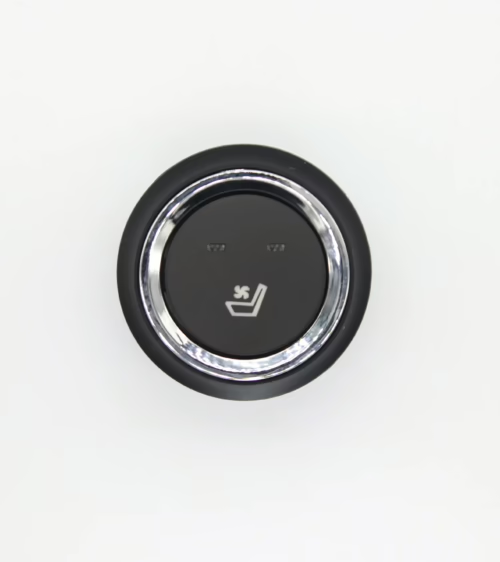
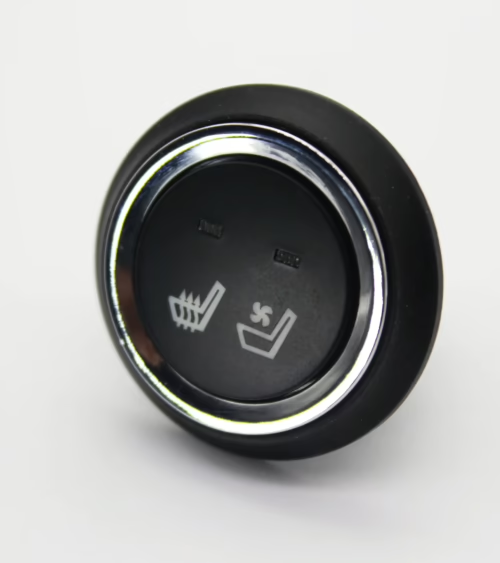
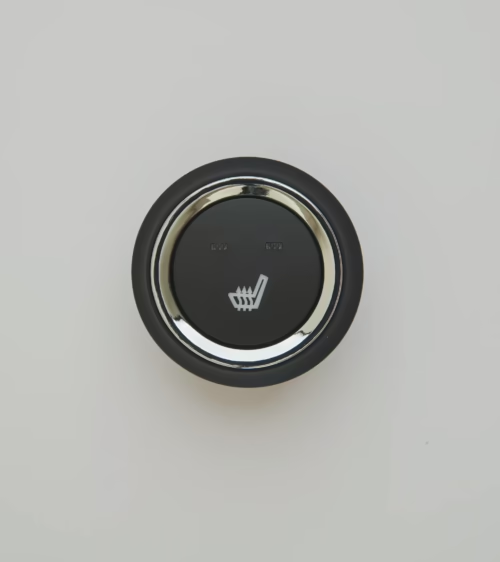
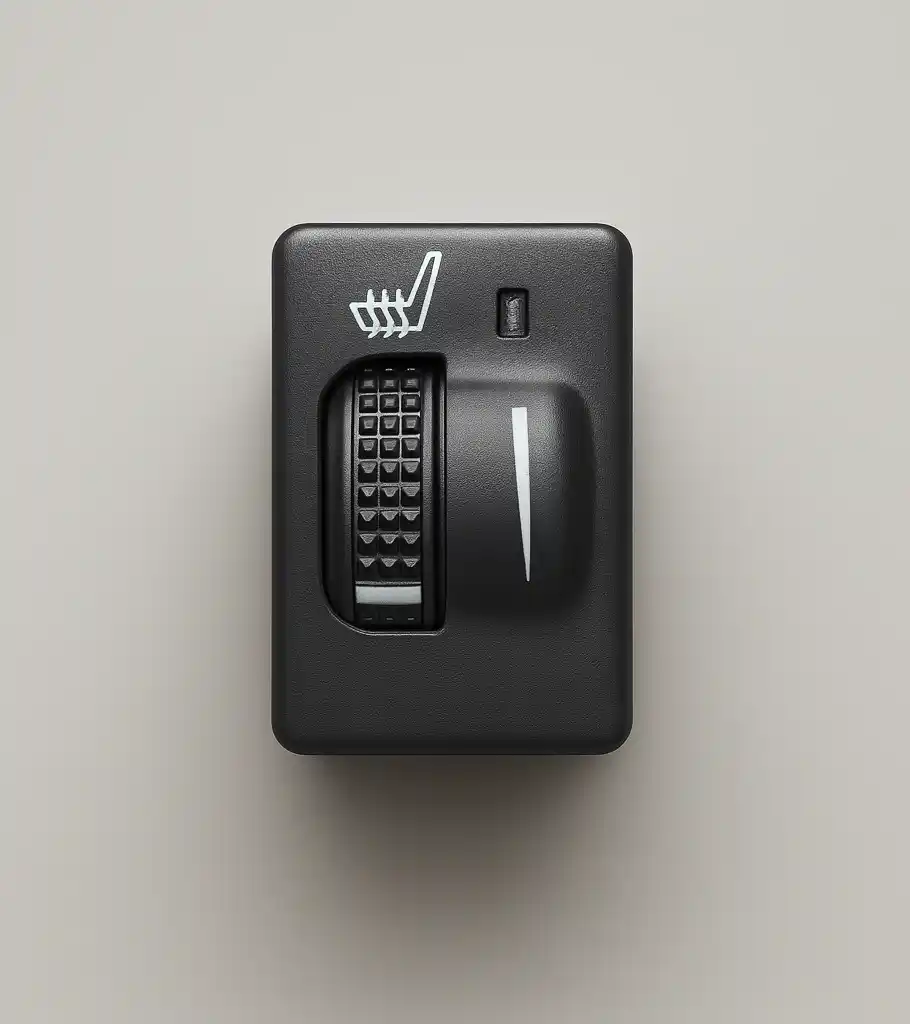
The control interface is where most retrofit and aftermarket programs break down. A two-stage rocker switch with an integrated LED indicator is the simplest approach and remains correct for commercial fleet and utility applications.
Premium passenger programs increasingly require the heater to respond to a CAN or LIN message so that the seat state survives an ignition cycle, syncs to the driver profile, and reports back to the infotainment display.
Those are different products with different validation burdens, and a supplier should hold inventory and tooling for both rather than pushing you toward whichever one they already build.
Pay attention to the mechanical and photometric details, because they drive perceived quality:
- detent force
- actuator travel
- icon legend durability under abrasion
- backlight color matched to the vehicle’s existing instrument illumination. Connector keying should make reverse insertion physically impossible. When you are specifying a replacement or an upgrade path
- our seat heater switch catalog lists the bezel dimensions and pinouts needed to confirm fitment before you commit to a build. For module-controlled systems
- request the message definition and the fault-code behavior in writing.
Criterion 4: Electrical Load and Harness Engineering
A pair of seat heating pads typically draws 45 to 70 watts per seat on high — roughly 4 to 6 amps at nominal 12 volts. Two front seats running simultaneously therefore represent a meaningful load on a vehicle whose alternator reserve is already committed to a heated steering wheel, rear defrost, and blower.
Confirm that your supplier sizes the wire gauge for the full-load case at the vehicle’s lowest expected operating voltage, not at 13.8 volts, and that the fuse rating is coordinated with the harness rather than copied from a previous program.
Terminal plating is a frequent cost-down target and a frequent failure source. Tin-plated terminals are acceptable in a dry, low-cycle location; a connector that sees moisture migration from spilled liquids or repeated mating during service deserves gold or a thicker tin barrier.
The highest-stress harness point in any seat is the cushion-to-backrest transition, where recline motion flexes the wire thousands of times. That segment needs stranded wire with a high flex rating, a service loop, and a strain relief that is bonded rather than taped.
Criterion 5: Validation Testing and Compliance Documentation
Ask a prospective seat heater OEM supplier for the validation plan before you ask for the price. The plan should name the test, the sample size, the acceptance criterion, and the lab. At minimum, expect the following:
- Electrical cycle life — tens of thousands of on-off cycles with resistance drift measured at interval, not just a pass-fail at the end
- Mechanical durability — repeated ingress-and-egress loading on a fully trimmed seat, since element damage usually comes from occupant motion rather than from heat
- Thermal runaway and fault injection — deliberately shorting the regulating device to confirm the backup protection opens the circuit
- Environmental exposure — humidity, thermal shock, and salt spray on connectors and terminals
- Flammability — documented conformance for the trim and element stack-up as an assembly
Equally important is the paperwork a supplier can hand you on request: a PPAP package, a control plan tied to the process flow, dimensional reports, and material declarations. If a vendor cannot produce these for an existing program, they will not produce them for yours.
Criteria 6 and 7: Tooling, MOQ, and Lead-Time Reliability
Criterion six is program economics. Seat heating pads are relatively tooling-light compared with injection-molded parts, but switches, bezels, and connector housings are not.
Establish who owns the tooling, where it is physically stored, and what the amortization schedule is — and get it in the purchase agreement, because tool ownership is what gives you the option to move production if quality degrades.
Minimum order quantities should scale with your actual program: a vendor that insists on 10,000 pieces for a validation build is telling you they do not want a development partner.
Criterion seven is lead-time discipline. For North American seat assemblers and distributors, a supplier holding domestic inventory converts a twelve-week ocean transit into a two-day shipment, which is the difference between a line stoppage and a non-event.
Ask for the last twelve months of on-time delivery data and the current finished-goods position by part number. Distributors evaluating stock depth can review the full assortment of available seat heating products to confirm what ships from inventory versus what runs to order.
Frequently Asked Questions
How long does a production seat heating pad last? A well-designed alloy-wire element in a properly specified seat routinely exceeds the vehicle’s service life — on the order of ten years or more of seasonal use. Premature failures almost always trace to mechanical causes rather than thermal ones:
- an element routed across a sewing line
- a harness without a service loop at the recline pivot
- or a pad creased during trim installation.
Can a single supplier cover both OEM seat programs and aftermarket distribution? Yes, provided they maintain two distinct documentation and change-control levels. OEM programs require PPAP, locked process controls, and formal change notification. Aftermarket requires broad fitment coverage, retail-ready packaging, and installation instructions.
The manufacturing capability overlaps; the quality systems and inventory strategies do not.
What should a request for quotation include? Send the seat frame and trim drawings, the target surface temperature and warm-up time, the available current and fuse budget, the control interface type, the annual volume with a production ramp, and the validation standard you intend to apply.
A supplier who quotes confidently without any of this information is quoting a commodity pad, not your system.
Ready to qualify a supplier against these seven criteria? Lucky Driver Inc.
manufactures and supplies seat heating pads, seat heater switches, electronic control modules, and seat ventilation systems to OEM seat manufacturers and aftermarket distributors across North America, with domestic inventory on high-volume part numbers and engineering support for custom element layouts.
Send us your seat drawings, thermal targets, and volume projections, and our team will return a layout proposal, a validation plan, and a quotation you can evaluate line by line.
Related Articles
- Seat Heater Manufacturer USA: 8 Factors to Check (2026)
- Heated and Cooled Seat Conversion: 7 Steps (2026)
- Seat Ventilation Kit Aftermarket: 7 Specs to Check (2026)
- Add Ventilated Seats to a Car: 6 Steps to Do It Right
- Ventilated Seats vs Cooled Seats: 7 Key Differences
Frequently Asked Questions About seat heater oem supplier
Procurement engineers evaluating seat heater oem supplier for OEM programs regularly ask the following questions. Answers cover specification, compatibility, certification, and sourcing for seat heater oem supplier requirements.
What voltage ratings are available for seat heater oem supplier?
Standard seat heater oem supplier configurations support 12 V DC for passenger vehicles and 24 V DC for commercial trucks. Selecting the correct seat heater oem supplier voltage at the design stage eliminates harness rework later. Lucky Driver maintains seat heater oem supplier inventory in both ratings for same-week shipment.
Which certifications apply to seat heater oem supplier production?
seat heater oem supplier assemblies entering OEM programs typically require UL recognition, REACH compliance, and RoHS documentation. Lucky Driver holds certification records for every seat heater oem supplier variant and includes copies with sample and production shipments.
How is watt density specified for seat heater oem supplier?
Watt density for seat heater oem supplier is expressed in W/cm² and ranges from 0.04 to 0.12 depending on heat-up time requirements. Lower watt density seat heater oem supplier designs improve element longevity, while higher values suit cold-climate applications.
Lucky Driver engineering reviews seat heater oem supplier requirements and recommends watt density based on your seat platform.
What connector families are used with seat heater oem supplier?
seat heater oem supplier harnesses are available with Molex, TE Connectivity, and Delphi connector families. Matching the seat heater oem supplier connector to the vehicle harness reduces assembly time and eliminates adapter cables. Specify your harness format when requesting a seat heater oem supplier quote from Lucky Driver.
What is the lead time for seat heater oem supplier samples?
seat heater oem supplier samples from Lucky Driver’s North American warehouse ship within 3 to 5 business days for standard configurations. Custom seat heater oem supplier variants with modified pad geometry or connector pinouts require 4 to 6 weeks.
Contact Lucky Driver to confirm seat heater oem supplier availability before submitting your engineering schedule.