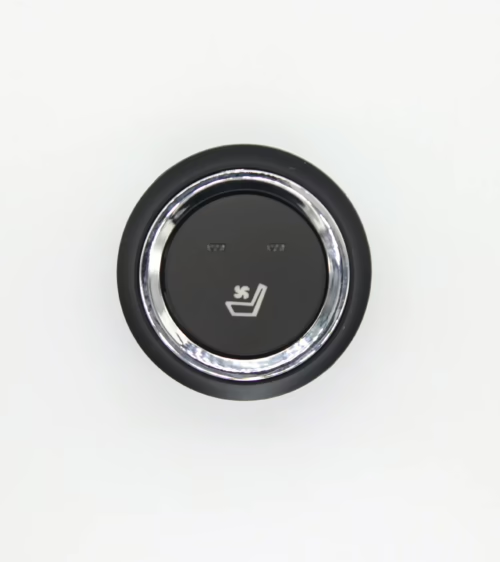
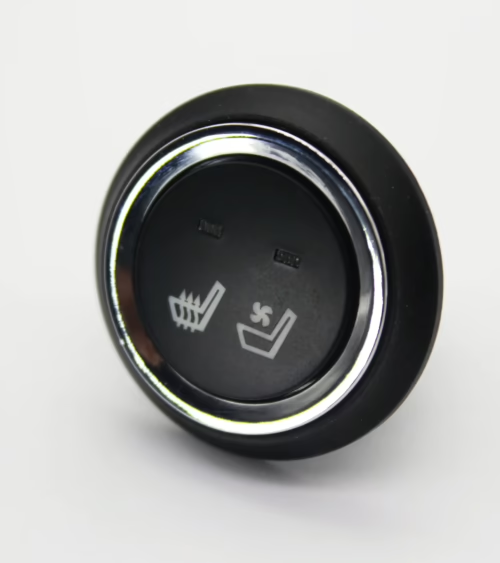
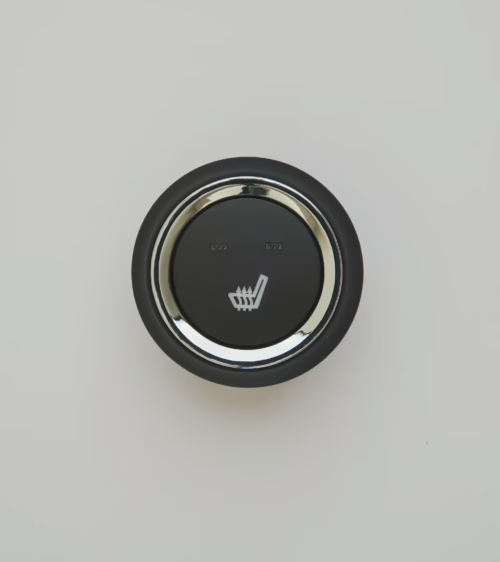
Toyota seat heater switch is the focus of this guide. Toyota vehicles across multiple model lines use round push-button seat heater switches with a similar design and connector family.
Whether you drive a RAV4, Camry, Tacoma, 4Runner, or Highlander, this guide covers how to identify the right replacement seat heater switch, what to look for in aftermarket options, and how to complete the installation.
1. Toyota Seat Heater Switch Design Across Models
Toyota standardized on a round illuminated push-button seat heater switch across most of its passenger vehicle lineup starting around 2010. The switch uses a sequential press mechanism:
- first press activates high heat (typically indicated by three bars or a full ring)
- second press steps down to medium
- third press to low
- fourth press turns off
This Hi-Med-Lo-Off sequence is consistent across RAV4, Camry, Highlander, and most other Toyota models, which means switches are often interchangeable between models of similar years when connector pinouts match.
2. Identifying Your Toyota Switch by Model Year
Connector pinout and switch diameter vary slightly across Toyota model years. Most 2012 to 2020 Toyota models use a 4-pin or 6-pin connector with a 22mm or 28mm switch body diameter. Pre-2012 models may use a different rocker or paddle switch depending on trim level.
The easiest way to confirm compatibility is to measure the panel cutout diameter and count the connector pins on the original switch before ordering a replacement.
3. OEM vs. Aftermarket Toyota Seat Heater Switches
Toyota OEM seat heater switches are available through dealers and typically priced between $40 and $90 per switch depending on model. Quality aftermarket alternatives are available at significantly lower prices and, when sourced from established automotive component manufacturers, provide equivalent electrical performance and similar appearance.
The key quality indicators to look for in aftermarket Toyota seat heater switches are: sealed housing for liquid resistance, LED illumination matching the OEM color temperature, and connector compatibility verified by the supplier.
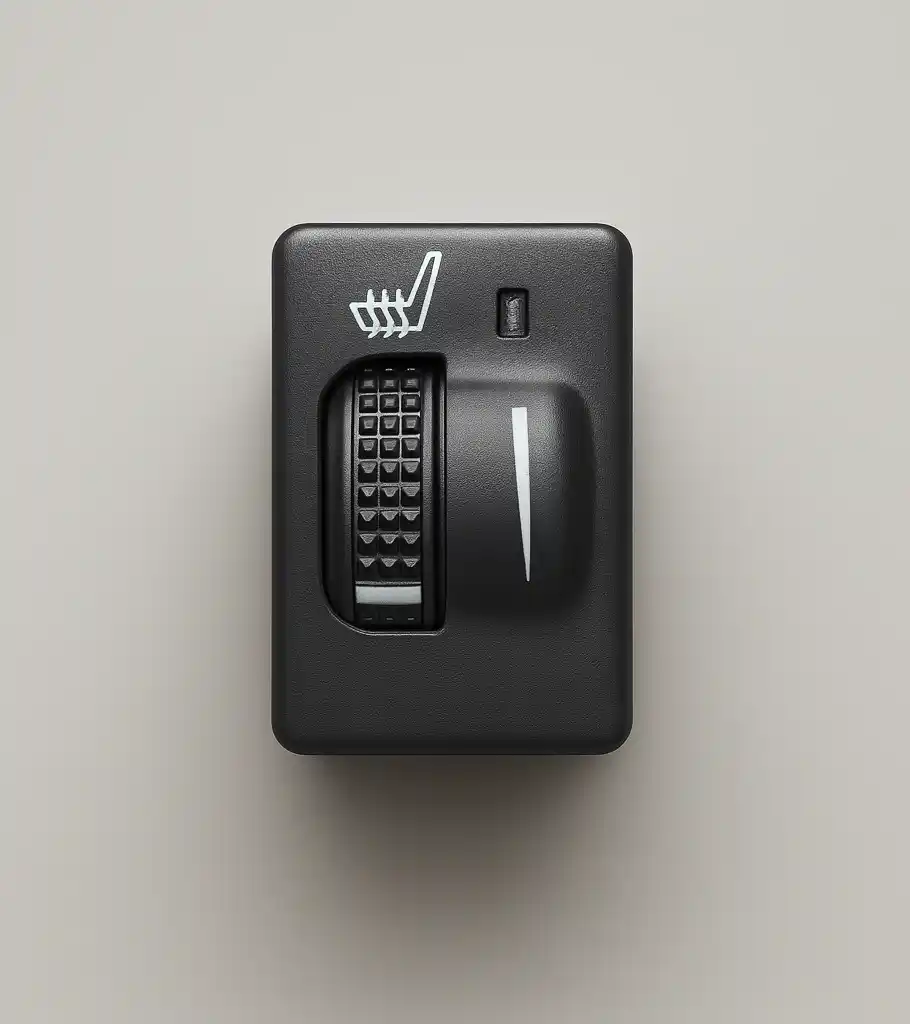
4. Common Toyota Models and Switch Compatibility
The following Toyota models commonly require seat heater switch replacement: RAV4 (2013-2023), Camry (2012-2023), Tacoma (2016-2023), Tundra (2014-2021), Highlander (2014-2023), 4Runner (2014-2023), and Sienna (2015-2023). Switches between these models are frequently cross-compatible when connector pinout and diameter match. Lucky Driver Inc.
supplies round seat heater switches compatible with the Toyota connector family used in these models, with high and low heat level variants available.
5. Installation Overview for Toyota Models
Toyota seat heater switch replacement follows the same general process across most models.
Disconnect the battery, remove the center console or instrument panel trim surrounding the switch using plastic pry tools, release the switch from its cutout by pressing the side tabs, unplug the connector, and install the replacement in reverse order.
Most Toyota switches do not require any programming or calibration — plug-and-play installation is standard for direct replacement switches.
6. When to Replace vs. Repair
Toyota seat heater switches are not serviceable components — internal contact failure or LED burnout requires full switch replacement. The switch assembly is priced low enough that repair is not economical. Replace the switch when:
- any heating level is non-functional
- the indicator light is partially or fully out
- or the switch requires repeated pressing to activate
Do not delay replacement — a switch with intermittent contact can cause the heater controller to enter a fault state in some Toyota models.
Shop Toyota-Compatible Seat Heater Switches
Lucky Driver Inc. manufactures round seat heater switches compatible with Toyota vehicle applications. Available in Hi-Lo and 3-level configurations with Toyota-matched illumination. Contact us or visit our online shop for current product listings and compatibility guidance.
Body Position and Ergonomic Considerations for Heated Seat Design
The distribution of seat heating elements must match the contact pressure map of the seated occupant. Pressure mapping studies show that contact pressure is concentrated in the ischial tuberosity region (sitting bones) of the seat cushion and in the lumbar and mid-back regions of the seat back.
Heating element density should be highest in these high-contact areas where heat transfer to the occupant is most effective.
Low-contact areas like the front edge of the cushion and the upper seat back have lower thermal efficiency and do not benefit from high watt-density element placement.
OEM seat heater designs that match element density to pressure map data provide better perceived warmth at the same electrical power level than uniform-density designs.
Integration with Active Seat Ventilation: Combined Comfort Systems
Premium seat comfort systems integrate heating and ventilation in a single system that transitions between warming and cooling modes. In heating mode, the ventilation blower is deactivated, and the heating element operates to warm the seat surface.
In cooling mode, the element is off, and the blower draws air through the perforated seat surface to cool the occupant.
The transition between modes must be managed to avoid simultaneous operation that would waste energy — running the heater while the ventilation blower exhausts the heat from beneath the seat surface.
Combined heating and ventilation systems require a seat trim cover compatible with both the heating element surface temperature and the airflow path requirements. Lucky Driver Inc.
has experience designing combined heating and ventilation systems for OEM seat customers who want to offer full-range thermal comfort in a single seat specification.
Prototype Build and Validation Timeline
OEM seat heater programs follow a structured prototype build and validation timeline that determines when production-intent components must be available. Typical milestone sequence:
- Component Design Review (CDR) at program start
- when material and design specifications are agreed
- Engineering Build (EB) at week 12-16
- when first-article components are built into evaluation seats
- Durability Validation (DV) test entry at week 20-24
- when statistically sufficient component samples begin endurance testing
- Production Validation (PV) build at week 32-40
- when production-line tooled components are installed in final validation builds.
A seat heater supplier who cannot deliver production-intent samples on schedule delays the program validation start and ultimately the vehicle production launch date. Lucky Driver Inc. manages prototype delivery against OEM program milestone schedules to support on-time validation entries.
Field Performance Data and Continuous Improvement Loops
After a seat heater program launches into production, field performance data from warranty returns and dealer service reports provides valuable feedback for continuous improvement.
Warranty data analysis typically reveals early wear-out failure mechanisms not captured in durability testing, installation-related failures that indicate training or documentation needs, and systematic design issues that require engineering change.
A seat heater supplier who participates in the OEM warranty data review process and drives root cause corrective action demonstrates program commitment beyond the initial launch. Lucky Driver Inc.
maintains quality engineering resources dedicated to program-in-production support, including warranty return analysis and corrective action implementation to improve field reliability over the production program life.
Frequently Asked Questions: Toyota Seat Heater Switches
Are Toyota seat heater switches interchangeable across different models?
Within a platform generation, Toyota often uses the same switch assembly across multiple models. However, between generations and across different platforms, switches are typically not interchangeable without a wiring adapter.
The key compatibility factors are the connector type and pin count, the resistance values at each switch position, and the indicator light interface.
Using an incompatible switch may result in no function, incorrect heat level control, or indicator light issues. Always confirm compatibility against the specific vehicle VIN before ordering a replacement switch.
Why does my Toyota seat heater switch feel warm to the touch?
A seat heater switch that feels warm indicates current is flowing through it, which is normal when the seat heater is operating.
The switch housing conducts a small amount of heat from the current flowing through the resistive contacts.
However, a switch that is hot to the touch (uncomfortably warm) may indicate a high-resistance contact connection causing excessive heat dissipation at the switch. Check the switch connector for corroded or partially inserted terminals, which increase contact resistance and cause abnormal heating.
Can I install a universal aftermarket switch to replace a Toyota OEM switch?
A universal aftermarket switch can be used as a replacement if it provides the correct electrical interface for the Toyota seat heater controller.
For standalone aftermarket seat heater systems installed in Toyota vehicles, the switch must match the aftermarket controller, not the Toyota OEM controller.
For Toyota OEM seat heater systems, the replacement switch must match the OEM resistive divider interface. Lucky Driver Inc. can advise on switch selection for both OEM and aftermarket Toyota seat heater applications.
Find Toyota-Compatible Seat Heater Switches at Lucky Driver Inc.
Lucky Driver Inc. supplies seat heater switches compatible with common Toyota vehicle applications including the RAV4, Camry, Highlander, Tacoma, and Tundra platforms. Our team can confirm compatibility for your specific vehicle make, model, and year before purchase.
Contact us with your Toyota vehicle details and we will identify the correct switch configuration and provide pricing for your replacement or upgrade requirement.
Selecting the correct Toyota seat heater switch for your vehicle is a straightforward process when you have the right information. Confirm the vehicle year, model, and whether it has the factory heated seat option, then use the OEM part number or vehicle connector specifications to identify the compatible replacement.
Lucky Driver Inc. maintains compatibility data for Toyota seat heater switches across multiple model years and can confirm the correct switch for your specific application before you order.
Contact us with your vehicle details to receive a compatibility confirmation and pricing for your Toyota seat heater switch requirement. Our team is familiar with common Toyota platforms including the RAV4, Camry, Highlander, Corolla, Tacoma, and Tundra across model years from 2010 to current production.
Toyota Seat Heater Switch: Final Buying Advice
Choosing the right Toyota seat heater switch comes down to three variables:
- the model year of your vehicle
- the switch body format (flush-mount vs. panel-mount)
- the connector pin configuration. A mismatched Toyota seat heater switch will either fail to connect to the existing harness or will not physically seat into the OEM switch cutout
Lucky Driver Inc. stocks Toyota seat heater switch assemblies for the most frequently serviced Toyota platforms and provides a compatibility checker to confirm the correct part before shipment.
Further Reading
Related Guides
- Toyota RAV4 Seat Heater Switch Replacement Guide
- Seat Heater Switch Replacement Guide
- Universal Heated Seat Switch Guide
- Seat Warmer Switch Replacement
- Heated Seat Switch Types Guide
Explore our universal seat heater switch options for direct-fit and universal applications.