Heated seat switches come in three main physical formats, each with different mounting requirements, tactile feel, and application fit. Understanding the differences helps you select the right switch for a replacement job or a new aftermarket heated seat installation.
1. Round Push-Button Switches
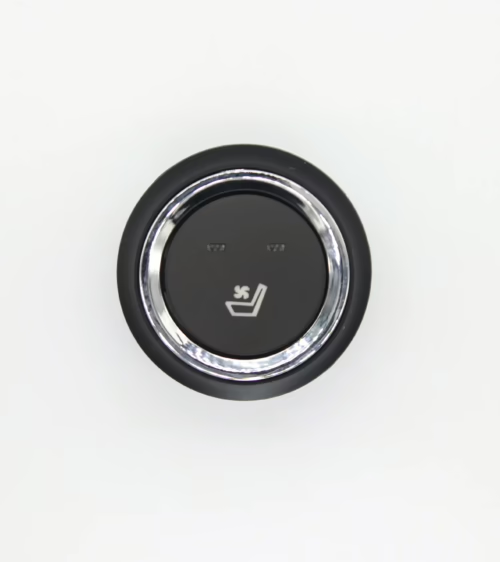
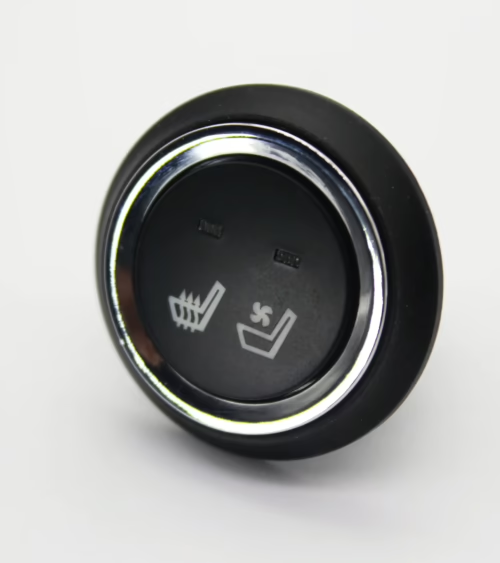
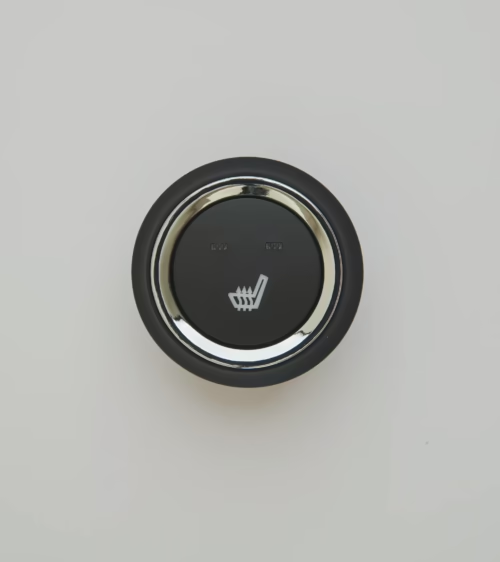
Round push-button heated seat switches are the most common format in modern vehicles, particularly Japanese brands (Toyota, Honda, Nissan, Subaru). The switch mounts in a round panel cutout, typically 22mm to 32mm in diameter, and uses a sequential press mechanism:
- each press steps through the heating levels in sequence. The switch illuminates with LED indicator bars or a full ring that shows the current heating level. Round push-button switches are compact
- clean-looking
- easy to install in aftermarket applications using a standard drill bit
2. Rocker Switches
Rocker heated seat switches use a pivot mechanism — the front of the rocker is pressed to activate heating and the switch returns to center (momentary) or stays latched (maintained) depending on the design.
Rocker switches are common in American and European vehicles (Ford, GM, BMW, Mercedes) and in older vehicle platforms. They mount in rectangular panel cutouts and are available in standard DIN sizes.
Rocker switches are simpler mechanically than push-button types, which makes them more reliable in high-humidity environments, but they are larger and harder to fit into tight modern console designs.
3. Rotary Switches
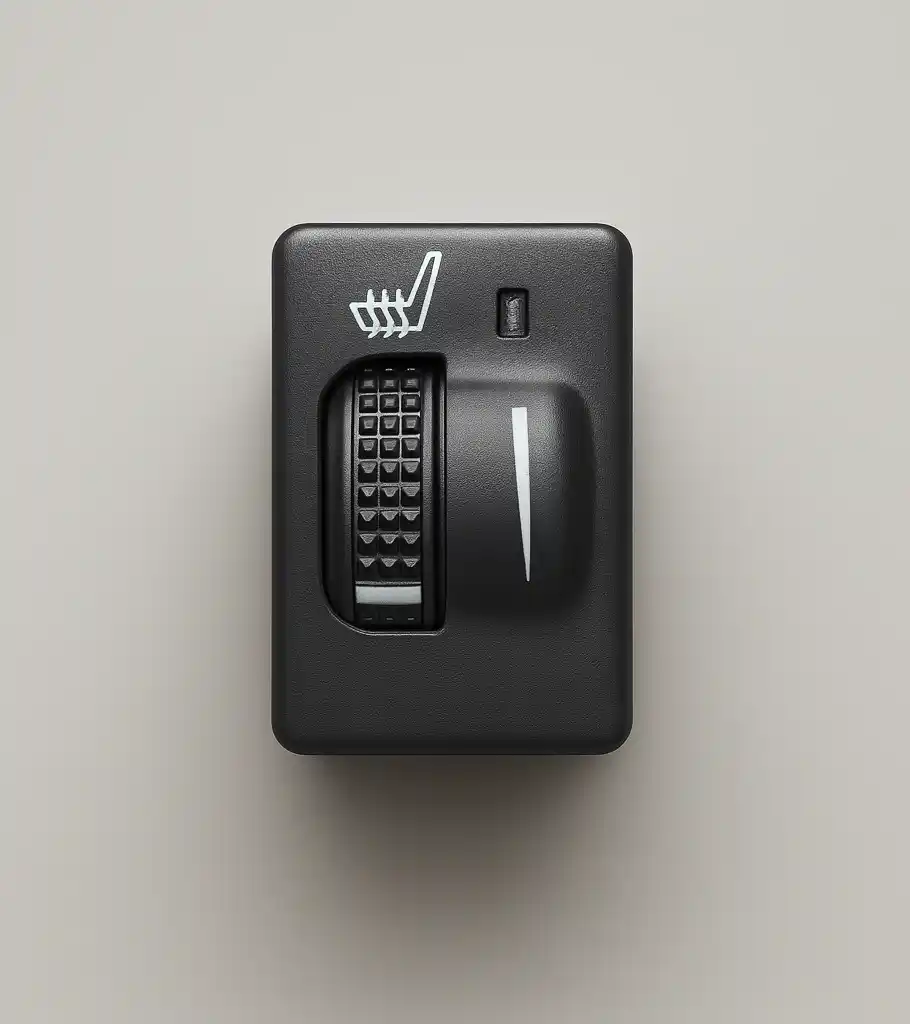
Rotary heated seat switches use a dial mechanism that steps between off and the available heating levels. Rotary switches provide distinct tactile detents at each position, which many drivers prefer for ease of use without looking at the control.
They are commonly specified in premium and luxury vehicles where the tactile quality of the control is part of the interior experience. Rotary switches are available in round formats that fit standard round cutouts, and in premium designs with metal bezels for high-end interior applications.
4. How to Choose the Right Type
For direct OEM replacement:
- match the original switch type exactly. A vehicle designed for a round push-button switch will have a round cutout in the trim panel — a rocker switch cannot be installed without panel modification.
- For aftermarket installation in a vehicle without factory heated seats: choose the format that best matches the available mounting location and interior style. Round push-button switches are the most versatile because a round hole is easy to drill in any trim panel. For RV
- boat
- or commercial vehicle applications: rocker switches are more robust in vibration-intensive environments
5. Electrical Compatibility
All three switch types are available in 12V configurations for automotive use. Confirm the switch current rating matches your heater kit output — a heated seat drawing 7 amps requires a switch rated for at least 10 amps.
Most quality automotive seat heater switches are rated for 10 to 15 amps continuous, which is sufficient for all standard heated seat applications. Lucky Driver Inc. manufactures round push-button heated seat switches in Hi-Lo and 3-level configurations, available for aftermarket and OEM supply programs.
6. Illumination Options
Modern heated seat switches use LED illumination rather than incandescent bulbs for longer life and lower power draw. Available illumination colors include white (most common in modern Japanese and Korean vehicles), amber (common in European vehicles and older platforms), and red (used in some truck and commercial vehicle applications).
Confirm the illumination color matches your interior before ordering — a white LED switch in an amber-lit interior is visually inconsistent.
Shop Heated Seat Switches
Lucky Driver Inc. supplies round push-button heated seat switches for OEM and aftermarket applications. Multiple connector families and illumination options available. Visit our shop or contact us for specifications and ordering.
High Voltage Seat Heating in Electric and Hybrid Vehicles
Electric vehicles and plug-in hybrids present an opportunity to implement seat heating using the high-voltage traction battery rather than the 12V auxiliary system.
High-voltage seat heating (typically operating at 400V or 800V systems) draws less current for equivalent heating power, which reduces wiring harness cost and weight compared to 12V systems.
However, HV seat heater elements require isolation testing to IEC 60664 and must comply with functional safety requirements that 12V systems do not face.
The heater controller must be designed with reinforced insulation between the HV circuit and the low-voltage control interface accessible to service technicians. For EV platform seat heater programs, ask prospective suppliers specifically about HV heating element experience and relevant IEC compliance testing. Lucky Driver Inc.
currently supplies 12V seat heating components and is evaluating HV heating product development for upcoming EV platform programs.
Occupant Detection and Presence-Based Heating Control
Modern seat heater systems in premium vehicles integrate with the occupant detection system (ODS) to automatically disable seat heating when no occupant is present.
This prevents energy waste when a passenger seat is unoccupied during a driving cycle and avoids heating a child safety seat placed on a heated seat.
The ODS integration typically works through the body control module, which provides an occupant presence signal to the seat heater controller via LIN or CAN bus.
When the seat heater controller receives a seat-unoccupied signal, it deactivates the heating element regardless of the switch position.
The integration requires coordination between the seat heater controller supplier, the ODS supplier, and the vehicle OEM during system design to confirm signal levels, timing, and default behavior in the absence of communication.
Remote Start and Pre-Conditioning Integration
Vehicles equipped with remote start systems can pre-condition the cabin, including seat heating, before the occupant enters the vehicle. Pre-conditioning integration requires the seat heater controller to accept activation commands from the body control module during remote start operation and to deactivate when the vehicle enters normal occupant-controlled operation.
The pre-conditioning temperature setpoint may differ from the occupant-controlled setpoint — some programs use a higher heat level during pre-conditioning to maximize heat-up speed in the unoccupied vehicle. Pre-conditioning integration is a feature increasingly requested by OEM customers for cold-climate markets. Lucky Driver Inc.
can design seat heater controller firmware to support remote start and pre-conditioning use cases as part of OEM program development.
Serviceability Design Requirements
Seat heater systems that are difficult to service in the field increase dealer warranty repair time and costs. Serviceability design requirements for seat heater components include:
- accessible connector locations that can be reached without removing the entire seat from the vehicle
- diagnostic access points that allow voltage and resistance measurements without disassembling the seat
- element repair accessibility by a single technician using standard automotive tools
- modular replacement design so a failed element can be replaced without replacing the entire seat assembly
OEM program design reviews include a serviceability assessment that evaluates repair time and tool requirements for each fault mode. Seat heater suppliers who consider serviceability during initial design produce components with lower field service costs over the program life. Lucky Driver Inc.
designs all seat heater products with field serviceability as an explicit design criterion.
Frequently Asked Questions: Heated Seat Switch Types
Which heated seat switch type is most reliable?
Rocker switches are the most proven and cost-effective design for heated seat control. Their mechanical simplicity — a pivoting lever actuating a set of contacts — provides long service life under normal use conditions.
Push-button switches with illuminated rings are reliable when correctly designed with quality tactile mechanisms, but lower-quality push-button designs are more prone to contact bounce and LED failure than rocker switches.
Rotary dial switches are reliable in automotive-grade designs but are more expensive and less space-efficient than rocker or push-button types. For simple three-level heat control applications, a quality rocker switch is the most reliable choice.
Can I change from a rocker switch to a push-button switch?
Yes, if the replacement switch provides the same electrical interface as the original. The switch mounting hole dimensions may differ, requiring a trim panel adapter or modification. The connector type may also differ, requiring a wiring adapter pigtail.
As long as the electrical interface is matched to the controller, the physical switch type can be changed with appropriate mounting and connector modifications. Contact Lucky Driver Inc. for guidance on switch type conversion for specific heated seat controller applications.
Do all heated seat switches have the same connector pinout?
No. Connector pinout varies by switch manufacturer, product line, and intended controller interface. Even switches with the same connector housing may have different pin assignments.
Always verify the pinout against the wiring diagram for your specific switch and controller before connecting. Incorrect pinout connection can damage the controller or cause incorrect heat level operation. Lucky Driver Inc. provides complete wiring documentation including pinout diagrams for all seat heater switches in our product range.
Find the Right Heated Seat Switch at Lucky Driver Inc.
Lucky Driver Inc. supplies heated seat switches in rocker, push-button, and rotary configurations for aftermarket installation and OEM supply programs. Our standard product range covers the most common heated seat controller interfaces, and custom switch designs are available for OEM program requirements.
Contact us with your application requirements — switch type, heat level configuration, illumination, and connector interface — to receive product recommendations and pricing.
Choosing the Right Heated Seat Switch: Summary
The right heated seat switch for a repair or new installation depends on three factors:
- the control signal your seat heater module expects
- the physical space available in the vehicle interior
- the user experience you want to deliver. A rocker heated seat switch is the easiest to install in a blank panel location. A rotary heated seat switch provides the most intuitive heat-level adjustment. A round push-button heated seat switch delivers the most compact footprint for tight dash locations.
- Lucky Driver Inc. stocks all three heated seat switch formats in 12 V configurations compatible with all major aftermarket seat heater control modules
Further Reading
Related Guides
- Toyota RAV4 Seat Heater Switch Replacement Guide
- Seat Heater Switch Replacement Guide
- Toyota Seat Heater Switch Guide
- Universal Heated Seat Switch Guide
- Seat Warmer Switch Replacement
For sourcing, see our OEM-style seat heater switches available for immediate delivery.