Long hours in a cold office wear down lower-back comfort, and a mains-powered blanket is rarely a practical answer at a desk. That is why the office chair heating pad 12V category has grown so quickly:
- most of these pads are direct descendants of automotive seat heaters
- engineered around the same low-voltage DC architecture used in every vehicle on the road. That heritage matters
- because automotive heating elements are designed for years of compression cycles
- not a single winter. This guide covers the seven things that separate a reliable 12V chair heating pad from a disposable one: element construction
- wattage and current draw
- temperature control
- safety circuits
- how to power one correctly at a desk.
1. How a 12V Office Chair Heating Pad Works
Electrically, a 12V heating pad is a simple resistive load. A regulated 12-volt DC supply pushes current through a resistance element, and the element converts that electrical energy directly into heat through Joule heating.
The element itself is routed in a serpentine pattern and laminated between layers of non-woven polyester or felt, which spreads heat evenly across the seat and backrest zones while protecting the conductor from abrasion.
What distinguishes a well-engineered pad from a cheap one is everything around that element:
- a temperature sensor (typically an NTC thermistor or bimetallic thermostat) bonded near the center of the heat field
- strain relief where the lead wire exits the pad
- terminations that survive thousands of sit-down compression cycles. In OEM automotive practice
- these details are validated with flex
- crush
- thermal-cycling tests — the same construction standards worth demanding in an office product.
2. Why 12V Beats USB and Mains Voltage for Chair Heating
Voltage choice defines what a chair heating pad can actually do. A standard USB-A port delivers 5V at 2A — about 10 watts, which is enough to take the chill off a small lumbar zone but not enough to heat a full seat surface in a cold room.
USB-C Power Delivery can negotiate higher power, but it requires trigger electronics and a capable charger, adding cost and failure points.
Mains-voltage (110V/230V) pads solve the power problem but introduce a shock hazard directly against the user’s body, which demands double insulation and stricter certification. A 12V system sits in the sweet spot:
- it qualifies as safety extra-low voltage
- so contact with a damaged conductor is not a shock risk
- yet it delivers 25 to 60 watts comfortably. Just as important
- 12V is the native voltage of the automotive seat heating industry
- so buyers get access to a deep
- mature supply base of proven elements
- sensors
- controllers rather than one-off consumer designs.
3. Heating Element Types: Alloy Wire vs. Carbon Fiber
Two element technologies dominate the market, and each has a distinct engineering profile:
- Alloy resistance wire — typically a copper-nickel or similar alloy conductor, often wound around an aramid core and insulated with PVC or TPE. This is the classic OEM automotive construction. It is mechanically robust, tolerates repeated flexing, and its resistance is stable and predictable, which makes thermostat calibration straightforward.
- For a chair that gets sat in eight hours a day, wire elements have the longest documented field record.
- Carbon fiber tow — bundles of carbon filament that heat quickly and produce a pleasant far-infrared warmth at lower surface temperatures.
- Carbon elements are lighter and drape well, but their weak point is termination: the crimp or clamp joint between the carbon bundle and the copper lead wire is prone to fatigue and resistance creep if not engineered carefully.
Neither technology is automatically better. What matters is validation — a wire element with proper strain relief will outlast a poorly terminated carbon pad, and a well-built carbon pad will outperform brittle bargain wire. Ask any supplier for flex-cycle and life-test data before committing to volume.
4. Wattage, Current Draw, and Warm-Up Time
Power output follows Ohm’s law: at a fixed 12V supply, the element’s resistance sets the wattage (P = V²/R). Practical figures for office chair use:
- 15–20W — lumbar-only pads; gentle background warmth, roughly 1.3–1.7 amps.
- 25–40W — full seat or seat-plus-back coverage; reaches a comfortable 38–42°C surface temperature in two to four minutes, drawing 2–3.3 amps.
- 45–60W — rapid warm-up designs; these must have active temperature regulation, because an unregulated 60W pad can exceed safe skin-contact temperatures within minutes.
Remember that foam and upholstery between the pad and the user act as insulation. A pad mounted under a thick cushion needs more wattage — or more patience — than a thin topper pad strapped over the chair surface.
This is why automotive pads, which sit directly under thin seat covers, feel faster than identical wattage buried in aftermarket cushions.
5. Temperature Control: From Simple Switches to Smart Controllers
Control strategy is where comfort and safety meet. The simplest pads use a two-position high/low switch that inserts a series resistance or switches between two element circuits.
More refined systems use a control module that reads an NTC thermistor in the pad and modulates power — either through pulse-width modulation or relay cycling — to hold a target temperature regardless of room conditions.
Multi-level controllers with three to five settings and LED indicators are now the expectation rather than the exception. The hardware is largely shared with vehicle applications:
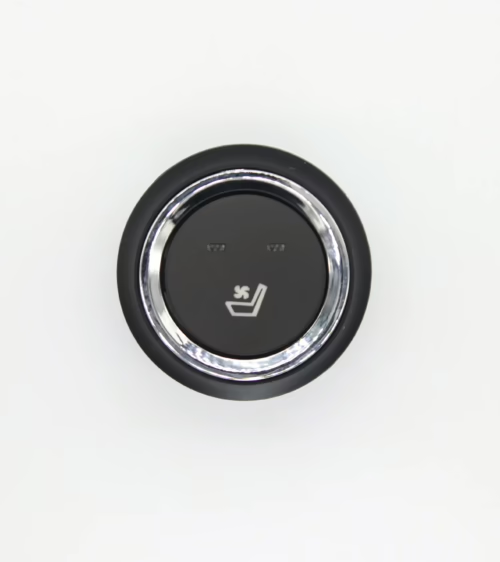
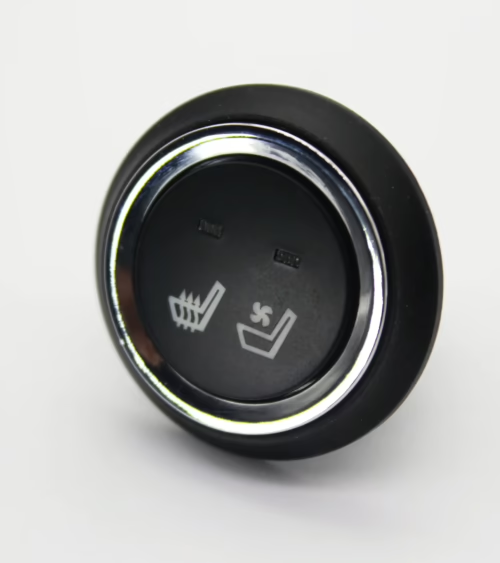
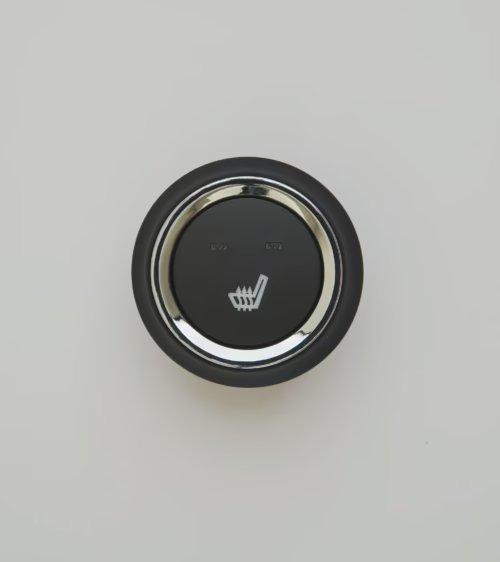
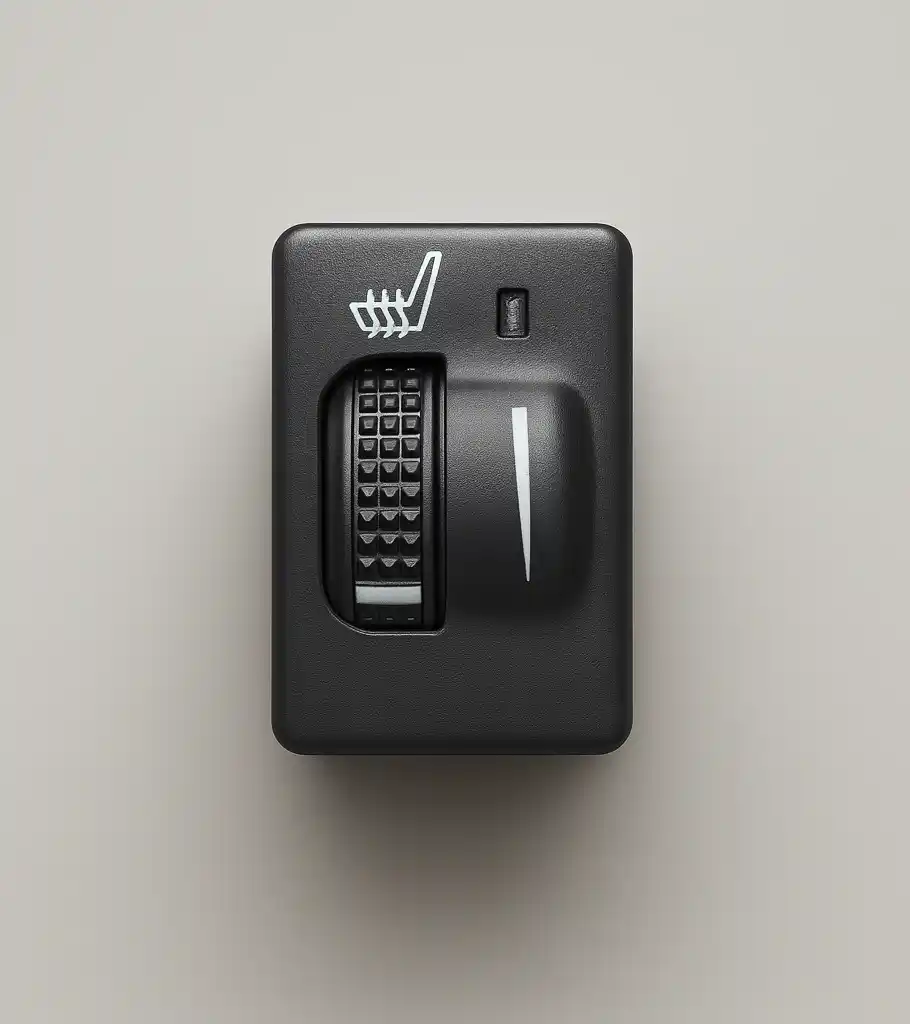
- the round and rocker-style controls in our seat heater switch catalog are the same designs found in aftermarket chair heating builds
- which keeps sourcing simple when a switch eventually wears out. A closed-loop controller also extends pad life
- because the element spends most of its time at partial duty cycle rather than full power.
6. Safety Features That Are Non-Negotiable
A heating device pressed against the human body for hours needs layered protection, not a single sensor. Look for all of the following:
- Primary temperature regulation — an NTC thermistor or bimetallic thermostat that cycles the element around the setpoint during normal operation.
- Independent overheat cutoff — a one-shot thermal fuse or secondary thermostat that opens the circuit permanently if the primary control fails. This is the layer that prevents a stuck relay from becoming a burn injury.
- Automatic shut-off timer — a 30-to-60-minute auto-off protects users who fall into deep focus (or a nap) and guards against low-temperature burns, which can occur below 45°C with prolonged exposure.
- Inline current fuse — a fuse on the 12V positive lead sized just above the pad’s rated draw, so a chafed wire shorts safely instead of overheating the harness.
- Flame-retardant substrate — pad materials rated to automotive flammability standards such as FMVSS 302.
Any pad that relies on a single thermostat with no backup layer should be disqualified, whatever its price.
7. Powering a 12V Pad at Your Desk the Right Way
Offices do not have 12V outlets, so the pad runs from an AC-to-DC adapter — and the adapter deserves as much scrutiny as the pad. Size it with 25–30% headroom above the pad’s rated wattage:
- a 40W pad belongs on a 12V/5A (60W) adapter
- not a 3A unit running at its ceiling. Insist on a safety-certified adapter (UL
- ETL
- or the local equivalent)
- because the adapter is the only mains-voltage component in the system and the most common point of failure in cheap kits.
On the wiring side, verify barrel connector polarity (center-positive is common but not universal), use lead wire of at least 18 AWG for pads above 30W, and route the cable away from the chair’s gas cylinder and caster path — a rolling caster will destroy an unprotected lead in weeks.
If the pad ships with a cigarette-lighter plug for dual car/office use, a quality adapter with a lighter socket output makes the transition seamless.
Frequently Asked Questions
Can I run a 12V office chair heating pad from a USB port? Not directly. USB-A supplies 5V, so a 12V element would produce less than one-fifth of its rated heat.
Some products use a USB-C Power Delivery trigger cable to request 12V from a PD charger, which works if the charger supports the 12V profile at sufficient current — but a dedicated certified 12V adapter remains the more reliable solution.
How hot does a 12V chair heating pad get? Well-designed pads regulate the seating surface to roughly 38–45°C. The high end feels distinctly warm through clothing without approaching burn territory during normal use, and the overheat cutoff typically opens between 55°C and 70°C at the element if regulation fails.
How much electricity does it use? Very little. A 40W pad cycling at a 50% duty cycle consumes about 0.02 kWh per hour — under one cent per workday at typical US electricity rates, far less than a space heater drawing 1,500W.
Get OEM-Grade 12V Heating Components
Lucky Driver Inc. supplies seat heating pads, switches, and control modules to OEM seat manufacturers and aftermarket distributors across North America, built on the same validated construction described in this guide.
Whether you are sourcing components for a heated seating product line or retrofitting workplace seating, you can browse our full range of seat heating products and contact our team for volume pricing, specifications, and application support.
Related Articles
- Wheelchair Seat Heater: 7 Things to Know Before You Buy (2026)
- Tractor Seat Heater: 7 Things to Know Before You Buy (2026)
- Golf Cart Heated Seats: 7 Things to Know Before You Buy (2026)
- UTV Heated Seat Kit: 5 Things to Know Before You Buy (2026)
- Boat Seat Heater: 5 Things to Know for 2026
Frequently Asked Questions About office chair heating pad 12v
Procurement engineers evaluating office chair heating pad 12v for OEM programs regularly ask the following questions. Answers cover specification, compatibility, certification, and sourcing for office chair heating pad 12v requirements.
What voltage ratings are available for office chair heating pad 12v?
Standard office chair heating pad 12v configurations support 12 V DC for passenger vehicles and 24 V DC for commercial trucks. Selecting the correct office chair heating pad 12v voltage at the design stage eliminates harness rework later.
Lucky Driver maintains office chair heating pad 12v inventory in both ratings for same-week shipment.
Which certifications apply to office chair heating pad 12v production?
office chair heating pad 12v assemblies entering OEM programs typically require UL recognition, REACH compliance, and RoHS documentation. Lucky Driver holds certification records for every office chair heating pad 12v variant and includes copies with sample and production shipments.
How is watt density specified for office chair heating pad 12v?
Watt density for office chair heating pad 12v is expressed in W/cm² and ranges from 0.04 to 0.12 depending on heat-up time requirements. Lower watt density office chair heating pad 12v designs improve element longevity, while higher values suit cold-climate applications.
Lucky Driver engineering reviews office chair heating pad 12v requirements and recommends watt density based on your seat platform.
What connector families are used with office chair heating pad 12v?
office chair heating pad 12v harnesses are available with Molex, TE Connectivity, and Delphi connector families. Matching the office chair heating pad 12v connector to the vehicle harness reduces assembly time and eliminates adapter cables.
Specify your harness format when requesting a office chair heating pad 12v quote from Lucky Driver.
What is the lead time for office chair heating pad 12v samples?
office chair heating pad 12v samples from Lucky Driver’s North American warehouse ship within 3 to 5 business days for standard configurations. Custom office chair heating pad 12v variants with modified pad geometry or connector pinouts require 4 to 6 weeks.
Contact Lucky Driver to confirm office chair heating pad 12v availability before submitting your engineering schedule.