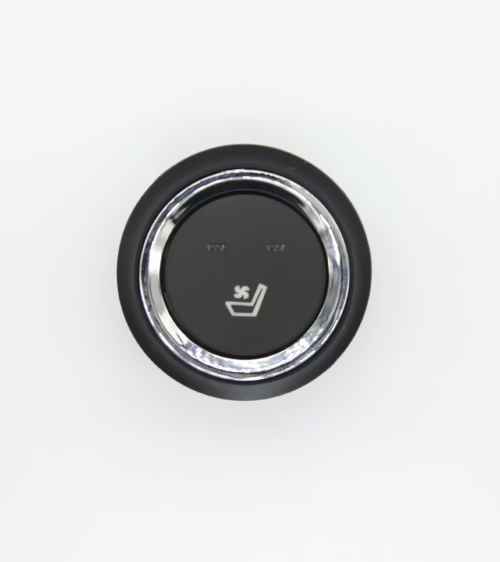
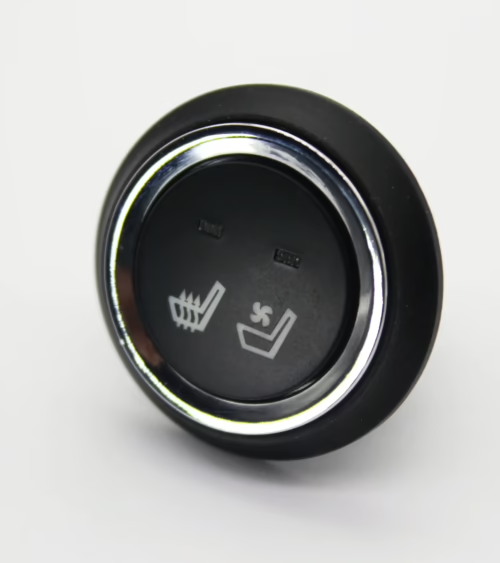
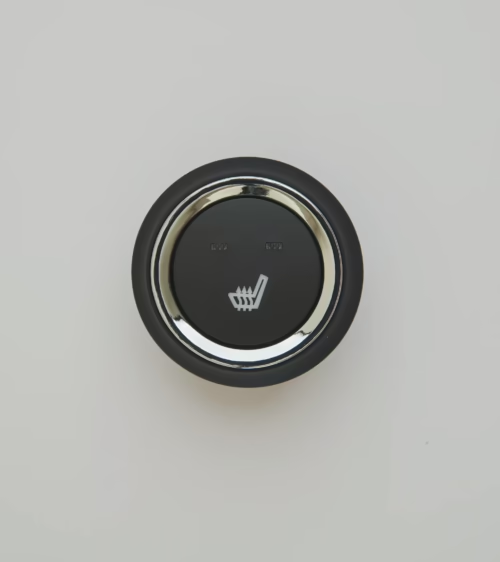
A 12v seat heater pad is the flat resistive element that sits between the seat foam and the trim cover and turns the vehicle’s 12-volt electrical supply into cabin comfort.
It sounds simple, but the difference between a pad that performs for ten years and one that develops a hot spot in its second winter comes down to a short list of measurable specifications.
This guide walks through the 7 specs that OEM seat manufacturers and aftermarket distributors should verify before approving a pad for production or resale, with the numbers you need to ask for and the failure modes each spec protects against.
1. Rated Wattage and the 12V Power Budget
The first spec to check is rated power at nominal voltage. A typical automotive seat heater pad set draws between 30 and 60 watts for the cushion and backrest combined, which corresponds to a current of roughly 2.5 to 5 amps at 12 volts.
A pad rated much higher than this will heat quickly but will also run into three problems:
- it exceeds the current rating of the stock seat harness
- it trips undersized fuses
- it reaches uncomfortable surface temperatures before the control loop can react.
Keep in mind that a running vehicle does not actually deliver 12 volts. With the alternator charging, system voltage sits between 13.5 and 14.4 volts. Since power scales with the square of voltage across a fixed resistance, a pad rated at 40 watts at 12 V will produce about 52 watts at 13.8 V.
Good pad designs account for this by specifying power at 13.5 V, and good control modules compensate by limiting duty cycle. When you compare quotes from different suppliers, always confirm which test voltage the wattage figure refers to, otherwise you are comparing pads that differ by 30 percent in real-world output.
2. Element Resistance and Tolerance
Resistance is what ultimately determines heat output, so it should be specified directly rather than inferred from wattage. For a 40-watt pad at 12 V, the target resistance is about 3.6 ohms; for a 25-watt cushion element it is roughly 5.8 ohms. What matters more than the nominal value is the tolerance.
A pad specified at plus or minus 5 percent will produce a consistent feel across every seat in a production run, whereas a pad at plus or minus 15 percent can leave one driver’s seat noticeably warmer than the passenger’s.
Ask for the resistance measurement method too. Resistance should be measured at 20 to 25 degrees Celsius on the finished pad, after lamination, because the bonding process can slightly compress the element and shift the value.
Suppliers who quote resistance on the bare wire before assembly are quoting a number you will never see on the incoming inspection bench.
For wire elements, the resistance also rises with temperature according to the material’s temperature coefficient, which is why the pad draws slightly less current once warm than it does at the cold start.
3. Heating Element Type: Wire vs Carbon Fiber
Two element technologies dominate the 12-volt seat heater market. Resistance wire pads use a fine alloy conductor, usually a copper alloy or nickel-chromium strand, stitched or laminated in a serpentine path across a nonwoven or foam carrier.
Carbon fiber pads use bundles of conductive carbon filaments laid in parallel or woven into a fabric, with copper bus bars at each end.
- Wire elements offer precise resistance control, easy repairability at the design stage, and a long track record in OEM programs. Their weakness is fatigue: repeated flexing at the seat bolsters can eventually crack a strand, and a single break opens the entire circuit.
- Carbon fiber elements heat more evenly across their surface and tolerate flexing well because current has thousands of parallel paths. Their weakness is at the terminations, where the bus bar to carbon joint must be crimped or bonded carefully to avoid a high-resistance junction that runs hot.
Neither type is universally better. For a bucket seat with aggressive bolsters and high occupant ingress wear, carbon fiber’s flex tolerance is valuable. For a flat bench seat in a commercial vehicle where cost and simple field diagnosis matter, wire remains the pragmatic choice.
4. Element Layout and Coverage Map
A pad’s heat distribution is set by the routing of its element.
The routing must place the highest watt density in the contact zones, meaning the center of the cushion under the thighs and the lumbar region of the backrest, while avoiding the seat’s trench lines, airbag deployment seams, and any area where the trim cover is pulled tight by listing wires.
Element runs that cross a trench line will be pinched by the hog rings or clips and are the single most common source of premature failure in retrofit pads.
When reviewing a pad drawing, verify three things. The spacing between adjacent element runs should be uniform, typically 10 to 20 mm, because widely spaced runs feel like stripes rather than an even warmth.
The element should stop at least 20 mm from any cut edge so the trimming operation cannot nick it.
And the pad outline should be drawn from the actual foam contour, not from a generic rectangle, because a pad that is too large will bunch up under the cover and create a fold that concentrates heat.
5. Temperature Sensing and Control Strategy
A 12-volt pad by itself has no intelligence. Something must limit how hot it gets, and the two common approaches differ significantly in feel and safety margin.
The simplest is a bimetallic thermostat embedded in the pad that opens the circuit at a fixed temperature, often around 40 to 45 degrees Celsius, and closes again after cooling. This gives on-off cycling that some occupants notice as a pulsing warmth.
The more refined approach uses a negative temperature coefficient thermistor laminated into the pad, read by an electronic control module that modulates the pad through pulse-width modulation.
The module can then offer multiple heat levels, ramp down gradually as the seat approaches the setpoint, and shut off entirely if the sensor reports an open or short. Whichever control method a program uses, the sensor location on the pad matters as much as the sensor itself.
It should sit in the primary contact zone, not at the edge, because the control loop can only regulate the temperature it can measure.
The underlying physics of heat transfer from the pad through the foam and trim to the occupant is governed by thermal conduction, which is why thick leather or a perforated cover changes the setpoint that feels right even though the pad is unchanged.
6. Connectors, Lead Length, and Switch Integration
The lead-out is where many pad specifications go quiet, and it is where installers spend most of their labor. Specify the lead length from the pad edge to the connector, the wire gauge, and the connector part number.
For a 5-amp load, 20 AWG leads are the practical minimum and 18 AWG gives comfortable headroom for the elevated charging voltage described earlier.
The connector should be a sealed automotive type with a positive latch, because seat connectors live in a zone that gets kicked, vacuumed, and exposed to spilled drinks.
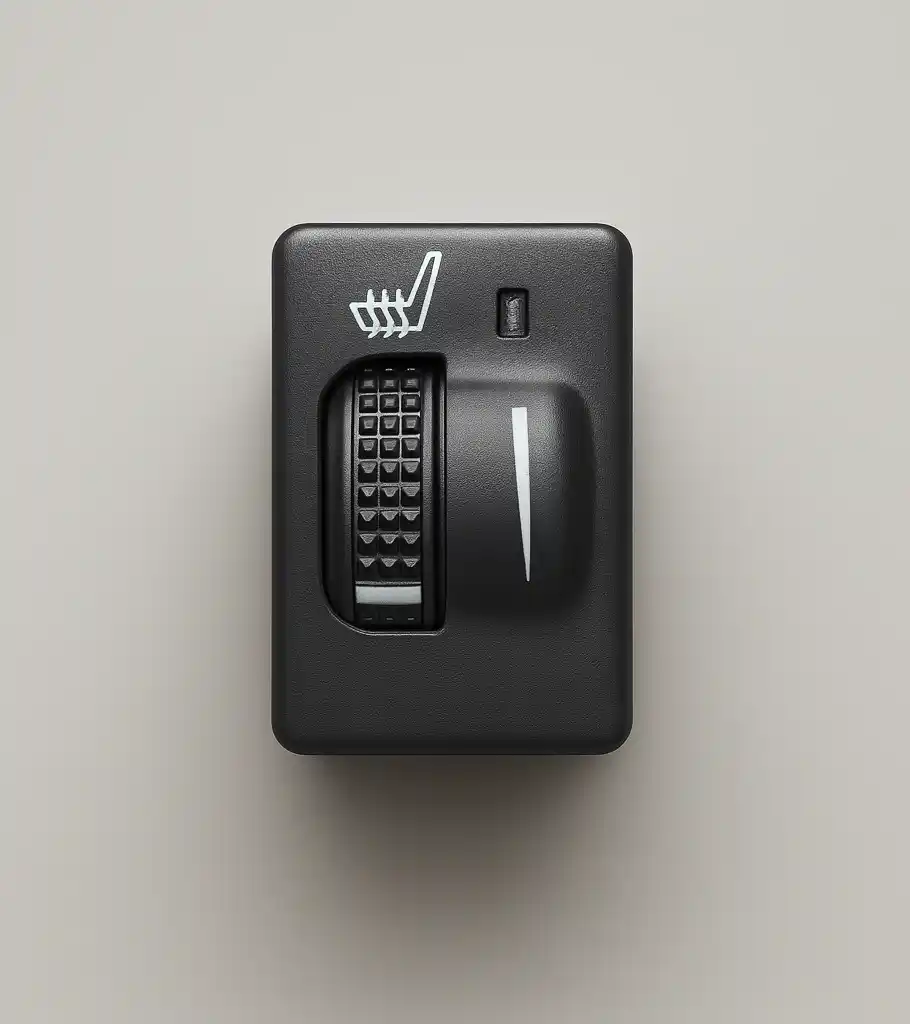
The switch is the occupant’s only interface with the whole system, so pad and switch should be specified together. A two-position switch wired directly in series with the pad is the simplest arrangement and works well with a thermostat-controlled pad.
For thermistor pads, a switch with high and low positions feeding a control module is the norm, and the switch must match the module’s input logic.
If you are sourcing replacement components for an existing program, our range of OEM-style seat heater switches covers the common rocker, push-button, and rotary formats with illumination options that match factory dashboards.
7. Durability Testing and Compliance Evidence
The final spec is not a number on the pad but the test report behind it. A credible 12-volt seat heater pad supplier should be able to show results from at least the following:
- a flex test of 50,000 or more cycles simulating occupant ingress and egress
- a thermal cycling test between minus 40 and plus 85 degrees Celsius
- an overvoltage test at 16 volts
- a humidity soak
- a hot-spot survey with an infrared camera at full power with no occupant on the seat. That last test matters because an empty
- insulated seat is the worst case for surface temperature
- it is exactly the condition a driver creates by turning on the heater and stepping out to scrape the windshield.
Ask also for the flammability rating of the carrier material and any adhesive, and for the supplier’s quality system certification. A pad built in an IATF 16949 facility comes with process controls on resistance, lamination pressure, and termination pull force that a general-purpose factory cannot match.
For distributors, this documentation is also your first line of defense in any product liability inquiry, so file it with the part number rather than treating it as a one-time sales formality.
Frequently Asked Questions
Can a 12V seat heater pad be cut to fit a smaller seat?
Only if the pad was designed for it. Some universal aftermarket pads include marked cut zones where the element does not run, allowing the carrier to be trimmed without breaking the circuit.
Cutting through the element on a standard pad opens the circuit on a wire design or creates an exposed conductive edge on a carbon fiber design. For OEM programs, always order a pad drawn to the actual foam contour instead.
Will a 12V pad work in a 24V truck or bus?
Not directly. At 24 volts, a 12-volt pad draws twice the current and dissipates four times the power, which will trip protection or damage the pad within minutes. Heavy vehicle programs need a pad wound to roughly four times the resistance, or a step-down control module that regulates output.
Specify the vehicle’s nominal system voltage on every RFQ so the supplier designs the element correctly from the start.
How long should a 12V seat heater pad last?
A properly specified and installed pad should outlast the seat foam, which typically means 8 to 12 years of daily use. Most field failures trace back to installation issues such as element runs crossing trench lines or leads chafing on seat frame edges, rather than to the pad itself.
Pads that fail early in the same location across multiple vehicles almost always indicate a layout or fitment problem rather than a material defect.
Choosing the Right Supplier for Your Program
Whether you are an OEM seat manufacturer qualifying a new supplier or a distributor building a heated seat product line, the seven specs above give you a checklist that separates production-grade pads from commodity ones. Lucky Driver Inc.
supplies 12-volt and 24-volt seat heater pads in both wire and carbon fiber constructions, along with the matching switches, thermistors, and control modules, with documentation ready for incoming inspection.
You can browse our full range of seat heating products to review current specifications, or contact our engineering team with a foam drawing and target wattage to receive a custom pad layout proposal for your seat platform.
Related Articles
- Seat Heater Element Resistance: 7 Facts for Buyers (2026)
- Carbon Fiber Seat Heater Pad: 7 Facts Buyers Need (2026)
- Carbon Fiber vs Wire Seat Heater: 7 Key Differences (2026)
- Seat Heater Temperature Sensor: 7 Facts Every Buyer Needs (2026)
- Heated Seat Thermostat Replacement: 7 Steps (2026 Guide)
Frequently Asked Questions About 12v seat heater pad
Procurement engineers evaluating 12v seat heater pad for OEM programs regularly ask the following questions. Answers cover specification, compatibility, certification, and sourcing for 12v seat heater pad requirements.
What voltage ratings are available for 12v seat heater pad?
Standard 12v seat heater pad configurations support 12 V DC for passenger vehicles and 24 V DC for commercial trucks. Selecting the correct 12v seat heater pad voltage at the design stage eliminates harness rework later. Lucky Driver maintains 12v seat heater pad inventory in both ratings for same-week shipment.
Which certifications apply to 12v seat heater pad production?
12v seat heater pad assemblies entering OEM programs typically require UL recognition, REACH compliance, and RoHS documentation. Lucky Driver holds certification records for every 12v seat heater pad variant and includes copies with sample and production shipments.
How is watt density specified for 12v seat heater pad?
Watt density for 12v seat heater pad is expressed in W/cm² and ranges from 0.04 to 0.12 depending on heat-up time requirements. Lower watt density 12v seat heater pad designs improve element longevity, while higher values suit cold-climate applications.
Lucky Driver engineering reviews 12v seat heater pad requirements and recommends watt density based on your seat platform.
What connector families are used with 12v seat heater pad?
12v seat heater pad harnesses are available with Molex, TE Connectivity, and Delphi connector families. Matching the 12v seat heater pad connector to the vehicle harness reduces assembly time and eliminates adapter cables. Specify your harness format when requesting a 12v seat heater pad quote from Lucky Driver.
What is the lead time for 12v seat heater pad samples?
12v seat heater pad samples from Lucky Driver’s North American warehouse ship within 3 to 5 business days for standard configurations. Custom 12v seat heater pad variants with modified pad geometry or connector pinouts require 4 to 6 weeks.
Contact Lucky Driver to confirm 12v seat heater pad availability before submitting your engineering schedule.