A carbon fiber seat heater pad replaces the traditional copper-alloy resistance wire with a flexible mat of conductive carbon fiber bundles laminated between non-woven or fleece layers. The concept is simple, but the engineering behind current draw, temperature control, and long-term durability is not.
This guide covers seven technical facts that OEM seat engineers, aftermarket distributors, and professional installers should understand before specifying or replacing a carbon fiber heating element in 2026.
1. How a Carbon Fiber Seat Heater Pad Generates Heat
Carbon fiber heating elements work on the same principle as every resistive heater:
- current flowing through a conductor with electrical resistance dissipates energy as heat
- a relationship described by Joule heating. The difference is in the conductor geometry. A wire element concentrates all of its resistance in a single serpentine path roughly 0.3 to 0.5 mm in diameter. A carbon fiber pad spreads that resistance across dozens or hundreds of parallel filament bundles
- each carrying only a fraction of the total current.
In a typical 12 V automotive pad, the carbon bundles are bonded to two copper bus bars running along opposite edges. Current enters one bus bar, passes through every bundle in parallel, and exits through the other.
Because the bundles are electrically parallel, the total pad resistance is low and predictable, while each individual bundle operates at a very low power density. The result is a surface that warms evenly with no distinct hot lines under the occupant.
2. Surface Temperature Uniformity Versus Wire Elements
The most noticeable difference between a carbon fiber seat heater pad and a wire pad is temperature distribution across the cushion. Thermal imaging of a wire element at steady state typically shows peaks of 8 to 15 °C directly over each wire trace, with cooler valleys between traces.
Carbon fiber pads with bundle spacing of 5 to 10 mm show variation of only 2 to 4 °C across the active area.
This matters for two reasons. First, occupant comfort is driven by perceived warmth, and a uniform surface feels warmer at a lower average temperature, which allows the same comfort at lower power. Second, foam and trim cover degradation is accelerated by localized hot spots.
A pad that never exceeds 45 °C at any single point is easier to validate against foam supplier limits than a wire pad with 55 °C peaks over the traces.
- Wire element: higher peak temperature, faster subjective warm-up feel on the traces, lower cost per pad.
- Carbon fiber element: lower peak temperature, more uniform warmth, better fit for perforated leather and ventilated seats.
3. Electrical Specifications: Resistance, Power, and Current Draw
Most carbon fiber cushion pads for 12 V systems are designed for 35 to 50 W, with backrest pads at 25 to 35 W. At 13.5 V charging voltage, a 45 W cushion pad draws roughly 3.3 A and has a nominal resistance near 4 Ω.
The cushion and backrest are usually wired in parallel to the control module, so a complete single-seat kit draws 5 to 7 A at full power.
Two properties of carbon fiber deserve attention during specification. Carbon has a slightly negative temperature coefficient of resistance, meaning resistance drops a few percent as the pad warms. This is the opposite of copper alloy wire, whose resistance rises with temperature and self-limits current.
A carbon pad therefore relies more heavily on the control module and thermostat to hold the target temperature, and it should never be run directly from a switched 12 V feed without regulation.
Resistance tolerance is also wider on carbon products. Where a wire pad might be held to ±5 %, a carbon pad from a good supplier is typically ±8 to ±10 % because fiber bundle density and bus bar contact resistance vary slightly across production lots.
Control modules using closed-loop temperature feedback compensate for this automatically. Open-loop timer modules do not.
4. Durability, Flex Life, and Failure Modes
Carbon fiber pads are often marketed as unbreakable, which is misleading. They do resist the single most common wire-pad failure, which is fatigue fracture of the resistance wire at a fold or a foam trench edge after tens of thousands of ingress and egress cycles.
Because a carbon pad has hundreds of parallel current paths, breaking a few filaments barely changes total resistance or output.
The actual weak points on a carbon fiber seat heater pad are different:
- Bus bar joints: the transition from carbon to copper is a dissimilar-material bond. Poor crimping or adhesive failure at this joint is the leading cause of open circuits and localized overheating on low-cost pads.
- Lead wire strain relief: the point where the harness exits the pad sees the highest mechanical stress during cushion assembly and service.
- Moisture ingress: carbon fiber is not damaged by water, but unsealed bus bars will corrode. Pads specified for convertibles or ventilated seats need sealed bus bar edges.
Industry validation typically follows SAE J1455 environmental exposure and customer-specific ingress and egress cycling, commonly 30,000 to 50,000 cycles with a weighted buttock form, followed by resistance measurement. A quality carbon pad should shift less than 5 % in resistance after this test.
5. Matching the Pad to the Control Module and Switch
A heating element is only one third of a working seat heater system. The pad must be paired with a control module that supplies the right regulation strategy, and with a switch that gives the occupant the intended level selection.
Because carbon fiber pads lack the self-limiting behavior of alloy wire, we recommend a module with a thermistor-based closed loop for any OEM or fleet application. Duty-cycle timer modules are acceptable for aftermarket kits where cost is the priority, provided the pad wattage is conservative.
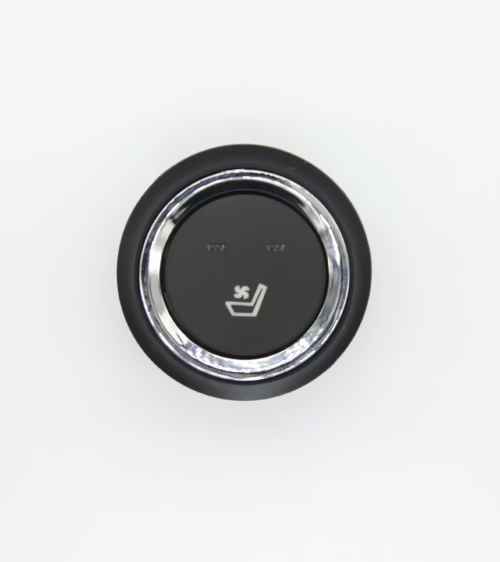
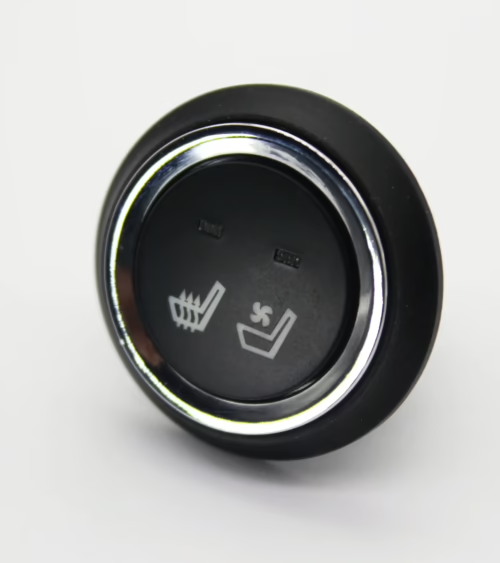
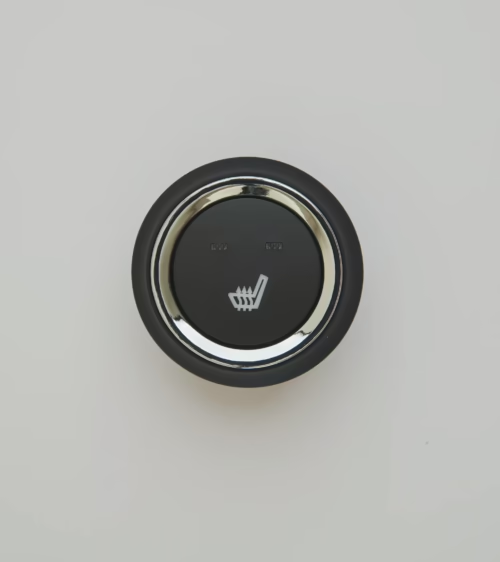
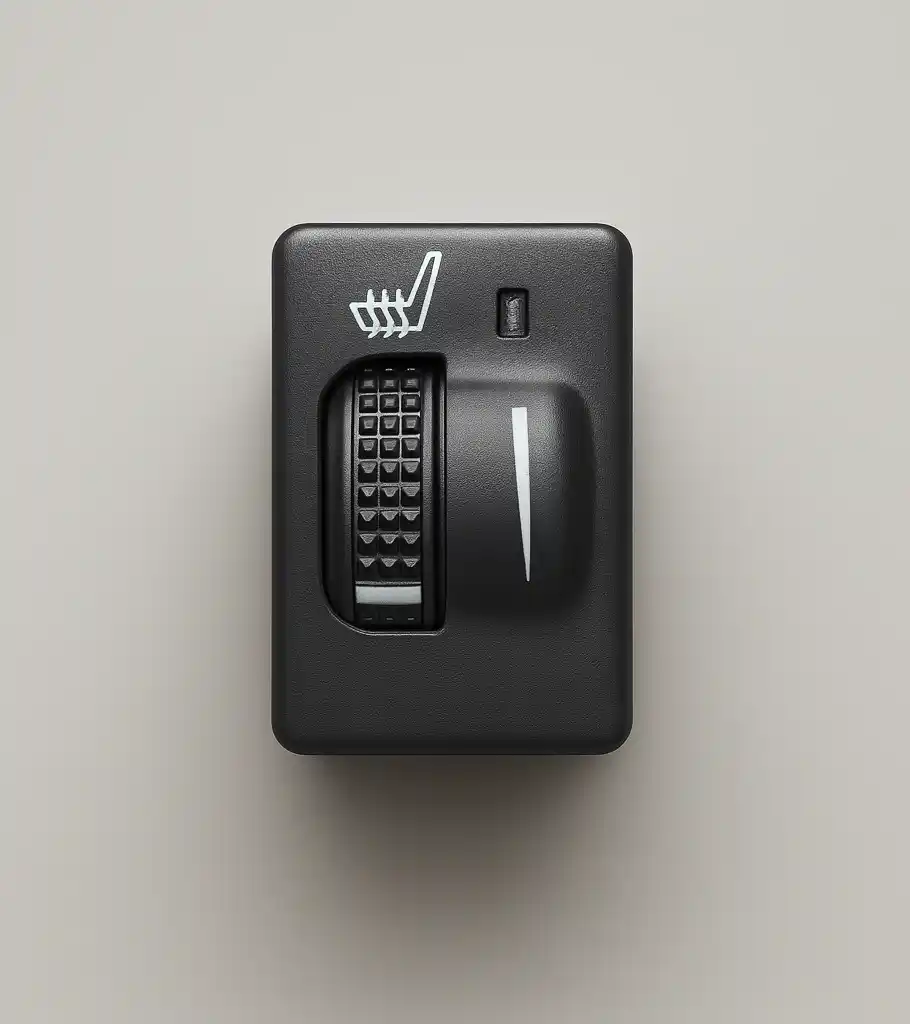
For multi-level systems, the switch is usually a two- or three-position momentary or latching unit that communicates level to the module either by resistance ladder or discrete signal lines.
When retrofitting a carbon pad into a vehicle with an existing factory heater, confirm that the original switch output is compatible with the new module, or select a module and switch as a matched pair from our seat heater switch catalog to avoid signal mismatch.
Thermistor placement on the pad also matters. The sensor should sit under the occupant’s thigh contact zone, roughly 100 to 150 mm forward of the seat back, and should be bonded to the pad rather than floating in the foam.
A sensor placed at the pad edge will read low and allow the center to overheat.
6. Installation Considerations for Foam and Trim
Carbon fiber pads are thinner than most wire pads, usually 0.6 to 1.0 mm versus 1.2 to 2.0 mm, and they conform more easily to contoured foam. That flexibility brings its own rules.
The pad must not be folded sharply over a bolster edge, because a crease compresses the fiber bundles against the bus bar and can create a high-resistance point. A minimum bend radius of about 15 mm is a safe working guideline.
Key installation practices:
- Trim the pad only in designated cut zones marked by the manufacturer. Cutting across a bus bar or through the sensor lead ruins the pad.
- Use the supplied pressure-sensitive adhesive or a foam-compatible spray adhesive. Solvent-based contact cement can attack the non-woven carrier.
- Route the lead wire along the foam trench toward the seat frame connector, with the strain relief anchored before the first bend.
- Keep the pad clear of seat occupancy sensor mats and side airbag deployment paths. Overlapping a heater on an occupant classification mat can change its calibration.
For perforated leather or ventilated seats, a carbon fiber pad is the preferred choice because the open weave allows airflow through the element. Wire pads on fleece carriers block ventilation and force an air gap that reduces heating efficiency.
7. Cost, Sourcing, and Where Carbon Fiber Makes Sense
A carbon fiber seat heater pad typically costs 20 to 40 % more than an equivalent wire pad at OEM volumes, with the gap narrowing on premium wire designs that use fine-stranded alloy on woven carriers.
The premium buys uniformity, ventilation compatibility, and a lower risk of the single-point fracture failure that drives most warranty returns on wire products.
Carbon fiber is the better choice when the seat has perforated trim or active ventilation, when the program targets a low peak-temperature validation limit, or when the foam contour requires a very thin element.
Wire elements remain competitive for base-trim seats, rear seats with low cycle counts, and cost-driven aftermarket kits.
Whichever direction you take, buy from a supplier who can provide resistance data by lot, cycling test reports, and matched control modules.
Distributors and installers can browse our full range of seat heating pads, modules, and kits to compare carbon fiber and wire options side by side with published specifications.
Frequently Asked Questions
Can a carbon fiber seat heater pad be repaired if it stops working?
Usually not in the field. Because the element is a parallel array, a single broken filament does not cause failure. When a carbon pad goes dead, the cause is almost always an open bus bar joint or a broken lead wire at the strain relief.
Bus bar repairs require re-crimping under controlled pressure and are not reliable when done by hand. Replacing the pad is the correct fix.
Is a carbon fiber pad safer than a wire pad?
Both types are safe when paired with a properly designed control module and thermostat. Carbon pads have a lower peak surface temperature and no single hot wire, which reduces the risk of localized heat concentration.
However, they lack the self-limiting resistance rise of alloy wire, so they depend on the module to cap temperature. Never operate any seat heater pad without a thermostat or closed-loop control.
Will a carbon fiber pad work with my existing factory seat heater switch?
The pad itself does not care what switch is used, but the control module does. If you are replacing only the pad and keeping the factory module, match the resistance and wattage of the original element within about 10 %.
If you are replacing the module as well, confirm the switch signal type matches the new module, or replace the switch and module together as a matched set.
Work With Lucky Driver Inc.
Lucky Driver Inc. supplies carbon fiber and wire seat heater pads, seat heater switches, control modules, and seat ventilation systems to OEM seat manufacturers and aftermarket distributors across North America. Every pad ships with lot-level resistance data and is compatible with our closed-loop control modules.
Contact our team to request samples, specification sheets, or volume pricing for your next seat heating program.
Related Articles
- Carbon Fiber vs Wire Seat Heater: 7 Key Differences (2026)
- Seat Heater Temperature Sensor: 7 Facts Every Buyer Needs (2026)
- Heated Seat Thermostat Replacement: 7 Steps (2026 Guide)
- Seat Heater Pad Replacement: 8 Steps for a Lasting Fix (2026)
- Seat Heater Element Repair: 7 Steps to Fix a Dead Pad (2026)
Frequently Asked Questions About carbon fiber seat heater pad
Procurement engineers evaluating carbon fiber seat heater pad for OEM programs regularly ask the following questions. Answers cover specification, compatibility, certification, and sourcing for carbon fiber seat heater pad requirements.
What voltage ratings are available for carbon fiber seat heater pad?
Standard carbon fiber seat heater pad configurations support 12 V DC for passenger vehicles and 24 V DC for commercial trucks. Selecting the correct carbon fiber seat heater pad voltage at the design stage eliminates harness rework later.
Lucky Driver maintains carbon fiber seat heater pad inventory in both ratings for same-week shipment.
Which certifications apply to carbon fiber seat heater pad production?
carbon fiber seat heater pad assemblies entering OEM programs typically require UL recognition, REACH compliance, and RoHS documentation. Lucky Driver holds certification records for every carbon fiber seat heater pad variant and includes copies with sample and production shipments.
How is watt density specified for carbon fiber seat heater pad?
Watt density for carbon fiber seat heater pad is expressed in W/cm² and ranges from 0.04 to 0.12 depending on heat-up time requirements. Lower watt density carbon fiber seat heater pad designs improve element longevity, while higher values suit cold-climate applications.
Lucky Driver engineering reviews carbon fiber seat heater pad requirements and recommends watt density based on your seat platform.
What connector families are used with carbon fiber seat heater pad?
carbon fiber seat heater pad harnesses are available with Molex, TE Connectivity, and Delphi connector families. Matching the carbon fiber seat heater pad connector to the vehicle harness reduces assembly time and eliminates adapter cables.
Specify your harness format when requesting a carbon fiber seat heater pad quote from Lucky Driver.
What is the lead time for carbon fiber seat heater pad samples?
carbon fiber seat heater pad samples from Lucky Driver’s North American warehouse ship within 3 to 5 business days for standard configurations. Custom carbon fiber seat heater pad variants with modified pad geometry or connector pinouts require 4 to 6 weeks.
Contact Lucky Driver to confirm carbon fiber seat heater pad availability before submitting your engineering schedule.