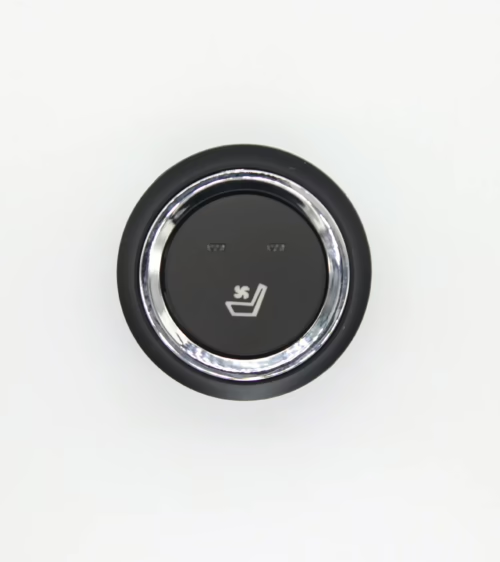
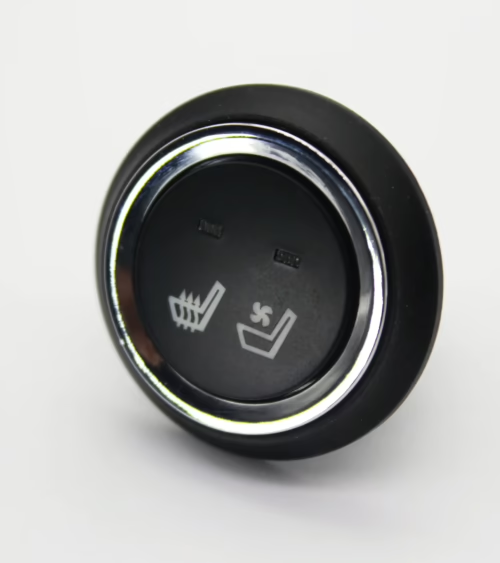
Heavy-duty trucks, transit buses, agricultural tractors and many off-highway machines run 24-volt electrical systems, and that single fact changes almost everything about how a seat heater must be specified. A 24V seat heater truck installation cannot simply reuse a 12V passenger-car pad:
- the element resistance
- current draw
- switch rating
- thermal protection and wiring all have to be engineered for the higher system voltage and for the harsher duty cycle of a commercial cab. This guide walks through the seven specifications that OEM seat manufacturers
- fleet upfitters and aftermarket distributors should confirm before sourcing a 24V seat heating system.
Why Commercial Trucks Use 24V Systems
Heavy trucks in Europe, Asia and most military and vocational fleets standardize on 24V because it halves the current required for a given load compared with 12V. Starter motors on large diesel engines, air-brake compressors and long cable runs all benefit from lower current:
- thinner conductors
- less voltage drop and smaller connectors. In North America most Class 8 tractors remain 12V
- but 24V is common in transit buses
- construction and mining equipment
- imported cab-over trucks.
A “24V” system is not a steady 24 volts. With the alternator charging, bus voltage typically sits between 27.5 and 28.5 volts, and transients during load dump can be considerably higher.
A seat heater rated at nominal 24V must tolerate that entire range without overheating, which is why the specifications below are framed around real operating voltage rather than the nameplate figure.
1. Element Resistance Must Be Designed for 24V
Seat heater output follows the relationship P = V²/R, the principle described in the Wikipedia article on Joule heating. Doubling the voltage across a fixed resistance quadruples the power.
A 12V cushion pad rated at 45 watts has a resistance of about 3.2 ohms; connect it to a 24V bus and it will try to dissipate roughly 180 watts, far beyond what its carrier fabric, adhesive and seat foam can survive.
The result is scorched foam, melted insulation or an open element within minutes.
A properly designed 24V pad delivering the same 45 watts uses an element of about 12.8 ohms. At 28V charging voltage that same pad rises to roughly 61 watts, so the controller and thermal limits must be designed around the upper end of the operating band.
Buyers should ask suppliers for the measured cold resistance and its tolerance, typically plus or minus 5 to 10 percent, and should confirm the value was designed for 24V nominal rather than reverse-calculated from an existing 12V layout.
2. Power Rating and Current Draw per Seat
Typical truck seat heaters deliver 40 to 60 watts for the cushion and 30 to 45 watts for the backrest in high mode. At 24V that means only about 1.7 to 2.5 amps per seat, compared with 3.5 to 5 amps for an equivalent 12V system. The lower current is an advantage:
- 18 AWG wire is usually sufficient for the heater branch circuit
- connector contacts run cooler
- voltage drop along a long cab harness becomes negligible.
Lower current also means fusing must be chosen carefully. A fuse sized for normal 24V operation may not clear quickly if the element develops a partial short that only modestly raises current.
Many OEM specifications therefore call for a dedicated fuse per seat plus a controller with electronic overcurrent detection.
- Cushion pad: 40 to 60 W at 24 V nominal, roughly 10 to 14 ohms
- Backrest pad: 30 to 45 W at 24 V nominal, roughly 13 to 19 ohms
- Combined current per seat: about 3 A worst case at 28 V
- Branch wire: 18 AWG minimum, 16 AWG for harness runs over 3 meters
3. Element Type: Resistance Wire vs Carbon Fiber at 24V
Both alloy resistance wire and carbon fiber elements are used in 24V truck applications. Wire elements, usually a copper-nickel or nickel-chromium alloy with a polyester or fabric insulation, are stitched in a serpentine pattern onto a non-woven carrier.
Their resistance is set by alloy, gauge and total path length, which makes it straightforward to hit a 24V target by lengthening the run or selecting a finer conductor.
Carbon fiber elements use bundles of carbon filament laid between two bus bars.
They spread heat evenly and tolerate flexing well, but the layout must be redesigned for 24V; a carbon pad tuned for 12V will produce too little heat if simply rewired in series and far too much if left in parallel.
For heavy-duty seats with deep bolsters and high occupant loads, wire elements remain the most common choice because a break is easier to detect during end-of-line testing and easier to localize in the field.
4. Temperature Control and Thermal Protection
Truck cabs see extreme ambient conditions, from minus 40°C during winter idling to interior soak temperatures above 70°C in summer. A 24V seat heater needs two layers of protection. The first is a regulating element:
- either a bimetal thermostat embedded in the pad that cycles the circuit at a set point
- or an NTC thermistor feeding a controller that regulates output through pulse-width modulation. The second is a non-resettable thermal fuse or a controller cutoff that opens if the pad exceeds a safe surface temperature
- typically in the 45 to 55°C range at the seat surface.
PWM control is particularly valuable on 24V systems because it compensates for the voltage swing between engine-off and charging. A controller that measures bus voltage and adjusts duty cycle can hold a consistent surface temperature whether the alternator is delivering 24 or 28.5 volts.
Buyers should confirm the controller’s rated input range, ideally 18 to 32V DC, and its behavior under a load-dump transient.
Prolonged low-temperature exposure is also a safety consideration.
Skin can be injured by sustained contact with a surface that feels only warm, so a well-designed truck seat heater limits maximum surface temperature and includes an automatic shutoff timer, commonly 30 to 60 minutes, rather than relying on the driver to switch it off during a long haul.
5. Switch and Controller Rated for 24V
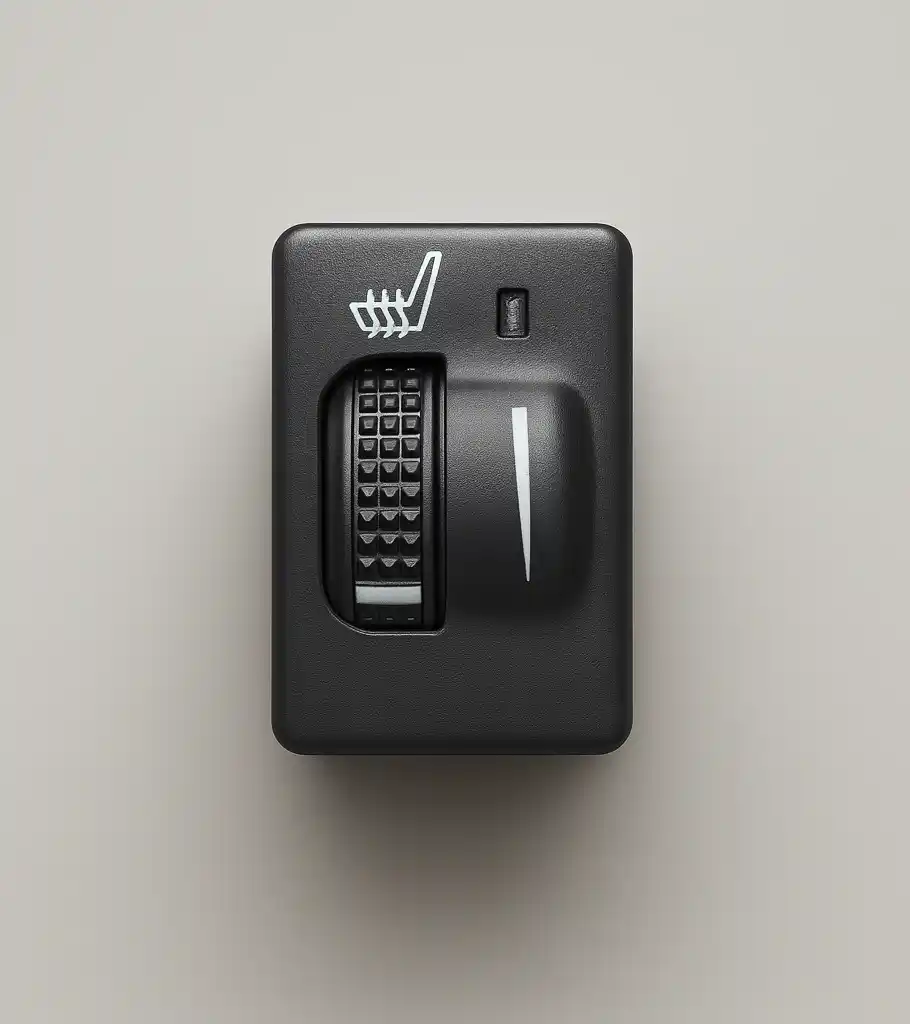
The rocker or push-button switch in a 24V system carries less current than its 12V counterpart, but its contacts and illumination must be rated for the higher voltage.
A 12V LED indicator wired directly to a 24V bus will fail almost immediately unless a series resistor or regulated supply is included, and contacts need greater clearance to avoid arcing when breaking the load.
When sourcing 24V-compatible seat heater switches, confirm the illumination voltage, the contact rating in amps at 28V DC, and whether the switch sends a low-current signal to a relay or controller instead of carrying the heater current directly.
For fleet applications, a two-stage or three-stage switch that returns to off after key-off is preferred, so the heater does not restart automatically at every engine start and drain the battery during short stops.
Some OEM specifications also require the switch to integrate with the control panel on air-suspension seats, where space and harness routing are already constrained.
6. Durability for Air-Suspension and Vocational Seats
Commercial truck seats are used far more intensively than passenger-car seats. A long-haul driver may sit for 10 to 11 hours a day, an air-suspension seat travels vertically several centimeters on every bump, and drivers enter and exit the cab dozens of times per shift.
The heating pad, its lead wires and the strain relief at the connector must survive this without fatigue failure.
Key durability specifications include flex-cycle testing, commonly 100,000 to 200,000 cycles, pull strength on the lead wire exit, resistance stability after thermal cycling, and abrasion resistance where the pad passes over seat frame edges.
Because the cushion on many trucks is a replaceable service item, the pad should be attached to the foam or trim in a way that allows the seat to be retrimmed without damaging the element or its sensor.
7. Testing and Documentation to Request from Suppliers
Before approving a 24V seat heater for production, request a documentation package that includes cold resistance at 20°C, measured power at 24V and 28V, surface temperature mapping after 30 minutes, thermal cutoff trip temperature, flex-cycle results, and a materials declaration for the carrier, adhesive and insulation.
Ask for evidence of testing against automotive electrical standards such as ISO 16750 for voltage range and load dump, and for flammability data on the pad substrate.
If the seat program will be offered in both North American 12V and export 24V configurations, confirm the supplier can deliver both voltages with an identical mechanical footprint so trim tooling and foam do not change.
Distributors who browse a range of seat heating pads, switches and control modules should verify that voltage is stated clearly on every part number to prevent mixed shipments reaching installers.
Frequently Asked Questions
Can I use a 12V seat heater pad in a 24V truck with a voltage reducer?
A DC-DC converter can step 28V down to 13.8V, but it adds cost, heat and another failure point, and it must be rated for the full heater current of every seat it feeds.
For a production or fleet application it is simpler and safer to specify a pad designed for 24V from the start.
Will a 24V pad work in a 12V vehicle?
It will operate, but at one quarter of its rated power. A 45W pad delivers only about 11W at 12V and will feel barely warm. The two voltages are not interchangeable in either direction without redesigning the element.
How long should a 24V truck seat heater take to warm up?
A well-matched pad should be noticeably warm at the seat surface within 2 to 3 minutes and reach its regulated set point within 5 to 8 minutes at minus 20°C ambient. Faster warm-up requires higher power, which increases the demands placed on thermal protection and surface temperature limits.
Lucky Driver Inc. supplies seat heating pads, seat heater switches, control modules and seat ventilation systems to OEM seat manufacturers and aftermarket distributors across North America.
If you are developing a truck, bus or off-highway seat program and need heating components engineered for the correct system voltage, contact Lucky Driver Inc. to discuss specifications, samples and volume requirements for your 24V application.
Related Articles
- 12V Seat Heater Pad: 7 Specs Every Buyer Must Check (2026)
- Seat Heater Element Resistance: 7 Facts for Buyers (2026)
- Carbon Fiber Seat Heater Pad: 7 Facts Buyers Need (2026)
- Carbon Fiber vs Wire Seat Heater: 7 Key Differences (2026)
- Seat Heater Temperature Sensor: 7 Facts Every Buyer Needs (2026)
Frequently Asked Questions About 24v seat heater truck
Procurement engineers evaluating 24v seat heater truck for OEM programs regularly ask the following questions. Answers cover specification, compatibility, certification, and sourcing for 24v seat heater truck requirements.
What voltage ratings are available for 24v seat heater truck?
Standard 24v seat heater truck configurations support 12 V DC for passenger vehicles and 24 V DC for commercial trucks. Selecting the correct 24v seat heater truck voltage at the design stage eliminates harness rework later. Lucky Driver maintains 24v seat heater truck inventory in both ratings for same-week shipment.
Which certifications apply to 24v seat heater truck production?
24v seat heater truck assemblies entering OEM programs typically require UL recognition, REACH compliance, and RoHS documentation. Lucky Driver holds certification records for every 24v seat heater truck variant and includes copies with sample and production shipments.
How is watt density specified for 24v seat heater truck?
Watt density for 24v seat heater truck is expressed in W/cm² and ranges from 0.04 to 0.12 depending on heat-up time requirements. Lower watt density 24v seat heater truck designs improve element longevity, while higher values suit cold-climate applications.
Lucky Driver engineering reviews 24v seat heater truck requirements and recommends watt density based on your seat platform.
What connector families are used with 24v seat heater truck?
24v seat heater truck harnesses are available with Molex, TE Connectivity, and Delphi connector families. Matching the 24v seat heater truck connector to the vehicle harness reduces assembly time and eliminates adapter cables. Specify your harness format when requesting a 24v seat heater truck quote from Lucky Driver.
What is the lead time for 24v seat heater truck samples?
24v seat heater truck samples from Lucky Driver’s North American warehouse ship within 3 to 5 business days for standard configurations. Custom 24v seat heater truck variants with modified pad geometry or connector pinouts require 4 to 6 weeks.
Contact Lucky Driver to confirm 24v seat heater truck availability before submitting your engineering schedule.