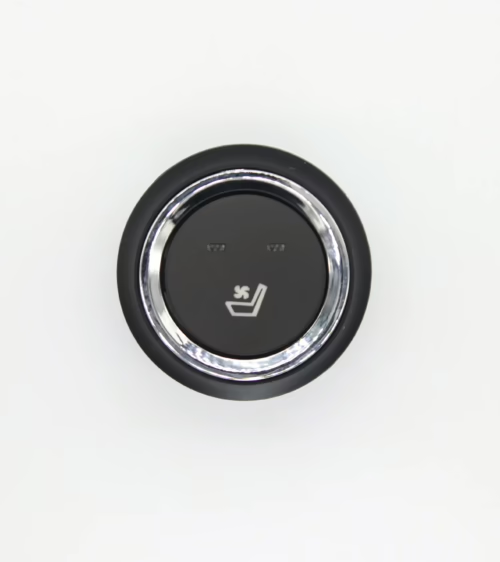
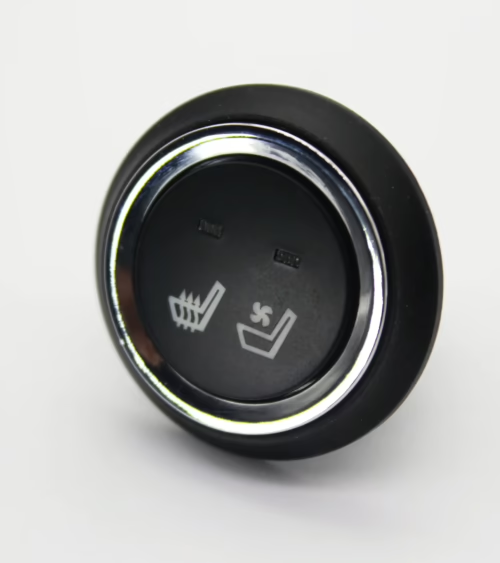
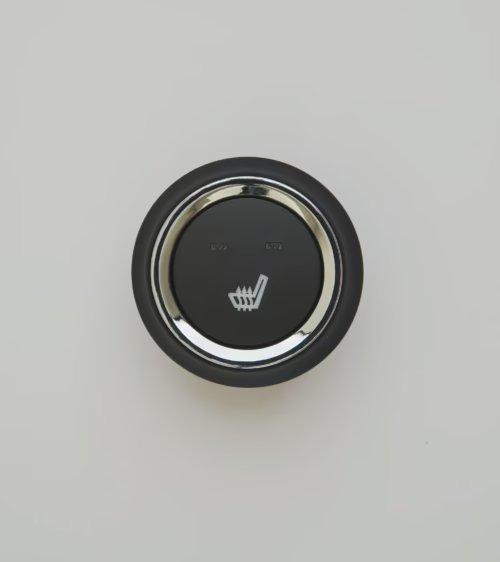
Getting seat heater amp draw right is the difference between a heating system that warms a cushion in ninety seconds and one that melts a connector, pops a fuse on every cold morning, or drags an idling alternator into brownout.
Current draw is not a single published number — it shifts with supply voltage, element resistance, ambient temperature, control strategy, and how many seats share a feed.
This guide walks through the seven numbers that actually govern current in a seat heating circuit, the math behind each one, and how to verify them on the bench before a design goes into production.
What Seat Heater Amp Draw Actually Measures
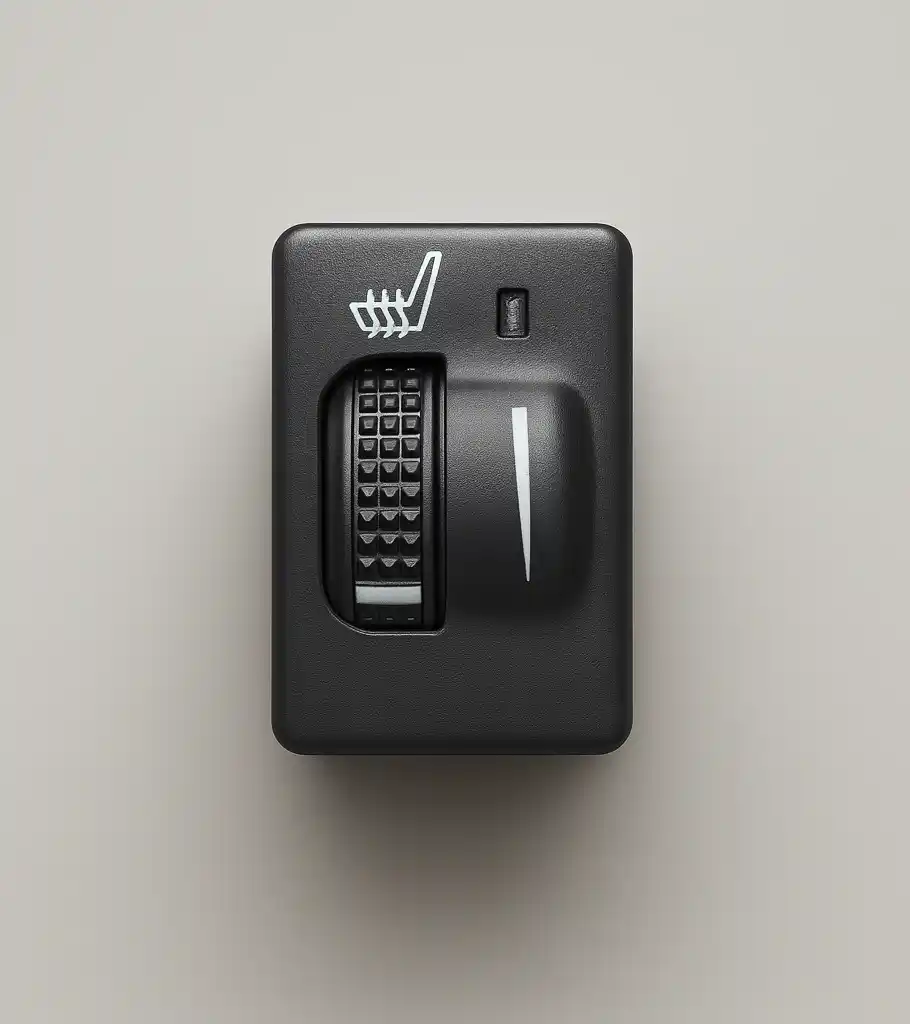
Amp draw is the current a heating pad and its control electronics pull from the vehicle’s electrical system while the heater is energized. It matters because every downstream component — the switch contacts, the relay or MOSFET, the wiring harness, the fuse, and ultimately the alternator — is sized against it.
Confusion usually starts because three different currents get quoted interchangeably:
- Peak (cold) current: what flows in the first seconds after switch-on, when the element is at ambient temperature and its resistance is at its lowest.
- Steady-state current: what flows once the element reaches operating temperature and resistance has risen.
- Average current: what the vehicle actually sees over a drive cycle, after the thermostat or PWM module has begun cycling the element.
Fuse and wire sizing must respect peak current. Alternator load budgets and battery drain estimates should use average current. Quoting one where the other belongs is the single most common specification error we see in incoming RFQs.
Typical Amp Draw for 12V and 24V Seat Heating Pads
A conventional passenger-car seat heater set consists of two pads — one in the cushion, one in the backrest — wired in parallel or in series depending on the design. On a 12V system, well-designed pads land in these ranges on the high setting:
- Cushion pad alone: 25–45 W, roughly 2.0–3.5 A
- Backrest pad alone: 20–35 W, roughly 1.6–2.8 A
- Complete single-seat set: 45–80 W, roughly 3.5–6.5 A
- Both front seats on high: 90–160 W, roughly 7–13 A
Note that these currents are calculated at a nominal 12 V, but a running vehicle sits at 13.8–14.4 V. That is a 15–20% voltage increase, which raises current proportionally and raises power by the square of the ratio.
A pad specified at 48 W on 12 V will dissipate roughly 65 W at 14 V and pull about 4.6 A instead of 4.0 A. Always size protection to the charging voltage, not the nominal one.
For 24V commercial trucks and buses, the same thermal output arrives at half the current. A 60 W seat set draws about 5 A at 12 V but only about 2.5 A at 24 V, which is why heavy-duty harnesses can run thinner gauge for the same heat.
The trade-off is that a 24V element needs roughly four times the resistance to deliver the same wattage, which changes the wire alloy, gauge, and circuit length inside the pad itself.
How Element Resistance Sets the Current
Every number above traces back to Ohm’s law and the resistance designed into the element. Current equals voltage divided by resistance, and power equals voltage squared divided by resistance — the relationship described in detail in this reference on Ohm’s law. In practice this gives a designer a simple lever:
- to change amp draw
- change resistance.
A worked example. A cushion pad built to 3.0 Ω at room temperature pulls 4.0 A at 12 V and dissipates 48 W. Raise the element to 4.0 Ω and it pulls 3.0 A for 36 W — a gentler, slower heater with a longer harness life.
Drop it to 2.4 Ω and it pulls 5.0 A for 60 W, heating fast but pushing much closer to the limits of an 18 AWG feed.
Two pads matter here as well. Wiring cushion and backrest in parallel means total current is the sum of both, and each pad sees full system voltage — fast, but the highest draw.
Wiring them in series halves the voltage across each pad and cuts total current dramatically, but heat output falls to roughly a quarter. Many two-stage systems exploit exactly this:
- series connection for the low setting
- parallel for high
- with no PWM electronics required.
Inrush, Cold Soak, and Why Measured Amps Drift
Heating elements do not have a fixed resistance. Copper and copper-alloy resistance wire has a positive temperature coefficient of roughly 0.39% per °C.
A pad measured at 3.0 Ω on a 22 °C bench will measure closer to 2.8 Ω after a night at −15 °C, so first-switch-on current in a cold-soaked vehicle can run 10–15% above the room-temperature figure.
Carbon fiber elements behave similarly but with a milder slope, and elements with deliberate PTC behavior self-limit more aggressively as they warm.
This is why a heater that tests clean in a warm QC room can nuisance-blow a marginally sized fuse in a Minnesota January. The practical rule:
- measure resistance at the coldest expected ambient
- calculate current at the highest expected charging voltage
- size protection against that worst-case pair. There is no meaningful magnetic inrush to worry about — a resistive pad has negligible inductance — so the cold resistance figure is the whole story.
Switch, Relay, and Module Current Ratings
The control path has to carry whatever the element pulls. A seat set drawing 5–6 A must not be run through a 3 A rocker switch, yet this is a routine failure mode in low-cost aftermarket kits:
- the contacts arc
- resistance builds at the contact face
- the switch runs hot
- the assembly eventually welds shut or fails open. Properly rated seat heater switches with the correct contact rating should carry at least 1.5× the calculated peak current
- with a rating stated at 14 V DC rather than at an AC figure that does not apply here.
For dual-seat systems or anything above roughly 10 A, the switch should be a signal-level device driving a relay or a solid-state module rather than carrying load current itself. A standard 30 A automotive mini relay handles a two-seat load comfortably.
Electronic control modules add PWM dimming, timed shutoff, and NTC thermistor feedback — and they draw a small quiescent current of their own, typically 5–30 mA, which belongs in any parasitic drain calculation.
Wire Gauge and Fuse Sizing for Seat Heater Circuits
Two constraints govern conductor selection: thermal capacity and voltage drop. Voltage drop is usually the binding one, because a 12V system has so little headroom. Keeping drop under about 3% (roughly 0.4 V) preserves rated heat output; a 1 V drop on a 48 W pad costs nearly 15% of its power.
- Up to 5 A, runs under 3 m: 18 AWG is adequate
- 5–10 A, or longer runs: 16 AWG
- 10–15 A dual-seat feed: 14 AWG
- Above 15 A: 12 AWG, with a dedicated relay feed from the battery or main junction
Fuse at roughly 125–150% of calculated peak current, then round up to the nearest standard value:
- a 5 A single-seat load takes a 7.5 A fuse
- a 12 A dual-seat load takes a 15 A fuse. Fusing far above that defeats the purpose — the fuse exists to protect the harness
- not the heater. Also confirm ground return quality
- a corroded chassis ground adds series resistance that reduces current and heat while creating a hot spot exactly where nobody inspects.
Alternator Load, Battery Drain, and Multi-Seat Systems
A single pair of front seat heaters on high adds 90–160 W to the electrical load — noticeable but rarely a problem on a modern 120 A+ alternator. The stress case is a cold start with everything on at once:
- seat heaters
- rear defroster (150–200 W)
- blower motor at maximum (150–250 W)
- headlights
- heated mirrors. At idle
- alternator output can fall well below its rated figure
- the combined load may exceed it
- discharging the battery until engine speed rises.
This is why OEM systems rarely run heaters at 100% duty. A thermostat or PWM controller typically settles into a 40–60% duty cycle once the setpoint is reached, cutting sustained load roughly in half. Add rear-seat heaters and the arithmetic changes again:
- four seats on high can approach 300 W
- which deserves a dedicated relay-fed circuit rather than a tap into an existing accessory feed. For vehicles where seats are heated with the engine off
- remember that a 10 A draw on a typical 60 Ah battery is a meaningful discharge rate
- a timed shutoff module is worth specifying.
How to Measure Amp Draw Correctly
Do not trust the label. Measure it, in this order:
- Cold resistance first. With the pad disconnected and at room temperature, measure across the element with a four-wire meter if available; a standard multimeter’s lead resistance can be a meaningful error on a 3 Ω load, so null the leads first.
- Calculate expected current at 14.4 V, not 12 V.
- Verify with a clamp meter on the feed wire during a live run, logging over ten minutes so you capture the initial peak and the settled value.
- Measure voltage at the pad connector under load, not at the battery, to catch harness losses.
- Record ambient temperature with every result. Undocumented current figures are not comparable between labs.
Documenting cold resistance, peak current at charging voltage, and settled average current gives a complete, auditable picture — and it is the data set we ask for whenever a customer’s existing heater is being cross-referenced against a replacement.
If you are specifying a new system, you can browse our full range of seat heating products to compare wattage and current figures across pad constructions.
Frequently Asked Questions
How many amps does a typical car seat heater draw? A complete single-seat set — cushion plus backrest — generally draws 3.5 to 6.5 A on a 12V system at the high setting, corresponding to roughly 45–80 W. Both front seats together land between 7 and 13 A.
At 24 V, currents are roughly halved for equivalent heat output.
What size fuse should a seat heater use? Size the fuse at 125–150% of the peak current measured at charging voltage, then round up to a standard value. A 5 A single-seat load takes a 7.5 A fuse; a 12 A dual-seat load takes a 15 A fuse.
The fuse protects the harness, so it must also be matched to the wire gauge — never install a 20 A fuse on an 18 AWG run.
Why does my seat heater draw more current when it is cold outside? Element resistance falls as temperature drops, at roughly 0.39% per °C for copper-alloy wire. A pad measured at 3.0 Ω on a warm bench may sit near 2.8 Ω after a cold soak, which raises first-switch-on current by 10–15%.
The draw settles back to its nominal figure as the element warms.
Specifying a seat heating system means committing to a current budget before the harness is cut, and that budget has to survive cold soak, high charging voltage, and every accessory running at idle.
Lucky Driver Inc. supplies seat heating pads, switches, control modules, and ventilation systems to OEM seat manufacturers and aftermarket distributors across North America, with documented resistance and current data for every part we ship.
Send us your voltage, target wattage, and pad dimensions, and our engineering team will return a specification with verified amp draw figures — measured, not estimated.
Related Articles
- 24V Seat Heater for Trucks: 7 Specs to Get Right (2026)
- 12V Seat Heater Pad: 7 Specs Every Buyer Must Check (2026)
- Seat Heater Element Resistance: 7 Facts for Buyers (2026)
- Carbon Fiber Seat Heater Pad: 7 Facts Buyers Need (2026)
- Carbon Fiber vs Wire Seat Heater: 7 Key Differences (2026)
Frequently Asked Questions About seat heater amp draw
Procurement engineers evaluating seat heater amp draw for OEM programs regularly ask the following questions. Answers cover specification, compatibility, certification, and sourcing for seat heater amp draw requirements.
What voltage ratings are available for seat heater amp draw?
Standard seat heater amp draw configurations support 12 V DC for passenger vehicles and 24 V DC for commercial trucks. Selecting the correct seat heater amp draw voltage at the design stage eliminates harness rework later. Lucky Driver maintains seat heater amp draw inventory in both ratings for same-week shipment.
Which certifications apply to seat heater amp draw production?
seat heater amp draw assemblies entering OEM programs typically require UL recognition, REACH compliance, and RoHS documentation. Lucky Driver holds certification records for every seat heater amp draw variant and includes copies with sample and production shipments.
How is watt density specified for seat heater amp draw?
Watt density for seat heater amp draw is expressed in W/cm² and ranges from 0.04 to 0.12 depending on heat-up time requirements. Lower watt density seat heater amp draw designs improve element longevity, while higher values suit cold-climate applications.
Lucky Driver engineering reviews seat heater amp draw requirements and recommends watt density based on your seat platform.
What connector families are used with seat heater amp draw?
seat heater amp draw harnesses are available with Molex, TE Connectivity, and Delphi connector families. Matching the seat heater amp draw connector to the vehicle harness reduces assembly time and eliminates adapter cables. Specify your harness format when requesting a seat heater amp draw quote from Lucky Driver.
What is the lead time for seat heater amp draw samples?
seat heater amp draw samples from Lucky Driver’s North American warehouse ship within 3 to 5 business days for standard configurations. Custom seat heater amp draw variants with modified pad geometry or connector pinouts require 4 to 6 weeks.
Contact Lucky Driver to confirm seat heater amp draw availability before submitting your engineering schedule.