Buyers sourcing wholesale heated seat kits in 2026 face a market where two kits can look identical in a product photo and behave nothing alike after 300 heat cycles. The differences are not cosmetic.
Element construction, thermistor placement, fuse sizing, and connector choice determine whether a kit warms a seat in 90 seconds or 4 minutes, and whether it survives three winters or fails in the first one.
This guide walks through the seven specifications that distinguish a sound wholesale program from a cheap one, written for seat manufacturers, upfitters, and distributors who carry the warranty risk rather than for end consumers installing a single kit.
1. Heating Element Construction: Carbon Fiber vs. Alloy Wire
Nearly all heated seat kits use one of two element types. Alloy resistance wire — typically a nickel-chromium or copper-nickel filament stitched or taped onto a non-woven carrier — has been the OEM standard for decades.
It delivers predictable resistance, tolerates known failure modes, and is easy to repair in a trim shop.
Carbon fiber ribbon spreads heat over a wider surface and feels less like discrete hot lines through thin leather, but it is more sensitive to creasing and to abrasion at the seat bolster.
The decision usually comes down to the seat itself. Flat, lightly contoured cushions with thick foam tolerate either.
Aggressive bucket seats with tight bolster radii and perforated leather favor alloy wire laid out in a pattern engineered around the stitch lines, because a carbon ribbon forced around a sharp radius develops stress points. Ask any supplier for the actual element layout drawing, not a generic illustration.
2. Power Draw, Wire Gauge, and Fuse Coordination
A two-seat kit running both cushions and both backrests on high typically pulls 8 to 12 amps at 13.8 volts. That number drives everything downstream.
Each pad should be specified with a nominal resistance and a tolerance band — commonly 1.8 to 3.0 ohms per element depending on wattage target — so that you can calculate load rather than trust a marketing figure.
Check three things in the harness:
- conductor gauge on the main feed
- fuse rating
- where the fuse sits. An 18 AWG feed protected by a 15-amp fuse is a mismatch
- the wire becomes the fuse. Look for 16 AWG or heavier on the supply leg
- an inline blade fuse within 150 mm of the power tap
- a ground ring terminal rather than a self-tapping screw. Kits that skimp here generate voltage-drop complaints that get blamed on the pads.
3. Temperature Control and Overheat Protection
Three control architectures dominate. A bimetallic snap-action thermostat bonded to the cushion element is the simplest and cheapest:
- it opens around 40 to 45 °C and closes again on cooldown
- producing a visible cycling pattern. A negative temperature coefficient sensor feeding a solid-state module gives smoother regulation and allows genuine multi-level output. Self-regulating positive temperature coefficient material limits its own current as it warms
- which is elegant but costly at seat scale.
If a supplier offers an NTC-based module, confirm the sensor curve and the module’s response to an open or shorted sensor; the correct behavior is to disable output, not to run at full power.
The underlying physics of thermistor behavior is well documented, but implementation quality varies enormously between vendors. Also ask whether a secondary thermal cutoff exists as a backstop. One sensing path with no redundancy is a single point of failure sitting directly under an occupant.
4. Switch Format, Mounting, and Control Modules
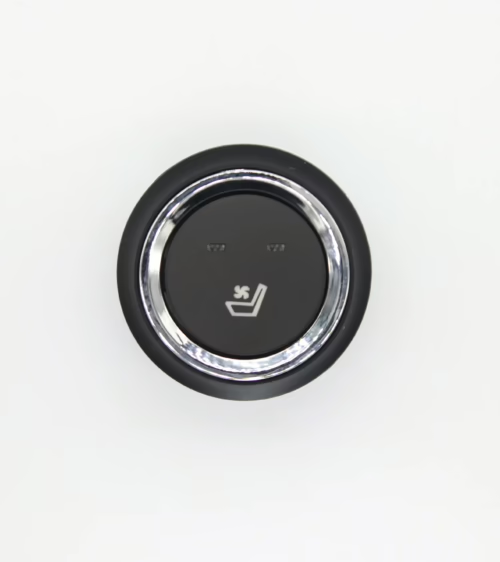
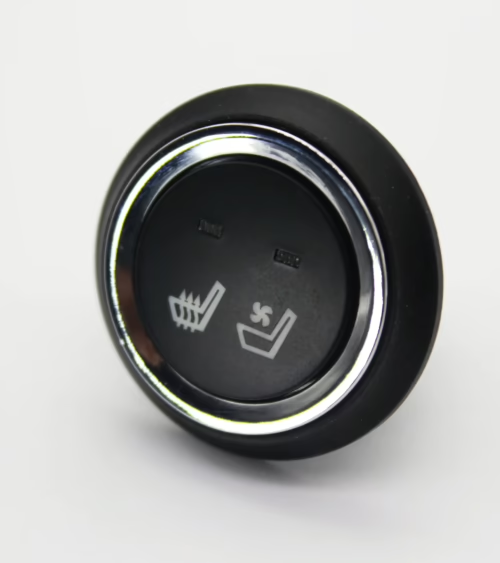
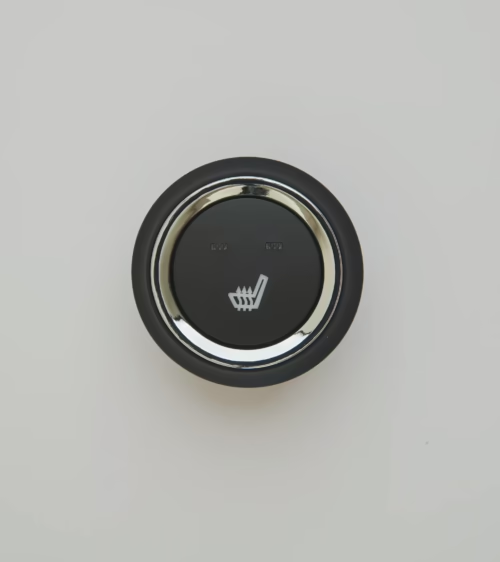
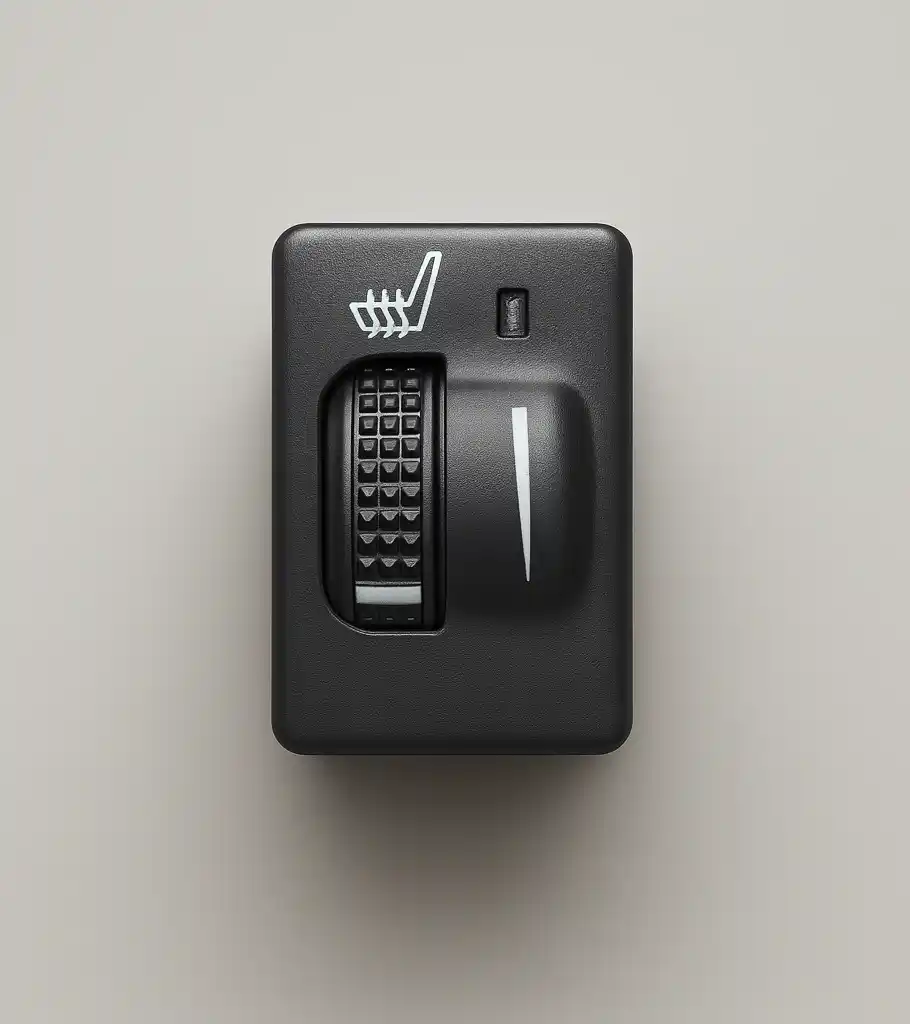
The switch is the only part of the kit the customer touches, and it generates a disproportionate share of returns. Decide early whether the program needs rocker switches, round bezel switches, flush-mount capacitive panels, or OEM-pattern switches that drop into a specific vehicle’s blank.
Each implies a different cutout, a different connector, and a different illumination approach — amber LED backlighting still reads as factory on most interiors, while white tends to look aftermarket.
Electrical ratings matter as much as appearance. A switch carrying full pad current directly needs a contact rating well above the measured load, whereas a low-current switch signaling a relay or module can be much smaller.
Many distributors keep replacement seat heater switches in stock separately from complete kits, because switches fail or get damaged during install far more often than elements do. Confirm that the switch is orderable as a standalone line item before committing to a kit SKU.
5. Certification, Testing, and Documentation to Request
For North American distribution, the practical document set includes material flammability test results, an ingress or moisture-resistance report for pads that will sit under a seat exposed to spills, electromagnetic compatibility results if a solid-state module is involved, and cycle-life data. Cycle-life is the one most often missing.
Ask for the number of on-off cycles tested, the temperature range, and whether the pad was flexed during testing or sat flat on a bench — a flat-bench result tells you very little about a driver’s seat.
Request the RoHS declaration and, if the kit ships to any program with recycled-content or substance reporting, the bill of materials at component level. Suppliers who cannot produce these quickly usually do not have them.
Build the document request into the RFQ rather than asking after the first container lands.
6. MOQ, Price Tiers, and Lead Time Reality
Wholesale heated seat pricing breaks at predictable volumes. Below roughly 100 sets you are buying stock configurations at close to retail-adjacent pricing. Between 100 and 500 sets, harness length, connector type, and switch style become negotiable.
Above 1,000 sets, element layout, pad dimensions, and packaging can be tooled to your specification, and per-set cost typically drops 25 to 40 percent from the low-volume tier.
Lead times deserve equal scrutiny. A stock kit from US inventory ships in days. A custom element pattern requires a sample round, a validation round, and then production — realistically eight to fourteen weeks before first delivery.
Distributors who need seasonal inventory for an October through March sell-through should place custom orders by late spring. Teams evaluating options can start by browsing available seat heating products and components to establish a baseline before specifying anything bespoke.
7. Installation Variables That Drive Warranty Claims
Most field failures trace back to installation, not manufacturing. The three recurring causes are element damage during trim removal, pads installed over an unsupported foam void so the element flexes with every entry, and harnesses routed through a seat frame pivot where repeated motion abrades insulation.
A good wholesale program reduces all three with pre-cut pad sizes that match common cushion dimensions, clear adhesive or hog-ring guidance, and a harness long enough to route around rather than through the frame.
Include a one-page install sheet in every carton and specify a pre-install resistance check — measure each pad before it goes under the cover, record the value, and measure again after installation. A changed reading catches a pinched element while the seat is still open on the bench.
That single step eliminates a large share of callbacks and gives you a defensible record when a claim arrives.
Frequently Asked Questions
How many amps does a typical heated seat kit draw? A single seat with cushion and backrest pads generally draws 4 to 6 amps on the high setting at 13.8 volts, so a two-seat kit lands between 8 and 12 amps.
Verify against the specific pad resistance rather than assuming, and size the circuit with headroom. Running both front seats on high with a marginal feed is where voltage-drop complaints originate.
Can heated seat pads be installed in perforated or ventilated leather seats? Yes, but element spacing and wattage per square inch have to be adjusted so that no individual wire sits directly beneath a perforation pattern where it can be felt or seen.
Combination heat-and-ventilation builds also need the heating element positioned so it does not block airflow channels. This is a case where a custom layout earns its tooling cost.
What warranty period is standard for wholesale heated seat kits? Twelve months is common at the low end and 24 to 36 months is achievable with validated components. More important than the stated term is what the supplier covers:
- pads only
- or pads plus switches
- modules
- harness. Get the exclusions in writing
- including whether installation-related damage voids coverage.
Work With a Supplier That Builds to Your Specification
Lucky Driver Inc. supplies seat heating pads, switches, control modules, and ventilation systems to OEM seat manufacturers and aftermarket distributors across North America, with both stock configurations for immediate shipment and custom element layouts engineered to your seat drawings.
If you are comparing wholesale heated seat kit programs for the 2026 season, send us your seat dimensions, target wattage, and switch requirements, and we will respond with a specification sheet, test documentation, and tiered pricing you can actually evaluate against competing quotes.
Related Articles
- Automotive Seat Heater Market: 7 Trends Shaping 2026
- Seat Heater OEM Supplier: 7 Criteria for 2026 Sourcing
- Seat Heater Manufacturer USA: 8 Factors to Check (2026)
- Heated and Cooled Seat Conversion: 7 Steps (2026)
- Seat Ventilation Kit Aftermarket: 7 Specs to Check (2026)
Frequently Asked Questions About wholesale heated seat kits
Procurement engineers evaluating wholesale heated seat kits for OEM programs regularly ask the following questions. Answers cover specification, compatibility, certification, and sourcing for wholesale heated seat kits requirements.
What voltage ratings are available for wholesale heated seat kits?
Standard wholesale heated seat kits configurations support 12 V DC for passenger vehicles and 24 V DC for commercial trucks. Selecting the correct wholesale heated seat kits voltage at the design stage eliminates harness rework later. Lucky Driver maintains wholesale heated seat kits inventory in both ratings for same-week shipment.
Which certifications apply to wholesale heated seat kits production?
wholesale heated seat kits assemblies entering OEM programs typically require UL recognition, REACH compliance, and RoHS documentation. Lucky Driver holds certification records for every wholesale heated seat kits variant and includes copies with sample and production shipments.
How is watt density specified for wholesale heated seat kits?
Watt density for wholesale heated seat kits is expressed in W/cm² and ranges from 0.04 to 0.12 depending on heat-up time requirements. Lower watt density wholesale heated seat kits designs improve element longevity, while higher values suit cold-climate applications.
Lucky Driver engineering reviews wholesale heated seat kits requirements and recommends watt density based on your seat platform.
What connector families are used with wholesale heated seat kits?
wholesale heated seat kits harnesses are available with Molex, TE Connectivity, and Delphi connector families. Matching the wholesale heated seat kits connector to the vehicle harness reduces assembly time and eliminates adapter cables. Specify your harness format when requesting a wholesale heated seat kits quote from Lucky Driver.
What is the lead time for wholesale heated seat kits samples?
wholesale heated seat kits samples from Lucky Driver’s North American warehouse ship within 3 to 5 business days for standard configurations. Custom wholesale heated seat kits variants with modified pad geometry or connector pinouts require 4 to 6 weeks.
Contact Lucky Driver to confirm wholesale heated seat kits availability before submitting your engineering schedule.