The automotive seat heater market has moved from a luxury-trim afterthought to a mainstream comfort system that appears on compact crossovers, work trucks, and virtually every battery-electric platform sold in North America.
What was once a dealer-installed accessory is now specified at the seat-assembly level, validated against OEM durability cycles, and increasingly bundled with ventilation and occupant detection.
For seat manufacturers, Tier 1 integrators, and aftermarket distributors, the practical question is no longer whether to offer heated seating but which element technology, control architecture, and supply arrangement will still be competitive in three model years.
The seven trends below outline where the demand is going and what it means technically.
1. Carbon Fiber Elements Are Displacing Copper-Alloy Wire
Traditional seat heating pads use a serpentine resistive wire — typically a copper-nickel or copper-tin alloy strand — stitched or bonded to a non-woven carrier. It is proven and inexpensive, but it has two chronic weaknesses:
- a single break anywhere along the circuit kills the entire zone
- the wire’s bending fatigue life limits how aggressively it can be routed around the cushion’s suspension and bolster contours.
Carbon fiber and carbon-coated polymer elements change that failure mode. Because current flows through many parallel filaments, localized damage reduces output slightly rather than producing an open circuit. They also tolerate tighter bend radii, which matters for thin-profile cushions and aggressively sculpted sport seats.
The trade-off is cost and process control:
- carbon elements require careful resistance-per-square-area tolerancing
- poor bonding leads to hot spots. Expect a split market through the decade — alloy wire holding the price-sensitive aftermarket and fleet segments
- carbon capturing premium and EV programs.
- Alloy wire: lowest piece cost, mature tooling, single-point failure risk
- Carbon fiber: graceful degradation, better flex life, higher cost and tighter process windows
- Printed/conductive ink: emerging, very thin, limited field history in automotive duty cycles
2. PTC Self-Regulation Is Becoming the Default Safety Layer
Thermal runaway on an occupied seat is the one failure the industry cannot tolerate, and regulators, insurers, and OEM quality teams all scrutinize it. The dominant engineering answer is layered protection:
- a thermal cutoff or resettable bimetallic switch as the hard limit
- an NTC sensor feeding closed-loop control
- increasingly a positive temperature coefficient element whose resistance rises with temperature so the pad throttles its own output. The underlying physics is simply the temperature dependence of resistance described by the thermistor behavior of the conductive material
- applied here as an inherent safety property rather than a measurement device.
Self-regulating elements are particularly valuable where heat extraction varies unpredictably — a heavy occupant compressing foam, a blanket or child seat laid across the cushion, or a pad partially covered by a seat cover.
Designs that rely only on a single remote NTC can read a comfortable 38 °C at the sensor while a covered zone climbs well past skin-tolerance limits. Specifying a PTC characteristic plus redundant sensing is now standard practice on serious programs.
3. EV Platforms Are Rewriting the Thermal Business Case
Cabin heating is the single largest auxiliary load on an electric vehicle in winter, and heating the occupant directly is far more efficient than heating the air volume around them. A pair of seat heaters draws roughly 60 to 120 watts combined; a resistive cabin heater draws kilowatts.
Pairing seat and steering-wheel heating with a reduced HVAC setpoint is one of the cheapest range-recovery levers available to an EV engineer, which is why heated seating appears on base-trim EVs that would never have carried it in a comparable combustion model.
This has two downstream effects on the automotive seat heater market. First, volumes are growing faster than vehicle production, because attach rates are rising inside a flat or declining unit market.
Second, EV programs push harder on wattage density and warm-up time — occupants judge the system in the first 90 seconds — which favors elements placed closer to the trim surface and controllers capable of a timed high-output boost phase.
4. Heating and Ventilation Are Converging Into One Assembly
Heated-only seats are increasingly the entry point rather than the end state. Climate seats that combine a heating pad with a blower-and-spacer ventilation stack are spreading from luxury sedans into mid-market SUVs and pickups, and in warm-climate regions ventilation is the feature customers actually ask for first.
Integrating both in one cushion is a packaging exercise more than an electrical one. The ventilation spacer must not insulate the heating element from the occupant, the blower cavity must not create a cold spot, and perforated leather or TEP trim must align with the airflow channels.
Done badly, the seat heats slowly and ventilates unevenly. Done well, the two functions share a harness, a control module, and a single HMI. Suppliers that can deliver matched heating and ventilation subassemblies — rather than two parts that a seat plant must reconcile — hold a clear advantage in quoting.
5. Control Modules Are Moving From Discrete Switches to Bus-Connected Logic
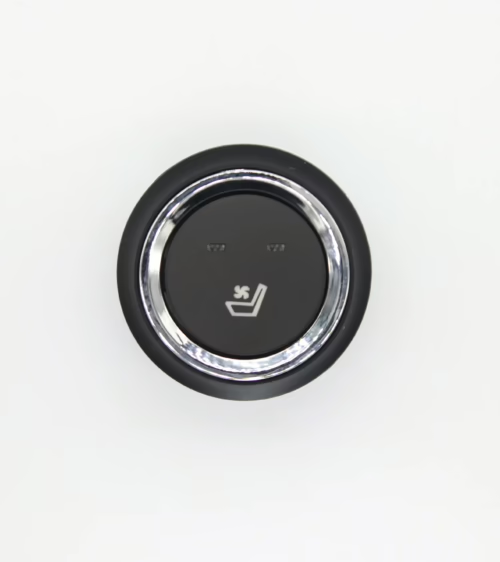
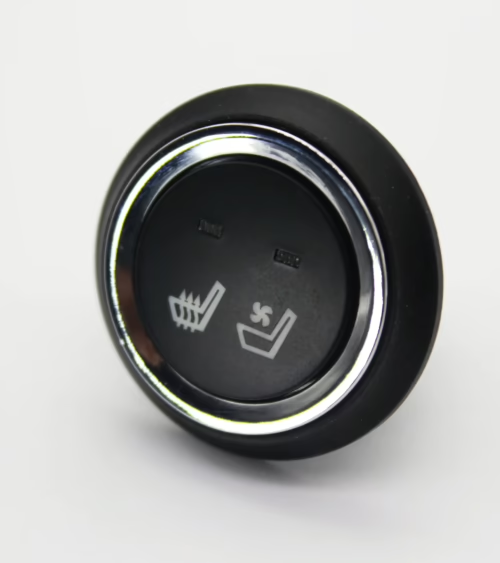
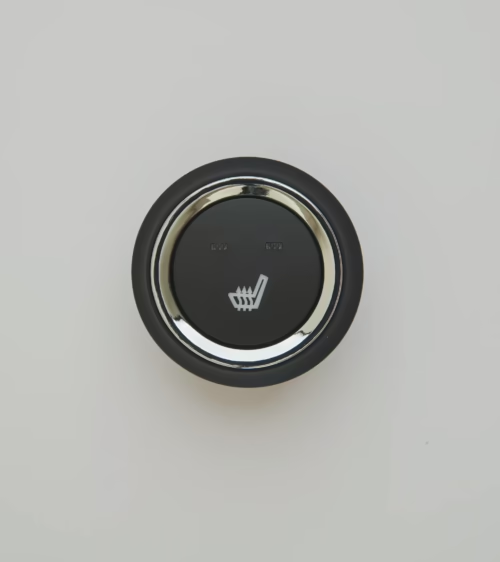
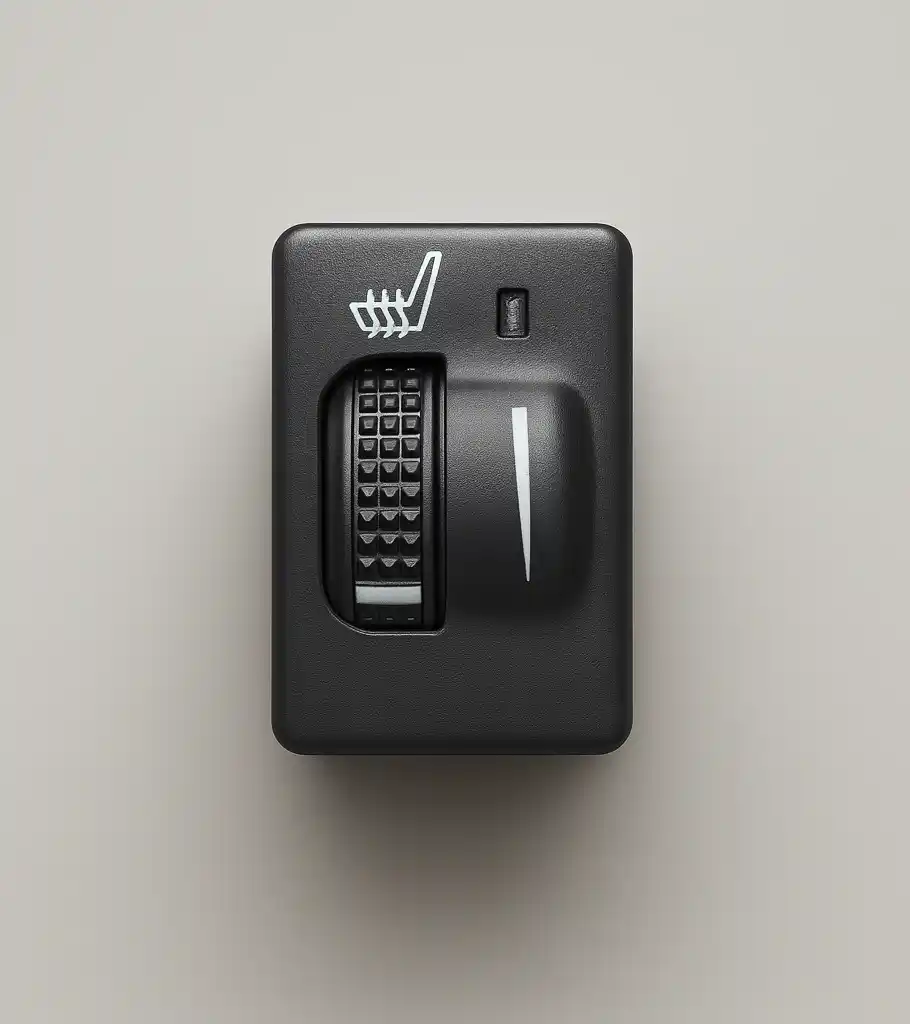
The simplest heated seat is a three-position rotary or rocker switch feeding a relay and a thermostat. It still sells in volume, and for retrofit and commercial-vehicle work it remains the right answer because it is diagnosable with a multimeter and needs no vehicle integration.
But OEM architecture is trending toward a seat control module on LIN or CAN, taking commands from the infotainment head unit, reporting fault codes, and coordinating with remote start, driver profiles, and ambient-temperature logic.
That bifurcation matters when sourcing. Distributors serving collision repair and upfitters need stocked, vehicle-specific replacement seat heater switches with correct connector keying and illumination color, because a mismatched switch is the most common reason a retrofit looks wrong. Seat manufacturers quoting new programs need the opposite:
- a module with documented bus behavior
- defined fault handling
- a validation report.
- Standalone switch + thermostat: lowest cost, universal, no diagnostics
- PWM module, hardwired: smooth level control, overcurrent and open-load detection
- LIN/CAN module: software-controlled levels, DTC reporting, profile and remote-start integration
6. Durability Validation Is the Real Barrier to Entry
Anyone can build a heating pad that works on a bench. Surviving a seat’s service life is the hard part.
A production element faces 50,000 or more ingress-egress cycles, repeated point loading from occupants shifting weight, humidity and spilled liquids, cleaning chemicals, and temperature swings from −40 °C to above 85 °C in a sun-loaded cabin.
Typical qualification includes cyclic load testing on the trimmed cushion, thermal shock, humidity soak, salt-fog on terminals, vibration per the relevant road-load profile, and resistance drift measured before and after.
Two failure patterns dominate warranty data:
- terminal and solder-joint fatigue where the lead exits the pad
- element breakage along a stitching line or a sharp foam edge. Both are design-and-process problems rather than material problems
- which is why buyers should weight a supplier’s validation documentation and PPAP discipline heavily. A quoted price that excludes real durability testing is not actually a lower price.
7. Supply Chains Are Regionalizing Toward North American Stock
Tariff exposure, container-rate volatility, and shortened OEM lead times have pushed buyers away from pure direct-import models toward suppliers holding inventory in North America. For a seat plant running a weekly build schedule, a 35-day ocean transit plus customs clearance is not a supply chain — it is a bet.
The practical compromise now common in the industry is dual-track:
- landed-cost pricing on forecast volume
- plus a domestic buffer stock covering four to eight weeks of demand for service and expedite orders.
The same logic applies downstream. Aftermarket distributors win on fill rate, not catalog breadth, so the ability to browse and order seat heating products from in-stock inventory changes what they can promise their own installers.
Across the automotive seat heater market, suppliers who combine offshore manufacturing economics with US warehousing are taking share from both pure importers and pure domestic shops.
Frequently Asked Questions
What wattage should an automotive seat heater pad draw? A typical single-zone cushion or backrest pad runs 30 to 50 watts at 12 V, giving roughly 60 to 100 watts per seat for a cushion-plus-backrest set.
Higher wattage shortens warm-up time but increases hot-spot and wiring risk, so output should be matched to element area, trim material thermal conductivity, and the controller’s boost strategy rather than maximized in isolation.
How long do seat heating elements typically last? A properly validated pad is designed to match vehicle service life — commonly 10 years or 150,000 miles.
Real-world failures cluster around lead-wire terminations and pads installed with sharp foam edges or incorrect routing, which is why installation quality is as decisive as element construction.
Can carbon fiber and alloy wire pads share the same controller? Usually not without verification. The two technologies present different resistance values and different resistance-versus-temperature curves, so a controller tuned for one may misread load status or mis-regulate the other.
Always confirm resistance range, sensor type, and fault thresholds when substituting element technology into an existing control architecture.
Work With a Supplier Who Knows Both Sides of the Market
Lucky Driver Inc. supplies seat heating pads, seat heater switches, control modules, and seat ventilation systems to OEM seat manufacturers and aftermarket distributors across North America.
Whether you need a validated element for a new seat program, a correctly keyed switch for a retrofit line, or a matched heating-and-ventilation subassembly, our team can quote against your actual specification — wattage, resistance tolerance, connector type, and durability requirements — and support it with North American stock.
Contact Lucky Driver Inc. to discuss your program requirements or request samples for evaluation.
Related Articles
- Seat Heater OEM Supplier: 7 Criteria for 2026 Sourcing
- Seat Heater Manufacturer USA: 8 Factors to Check (2026)
- Heated and Cooled Seat Conversion: 7 Steps (2026)
- Seat Ventilation Kit Aftermarket: 7 Specs to Check (2026)
- Add Ventilated Seats to a Car: 6 Steps to Do It Right
Frequently Asked Questions About automotive seat heater market
Procurement engineers evaluating automotive seat heater market for OEM programs regularly ask the following questions. Answers cover specification, compatibility, certification, and sourcing for automotive seat heater market requirements.
What voltage ratings are available for automotive seat heater market?
Standard automotive seat heater market configurations support 12 V DC for passenger vehicles and 24 V DC for commercial trucks. Selecting the correct automotive seat heater market voltage at the design stage eliminates harness rework later. Lucky Driver maintains automotive seat heater market inventory in both ratings for same-week shipment.
Which certifications apply to automotive seat heater market production?
automotive seat heater market assemblies entering OEM programs typically require UL recognition, REACH compliance, and RoHS documentation. Lucky Driver holds certification records for every automotive seat heater market variant and includes copies with sample and production shipments.
How is watt density specified for automotive seat heater market?
Watt density for automotive seat heater market is expressed in W/cm² and ranges from 0.04 to 0.12 depending on heat-up time requirements. Lower watt density automotive seat heater market designs improve element longevity, while higher values suit cold-climate applications.
Lucky Driver engineering reviews automotive seat heater market requirements and recommends watt density based on your seat platform.
What connector families are used with automotive seat heater market?
automotive seat heater market harnesses are available with Molex, TE Connectivity, and Delphi connector families. Matching the automotive seat heater market connector to the vehicle harness reduces assembly time and eliminates adapter cables. Specify your harness format when requesting a automotive seat heater market quote from Lucky Driver.
What is the lead time for automotive seat heater market samples?
automotive seat heater market samples from Lucky Driver’s North American warehouse ship within 3 to 5 business days for standard configurations. Custom automotive seat heater market variants with modified pad geometry or connector pinouts require 4 to 6 weeks.
Contact Lucky Driver to confirm automotive seat heater market availability before submitting your engineering schedule.