The US automotive seat heater market has moved from a cold-climate luxury feature to a mainstream expectation.
Heated front seats are now standard or optional on most new light vehicles sold in North America, and demand for replacement pads, retrofit kits, and switches keeps growing as the vehicle fleet ages.
For OEM seat manufacturers and aftermarket distributors, understanding where this market is heading determines which products to stock, which specifications to demand from suppliers, and how to plan sourcing for the next model cycle.
This guide walks through seven trends shaping the market in 2026 and the technical details behind each one.
1. Heated Seats Are Now a Volume Product, Not a Premium Option
A decade ago, seat heating was concentrated in premium sedans and in trucks sold in northern states. Today it appears across mid-trim pickups, crossovers, and compact cars, and rear-seat heating is increasingly offered on three-row SUVs and minivans. Two forces drive this.
First, OEMs discovered that heated seats are one of the cheapest comfort features to add relative to how strongly buyers value them.
Second, the rise of electric vehicles made seat heating a range-management tool: warming the occupant directly consumes a fraction of the energy needed to heat the entire cabin with a resistive HVAC heater.
For the aftermarket, the consequence is a large installed base of heating pads that eventually fail. Average vehicle age in the United States continues to climb, and seat heater elements are a common repair item after eight to twelve years of seat-cushion flexing.
Distributors who once stocked only universal retrofit kits now see steady demand for vehicle-specific replacement pads and matching switches, which carry better margins and fewer returns.
2. Carbon Fiber Elements Are Displacing Copper Alloy Wire
Traditional heating pads use a copper or copper-nickel alloy wire stitched or laminated in a serpentine pattern onto a nonwoven or foam carrier. The wire converts electrical energy to heat through Joule heating, and total output is set by wire resistance and the 12-volt supply.
A typical front cushion or backrest pad is designed in the range of roughly 30 to 60 watts, which translates to a current draw of about 2.5 to 5 amps per element.
Carbon fiber elements have gained share because they solve the main failure mode of wire: fatigue breakage at a single point that opens the whole circuit. Carbon fiber bundles contain thousands of filaments, so localized damage reduces output slightly rather than killing the pad.
They also distribute heat more evenly, flex more naturally with seat foam, and weigh less. The trade-off is that carbon fiber requires more careful termination at the lead wires, and resistance tolerance must be controlled tightly during manufacturing to keep wattage within specification.
Buyers comparing quotes should ask which element type is used and what the resistance tolerance is, because a 10 percent resistance error produces a 10 percent power error.
3. Controls Are Moving From Simple Switches to Control Modules
The simplest seat heater circuit is a two-position rocker switch feeding a pad with an embedded bimetal thermostat. That architecture still dominates the retrofit market because it is inexpensive and easy to wire. OEM programs, however, have shifted to electronic control.
A small module reads an NTC thermistor embedded in the pad, drives the element with pulse-width modulation, and ramps power down as the surface approaches the target temperature. This gives faster warm-up, tighter temperature control, and the familiar three-level high, medium, low selection.
Integration with vehicle networks is the next step. Many current platforms expose seat heating on the LIN or CAN bus so the climate system can switch heating on automatically in an auto mode, or the infotainment screen can replace a physical button.
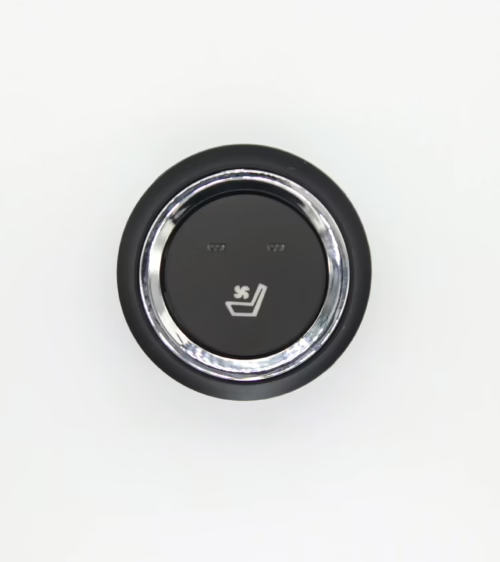
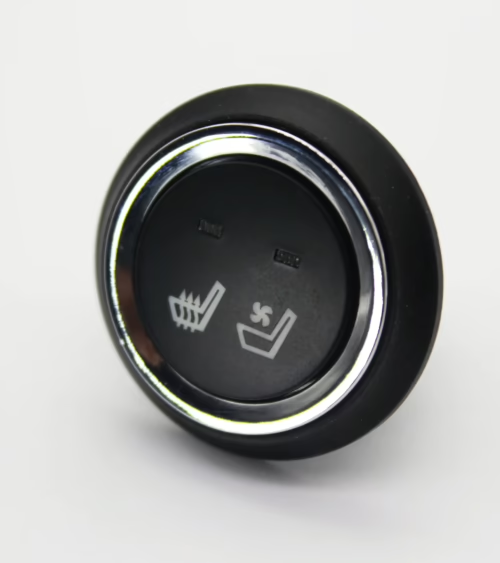
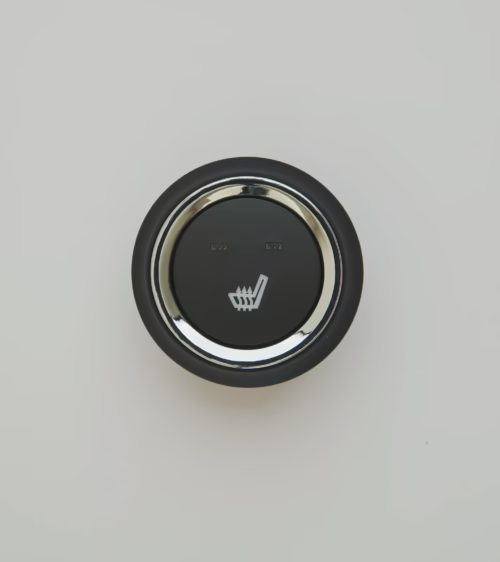
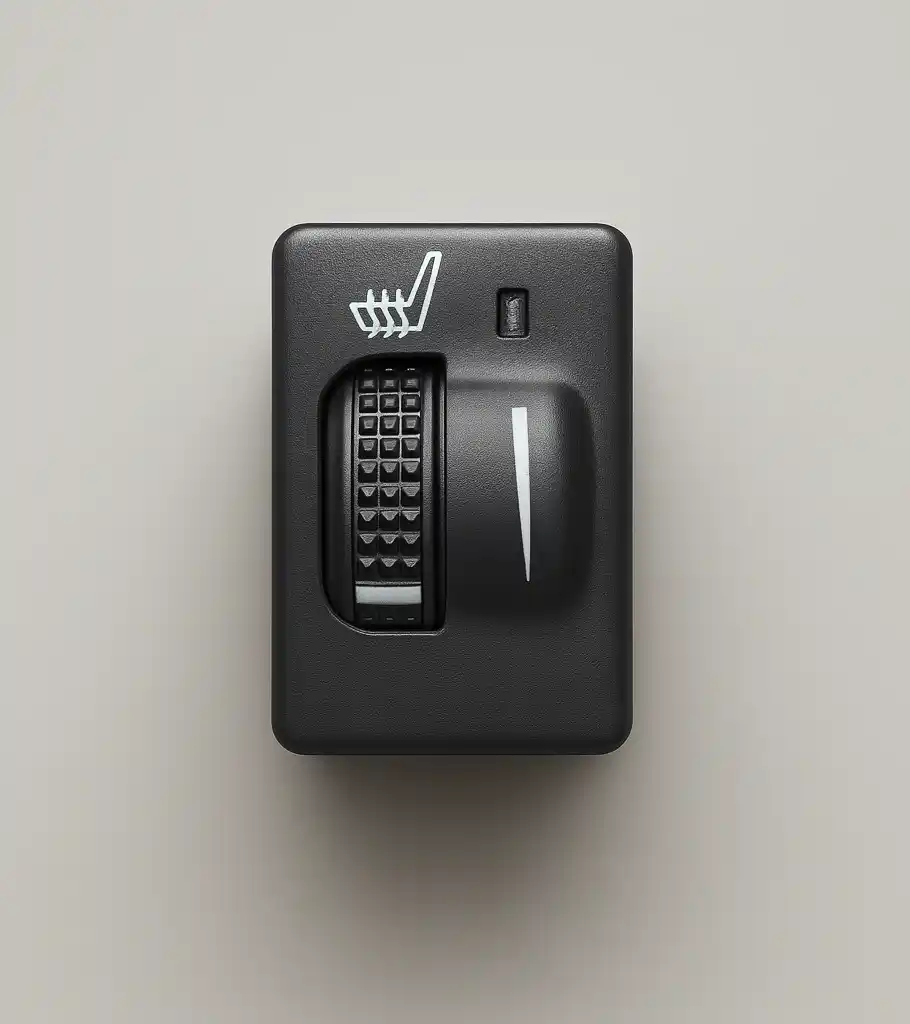
For seat manufacturers, this means the pad, sensor, module, and switch must be specified together rather than sourced as unrelated commodities. For the aftermarket, it means repair technicians still need physical replacement switches in large numbers, since mechanical rocker and push-button switches wear out long before the pad does.
Lucky Driver maintains a broad range of replacement seat heater switches covering single-level, dual-level, and illuminated designs for exactly this reason.
4. Thermal Safety and Compliance Requirements Are Tightening
Seat heaters sit in direct contact with occupants for long periods, so overheat protection is the single most important design requirement. Prolonged skin contact at surface temperatures above roughly 43 degrees Celsius can cause low-temperature burns, and occupants with reduced sensation are especially at risk.
Well-designed pads use layered protection: a thermistor for closed-loop control, a bimetal thermostat that opens if the controller fails, and in many cases a one-shot thermal fuse as the final backstop.
Materials compliance is also under closer scrutiny. Interior components in the United States must meet FMVSS 302 flammability requirements, which applies to the carrier material and insulation used in the pad.
OEM programs further require validation testing that includes repeated flex cycling to simulate years of ingress and egress, crush and point-load tests to confirm the element survives knees and tools, salt spray or humidity exposure on connectors, and electrical cycling at supply voltages beyond nominal.
Distributors should request test reports rather than accepting a generic compliance statement, because low-cost pads that skip the thermostat or use undersized lead wire are still common in the import channel.
5. Seat Ventilation Is Being Bundled With Heating
Ventilated seats were once limited to luxury brands, but the same cost logic that pushed heating downmarket is now working on ventilation.
A ventilated seat uses one or more small axial or blower fans mounted in the cushion and backrest, pulling or pushing air through a spacer fabric layer and out through perforated leather or mesh fabric.
Because the heating pad sits in the same stack, the two systems must be engineered together. The pad needs perforations aligned with the airflow path, and the heating element pattern has to leave room for fan housings and ducts.
From a control standpoint, combined heating and ventilation modules are replacing separate circuits. A single module drives the heating element and fan speed, shares the thermistor for cabin comfort logic, and connects to the body network through one harness.
For seat manufacturers, the practical change is a shift from buying a pad to buying a climate stack: pad, spacer fabric, fans, module, and switch. Suppliers who can deliver the full stack with matched connectors reduce assembly complexity and warranty exposure.
6. Sourcing Is Shifting Toward North American Inventory
Most seat heating elements are manufactured in Asia, and that is unlikely to change given the labor content in wire laying and pad assembly. What is changing is where inventory sits.
Tariff volatility, ocean freight disruptions, and shorter OEM program timelines have pushed buyers to favor suppliers with stock held in the United States.
A distributor cannot wait eight weeks for a container when a fleet customer needs fifty replacement pads this month, and a seat plant cannot shut a line because a connector revision is stuck in customs.
The practical result is a two-tier supply structure. High-volume OEM programs still run direct from overseas factories under long-term agreements with safety stock. Aftermarket and low-volume OEM demand is increasingly served from domestic warehouses that can ship within days. This also simplifies returns, samples, and small-batch testing.
Buyers evaluating a supplier should confirm where the goods physically are, what quantities are held, and whether the supplier can provide mixed pallets of pads, switches, and harnesses.
You can see what is in stock today by browsing our seat heating products online, where pads, switches, modules, and ventilation parts ship from inventory in the United States.
7. What Buyers Should Specify in 2026
With the technology maturing, the gap between a good pad and a problem pad comes down to specification discipline. Before issuing a purchase order or approving a sample, confirm the following items in writing:
- Element type and resistance: carbon fiber or alloy wire, nominal resistance at 20 degrees Celsius, and tolerance band.
- Rated power and voltage: wattage at 13.5 volts for cushion and backrest separately, plus behavior at 16 volts.
- Dimensions and cutouts: overall size, heated zone size, and clearance for side airbags, occupant classification sensors, and ventilation fans.
- Protection scheme: thermostat open temperature, thermistor type and resistance curve, and whether a thermal fuse is present.
- Connector and lead length: exact connector part number and lead wire gauge so the harness mates without adapters.
- Test documentation: flex cycle count, FMVSS 302 results, and electrical endurance data.
- Switch and module compatibility: which switch part numbers and modules are validated with the pad.
Suppliers who cannot answer these questions quickly are usually reselling generic pads with no engineering control. Suppliers who can answer them are the ones worth building a multi-year relationship with.
Frequently Asked Questions
How long does a factory seat heater pad typically last?
Most OEM pads are validated to survive the vehicle’s design life, which is often ten years or more. In practice, failures appear earlier in the driver’s seat because it sees far more entry and exit cycles than the passenger side.
Alloy wire pads usually fail as an open circuit from wire fatigue, while carbon fiber pads degrade more gradually. Switch failures are more common than pad failures on many older vehicles.
Can an aftermarket seat heater kit be installed in a seat with side airbags?
Yes, but the pad must stay clear of the airbag deployment seam and tear path, and the kit should not be stitched or glued in a way that changes how the cover separates. Vehicle-specific pads are cut with these clearances built in.
For universal kits, installers must follow the seat manufacturer’s airbag zone guidance and avoid routing lead wires across the deployment path.
Is there a difference between pads for OEM assembly and pads for aftermarket replacement?
The heating technology is the same, but OEM pads are built to a specific seat geometry with pre-terminated connectors and are validated against that program’s test plan. Aftermarket replacement pads are either direct-fit reproductions of those parts or universal pads that the installer trims to size.
Direct-fit replacements cost more but install faster and carry lower warranty risk.
Lucky Driver Inc. supplies seat heating pads, seat heater switches, control modules, and seat ventilation components to OEM seat manufacturers and aftermarket distributors across North America, with inventory held in the United States for fast delivery.
If you are planning a new seat program, sourcing replacement parts for a service network, or looking for a reliable second source, contact Lucky Driver Inc. for specifications, samples, and volume pricing.
Related Articles
- Seat Heater Pad Thickness: 7 Factors Engineers Must Check
- Heated Seat Pad Size Chart: 7 Dimensions to Measure First
- Aftermarket Seat Heater Pad: 7 Specs to Check Before You Buy
- Seat Heater Kit Wiring Harness: 7 Things Installers Must Know
- Heated Seat Element Kit: 7 Things to Know Before You Buy
Frequently Asked Questions About us automotive seat heater market
Procurement engineers evaluating us automotive seat heater market for OEM programs regularly ask the following questions. Answers cover specification, compatibility, certification, and sourcing for us automotive seat heater market requirements.
What voltage ratings are available for us automotive seat heater market?
Standard us automotive seat heater market configurations support 12 V DC for passenger vehicles and 24 V DC for commercial trucks. Selecting the correct us automotive seat heater market voltage at the design stage eliminates harness rework later.
Lucky Driver maintains us automotive seat heater market inventory in both ratings for same-week shipment.
Which certifications apply to us automotive seat heater market production?
Us automotive seat heater market assemblies entering OEM programs typically require UL recognition, REACH compliance, and RoHS documentation. Lucky Driver holds certification records for every us automotive seat heater market variant and includes copies with sample and production shipments.
How is watt density specified for us automotive seat heater market?
Watt density for us automotive seat heater market is expressed in W/cm² and ranges from 0.04 to 0.12 depending on heat-up time requirements. Lower watt density us automotive seat heater market designs improve element longevity, while higher values suit cold-climate applications.
Lucky Driver engineering reviews us automotive seat heater market requirements and recommends watt density based on your seat platform.
What connector families are used with us automotive seat heater market?
Us automotive seat heater market harnesses are available with Molex, TE Connectivity, and Delphi connector families. Matching the us automotive seat heater market connector to the vehicle harness reduces assembly time and eliminates adapter cables.
Specify your harness format when requesting a us automotive seat heater market quote from Lucky Driver.
What is the lead time for us automotive seat heater market samples?
Us automotive seat heater market samples from Lucky Driver’s North American warehouse ship within 3 to 5 business days for standard configurations. Custom us automotive seat heater market variants with modified pad geometry or connector pinouts require 4 to 6 weeks.
Contact Lucky Driver to confirm us automotive seat heater market availability before submitting your engineering schedule.