Seat heater pad thickness is one of the least discussed yet most consequential specifications in a heated seat program. A pad that is too thick telegraphs through the trim cover, changes seat comfort, and can interfere with occupant classification sensors.
A pad that is too thin may lack the mechanical durability to survive years of ingress and egress cycles.
This guide explains what actually makes up the thickness of a seat heater pad, what ranges are typical for each construction, and the seven factors engineers and purchasing teams should check before they approve a drawing.
What Seat Heater Pad Thickness Actually Includes
When a supplier quotes a pad at 0.8 mm or 2.5 mm, the number is only meaningful if both sides agree on what is being measured. A seat heater pad is a laminate, and its total thickness is the sum of several layers:
- Heating element: alloy resistance wire, a carbon fiber bundle, or a printed conductive layer. Alloy wire for automotive pads typically runs 0.2 to 0.5 mm in diameter including insulation. Carbon fiber tows lie flat and add far less height.
- Carrier substrate: the nonwoven polyester, spunbond, or thin polyurethane foam onto which the element is stitched or bonded. Nonwoven carriers range from 0.3 to 1.0 mm. Foam carriers run 2 to 5 mm.
- Cover layer: an optional second nonwoven or scrim that sandwiches the element and protects it from the trim cover.
- Adhesive or hot-melt film: 0.05 to 0.15 mm when used to bond the pad to foam or to the cover.
- Thermostat and lead exit: local features that can be several millimeters high and must be positioned away from the H-point and seat bolsters.
Good drawings call out nominal thickness of the flat laminate separately from the maximum height at the thermostat, connector, and wire exit. Confusing the two is a common reason for first-article rejections.
Typical Thickness Ranges by Element Technology
The heating element technology sets the floor for how thin a pad can be. Three constructions dominate the North American market.
- Carbon fiber pads: 0.5 to 1.2 mm total. Carbon fiber heating tows are flat and are usually bonded to a thin nonwoven. These are the preferred choice for perforated leather, thin foam, and seats with occupant detection mats, because they are the least likely to be felt or seen.
- Alloy wire on nonwoven: 1.0 to 2.0 mm total. Copper-nickel or copper-clad alloy wire stitched or ultrasonically bonded to polyester nonwoven. Slightly thicker than carbon fiber, but very robust and easy to repair at the module level.
- Alloy wire on foam: 3.0 to 6.0 mm total. The wire is laminated between foam and a scrim. This construction is common in aftermarket kits because the foam masks wire read-through on a wide variety of unknown seats, but it is rarely acceptable for OEM programs with tight comfort targets.
These are laminate thicknesses before compression. Under an occupant, foam-carried pads compress significantly, while nonwoven pads change very little. That difference matters when you evaluate read-through and comfort, which we address next.
Factor 1 and 2: Foam Compression and Read-Through
Read-through is the visible or tactile line pattern of a heating element showing through the trim cover. It is driven by two things: the height of the element above the carrier and the stiffness of the foam beneath the pad.
On a soft seat foam of 45 to 55 kg per cubic meter density, a 0.4 mm wire on a 0.5 mm nonwoven usually disappears once the cover is tensioned. On high-density bolster foam or a thin comfort layer over a rigid pan, the same pad can be felt through the leather.
Engineers should ask the supplier for element height above substrate, not just total pad thickness. A pad whose wire sits on top of the nonwoven behaves very differently from one whose wire is stitched into it, even at identical total thickness.
For premium leather trim, a thin scrim over the wire or a switch to carbon fiber is the most reliable way to eliminate read-through without adding foam.
Factor 3 and 4: Thermal Response and Heat Distribution
Thickness affects how fast the occupant feels heat and how evenly it spreads. The pad generates heat through resistive Joule heating in the element, and every layer between the element and the occupant acts as thermal insulation.
A thicker cover layer or a foam-laminated pad slows the time to perceived warmth by tens of seconds and raises the steady-state temperature at the element for the same surface temperature at the cover. That higher element temperature accelerates aging of the wire insulation and adhesive.
Thin nonwoven pads reach perceived warmth faster at lower element temperatures, which is why OEM programs with time-to-warmth targets of 2 to 3 minutes almost always specify them. Heat distribution follows the same logic.
A thin pad transmits the pattern of the element almost directly, so wire pitch must be tight enough to avoid hot stripes, typically 8 to 15 mm. A foam-carried pad spreads heat laterally and tolerates wider pitch but gives up response time to do so.
The control strategy interacts with thickness as well. A pad that runs behind a two- or three-level control module can be tuned to compensate for a slower thermal path, but the module cannot recover the energy lost into the foam below the pad.
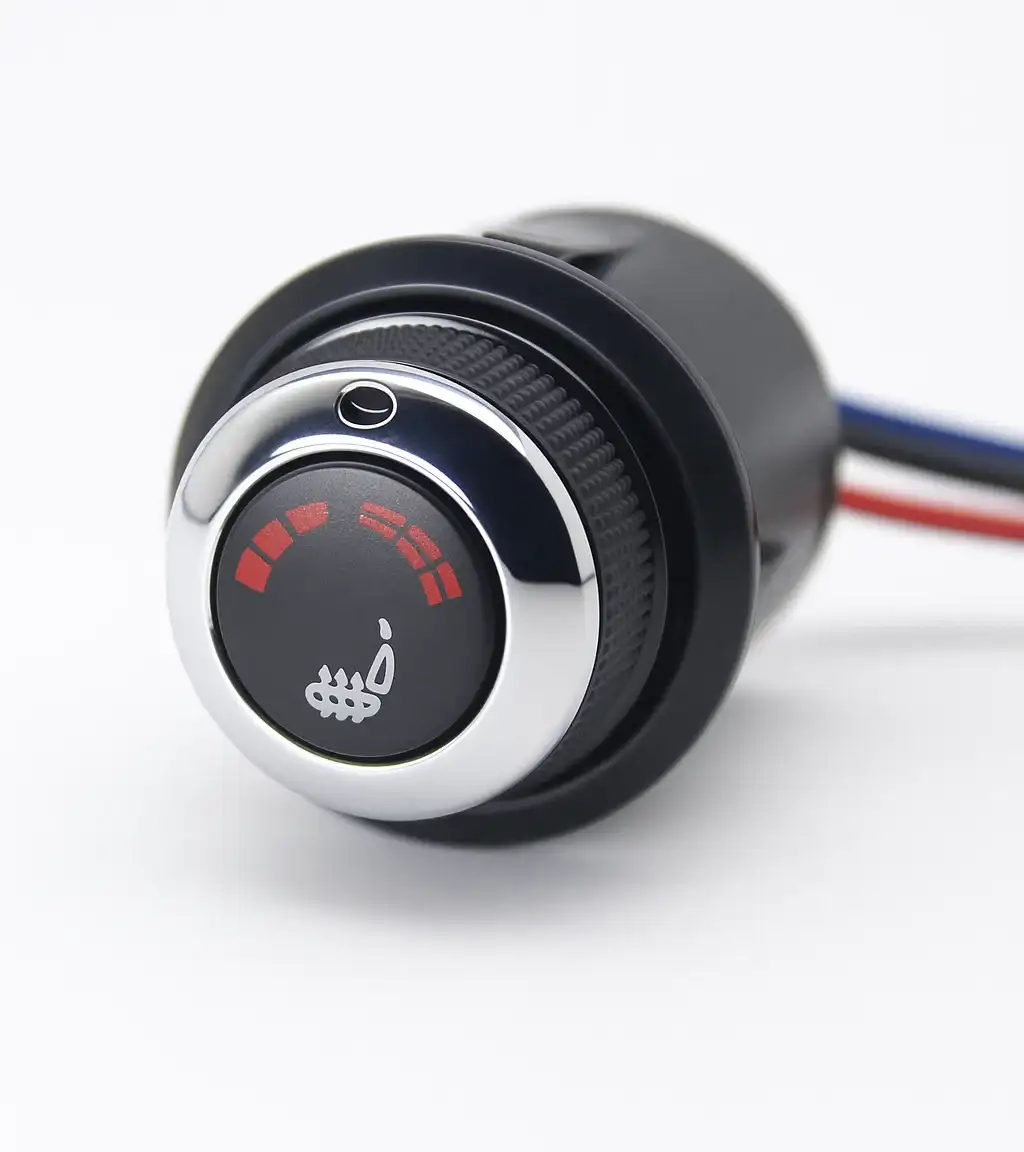
If you are selecting controls for a new application, our seat heater switch catalog covers both simple two-position switches and multi-level controllers that pair with thin and thick pads alike.
Factor 5 and 6: Occupant Sensors and Ventilation Compatibility
Modern passenger seats often carry an occupant classification mat or a capacitive sensor film directly under the trim. These sensors are calibrated against a known stack-up.
Adding a 4 mm foam-laminated heater between the sensor and the occupant can shift pressure readings enough to misclassify a small adult or child, which is a safety and compliance issue, not a comfort issue.
For any seat with an occupant detection system, specify a pad of 1.2 mm or less and confirm the stack-up with the sensor supplier before tooling.
Ventilated seats add a second constraint. Air must pass from the blower through the foam and out of the perforated cover. A dense nonwoven heater blocks that path unless it is perforated to match the airflow channels.
Carbon fiber pads on open-structure spunbond are the usual solution because they combine minimal thickness with high open area. Alloy wire pads can also be perforated, but the hole pattern must avoid the wire routing, which adds engineering time and increases the minimum practical thickness.
Factor 7: Trim Cover Tolerance Stack and Attachment Method
The final factor is how the pad is held in place. Hook-and-loop strips, foam-in-place channels, and pressure-sensitive adhesive each add height in specific locations. A 1.0 mm pad held with 2.5 mm hook-and-loop tape has a 3.5 mm local step that can show through at the pad edge.
Adhesive attachment keeps the stack thin but requires a clean foam surface and a pad carrier that accepts adhesive without delaminating under repeated compression.
OEM seat engineers should run the full tolerance stack from pan to A-surface with the heater included, not as an afterthought.
A pad specified at 1.0 mm plus or minus 0.2 mm behaves very differently from one at 1.0 mm plus or minus 0.5 mm when the foam itself has a plus or minus 2 mm thickness tolerance.
Ask for the thickness tolerance in writing and verify it on incoming inspection with a dial thickness gauge under a defined preload.
Specifying Pad Thickness for OEM Versus Aftermarket Programs
OEM and aftermarket buyers face different constraints and should write different specifications.
- OEM seat manufacturers know the foam, cover, and sensor stack. They should specify nominal thickness, tolerance, element height, and maximum local height at the thermostat.
- Carbon fiber or thin nonwoven wire pads at 0.5 to 1.5 mm are the norm, with flammability performance documented to FMVSS 302 as part of the material submission.
- Aftermarket distributors sell into unknown seats. A moderately thicker nonwoven wire pad at 1.5 to 2.0 mm offers a good balance of durability and low read-through across many seat types. Foam-laminated pads above 3 mm should be reserved for heavy cloth or vinyl seats where the installer cannot verify sensor presence.
- Both should insist on a universal thickness callout on the drawing, a defined measurement method, and samples from production tooling rather than hand-built prototypes.
Installers and distributors who want to compare constructions side by side can browse our seat heating products, where each pad lists its carrier material, element type, and nominal thickness so the right construction can be matched to the seat.
How to Measure and Verify Seat Heater Pad Thickness
Thickness claims are only useful if they are measured consistently. A practical incoming inspection procedure looks like this:
- Use a dial or digital thickness gauge with a foot of at least 25 mm diameter and a defined preload, commonly 0.5 to 2 kPa, so that the nonwoven is not crushed during measurement.
- Measure at five points across the flat heating area, avoiding wire crossovers, the thermostat, and the lead exit. Record the mean and the range.
- Measure local maxima separately at the thermostat and connector and compare them against the drawing callout for maximum local height.
- Check after compression cycling on a sample lot. A pad that loses more than 15 percent of its thickness after 10,000 compression cycles is likely to develop read-through or loose wires in service.
- Correlate with resistance, since a pad that has been over-compressed in lamination can show both reduced thickness and a resistance shift from wire damage.
Documenting these measurements on the first article report and repeating them on each production lot catches lamination drift early, long before field complaints about hot spots or visible lines appear.
Frequently Asked Questions
What is the ideal seat heater pad thickness for leather seats?
For leather, especially perforated or thin-grain leather, keep the laminate at 1.2 mm or less with element height minimized. Carbon fiber pads at 0.5 to 1.0 mm are the safest choice.
Thicker wire-on-foam pads frequently show read-through on leather and should be avoided unless the foam is very soft and the cover is heavily padded.
Does a thicker seat heater pad produce more heat?
No. Heat output is set by the element resistance and supply voltage, not by pad thickness. A thicker pad insulates the element from the occupant, so it reaches perceived warmth more slowly and runs the element hotter for the same surface temperature.
Thinner pads deliver heat more efficiently and respond faster.
Can a seat heater pad be installed under an occupant classification sensor?
The pad should be placed above the sensor only if the sensor supplier has validated the stack-up with that specific pad. In most programs, heaters of 1.2 mm or less are placed above the sensor mat and validated together.
Thick foam-laminated pads should never be added to a sensor-equipped seat without re-validation, because they can change occupant classification results.
Lucky Driver Inc. supplies seat heating pads in carbon fiber, nonwoven alloy wire, and foam-laminated constructions, along with matching switches, control modules, and seat ventilation systems for OEM seat manufacturers and aftermarket distributors across North America.
If you are defining a thickness specification for a new program or need samples measured to your inspection method, contact Lucky Driver Inc. and our engineering team will help you select and verify the right pad for your seat.
Related Articles
- Heated Seat Pad Size Chart: 7 Dimensions to Measure First
- Aftermarket Seat Heater Pad: 7 Specs to Check Before You Buy
- Seat Heater Kit Wiring Harness: 7 Things Installers Must Know
- Heated Seat Element Kit: 7 Things to Know Before You Buy
- Heated Seat Kit vs Heated Seat Cover: 6 Key Differences
Frequently Asked Questions About seat heater pad thickness
Procurement engineers evaluating seat heater pad thickness for OEM programs regularly ask the following questions. Answers cover specification, compatibility, certification, and sourcing for seat heater pad thickness requirements.
What voltage ratings are available for seat heater pad thickness?
Standard seat heater pad thickness configurations support 12 V DC for passenger vehicles and 24 V DC for commercial trucks. Selecting the correct seat heater pad thickness voltage at the design stage eliminates harness rework later. Lucky Driver maintains seat heater pad thickness inventory in both ratings for same-week shipment.
Which certifications apply to seat heater pad thickness production?
Seat heater pad thickness assemblies entering OEM programs typically require UL recognition, REACH compliance, and RoHS documentation. Lucky Driver holds certification records for every seat heater pad thickness variant and includes copies with sample and production shipments.
How is watt density specified for seat heater pad thickness?
Watt density for seat heater pad thickness is expressed in W/cm² and ranges from 0.04 to 0.12 depending on heat-up time requirements. Lower watt density seat heater pad thickness designs improve element longevity, while higher values suit cold-climate applications.
Lucky Driver engineering reviews seat heater pad thickness requirements and recommends watt density based on your seat platform.
What connector families are used with seat heater pad thickness?
Seat heater pad thickness harnesses are available with Molex, TE Connectivity, and Delphi connector families. Matching the seat heater pad thickness connector to the vehicle harness reduces assembly time and eliminates adapter cables. Specify your harness format when requesting a seat heater pad thickness quote from Lucky Driver.
What is the lead time for seat heater pad thickness samples?
Seat heater pad thickness samples from Lucky Driver’s North American warehouse ship within 3 to 5 business days for standard configurations. Custom seat heater pad thickness variants with modified pad geometry or connector pinouts require 4 to 6 weeks.
Contact Lucky Driver to confirm seat heater pad thickness availability before submitting your engineering schedule.