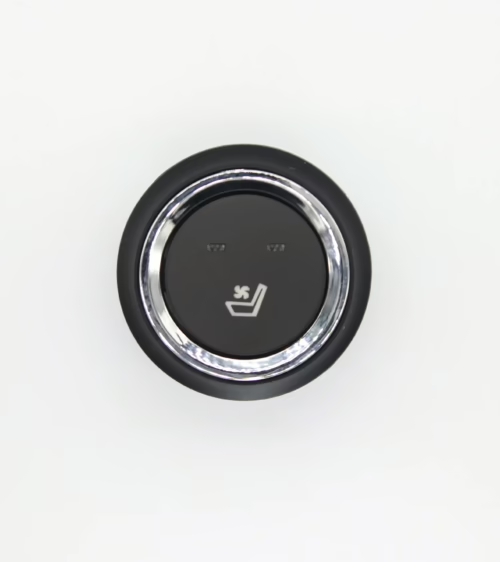
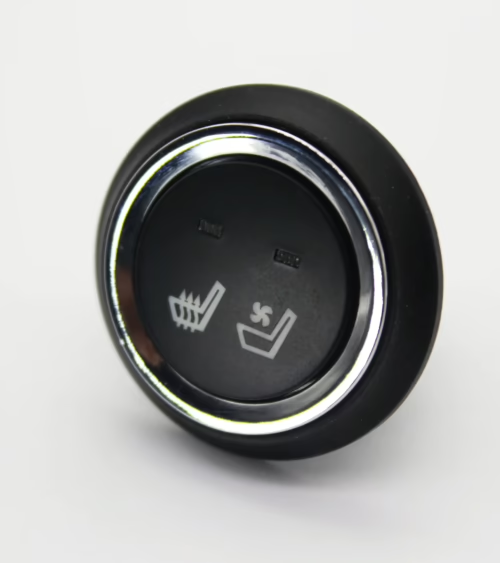
The jeep wrangler heated seat switch is a small component with an outsized impact on cold-weather comfort—and when it fails, diagnosing the root cause correctly saves hours of unnecessary disassembly.
Whether you drive a JK (2007–2018), JL (2018–present), or JT Gladiator (2020–present), the switch controls the low and high heat settings delivered to the resistive heating element in your seat cushion and governs the indicator light feedback on the switch face itself. This guide covers everything:
- how the system works
- how to isolate switch failure from element failure
- how to complete the swap correctly the first time.
How the Jeep Wrangler Heated Seat System Works
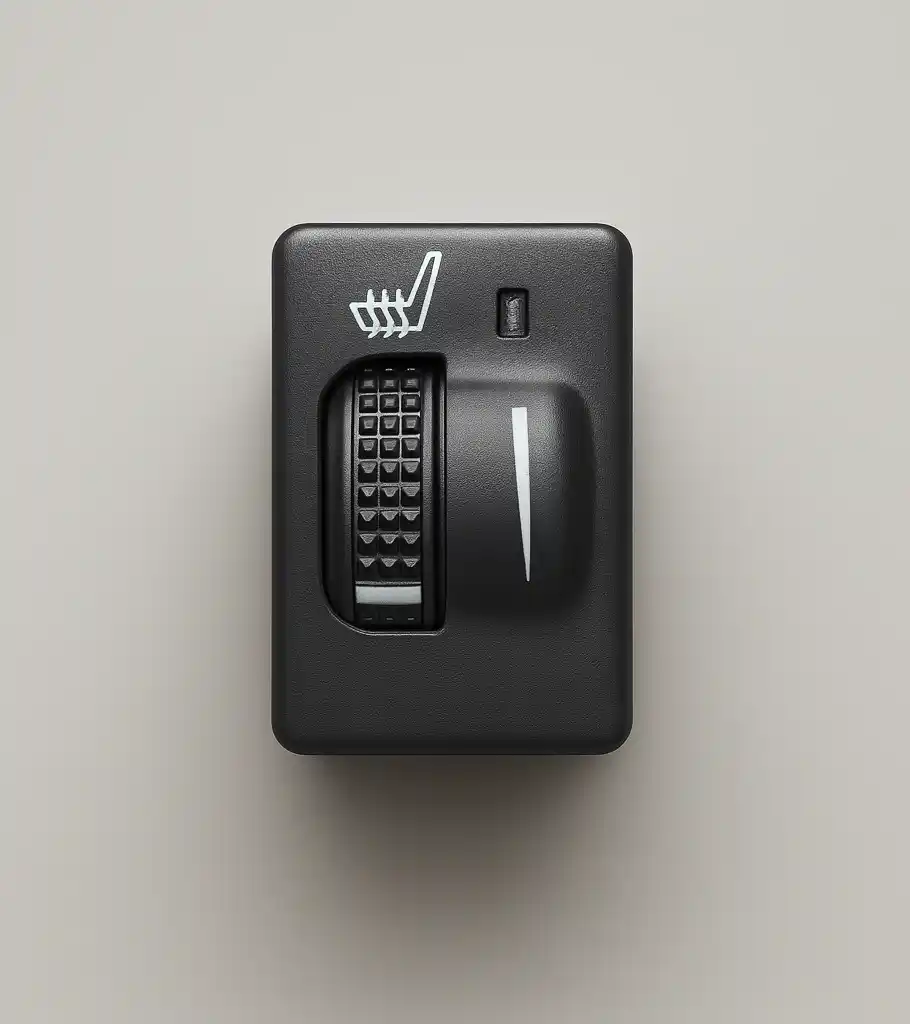
The heated seat system in a Jeep Wrangler consists of four main components:
- the heated seat switch mounted on the center console or HVAC control panel
- a thermistor (temperature sensor) embedded in the seat cushion foam
- a resistive heating element woven through the seat padding
- and—on JL and JT platforms—the body control module (BCM) that monitors system state and stores diagnostic codes.
When you press the switch, it either sends voltage directly to the heating element (the simpler circuit used on most JK models) or signals the BCM to activate the element relay (the architecture used on JL and JT). The thermistor reads seat temperature continuously.
The BCM cycles the element on and off to hold the target temperature band—typically around 100°F on the low setting and 118–122°F on the high setting.
Many modern Wrangler seat heaters use a positive temperature coefficient (PTC) thermistor as the feedback sensor, which self-limits current draw as temperature rises and adds a passive layer of thermal protection against runaway heating.
Understanding this architecture matters because a symptom like “seat won’t heat” can originate at the switch, the element, the thermistor, the BCM, or a blown fuse—and each root cause has a different fix.
Common Symptoms of a Failing Heated Seat Switch
Knowing exactly what to look for narrows the diagnosis before you pull a single trim panel:
- Switch illuminates but seat never heats. The LED or indicator light inside the switch is powered separately from the heating circuit on JK models. The switch can light up while its internal contacts have failed open, delivering no current to the element.
- Switch does not illuminate at all. Either the switch has no power, the internal LED has burned out, or the switch is completely dead. Confirm fuse integrity before condemning the switch itself.
- Only one heat level functions. Many Wrangler switches use separate internal contacts for the low and high settings. A partially failed switch may still deliver one heat level while the other contact has corroded or physically burned through.
- Seat heats continuously without cycling off. This points to a shorted switch contact holding the element energized, or a failed thermistor feeding an artificially low temperature reading to the BCM so the system never thinks the seat is warm enough.
- Switch feels physically intermittent or loose. On high-mileage JK consoles especially, the snap-in retaining clips on the switch body can crack, allowing the switch to rock in its cutout and break contact intermittently under off-road vibration.
Step-by-Step Diagnosis Before You Replace Anything
Replacing the switch without confirming it is the actual fault wastes time and money. Follow this sequence to isolate the defective component:
- Step 1 — Check the fuse. On JK models, the heated seat fuse is typically in the interior fuse block on the driver’s side dash; on JL and JT, check both the interior PDC and the under-hood PDC. The fuse is usually rated 20A or 25A.
- A blown fuse indicates a downstream short in the element or wiring harness, not simply a switch failure.
- Step 2 — Read BCM diagnostic trouble codes. On JL and JT platforms, connect an OBD-II scanner capable of accessing body module codes—not just powertrain codes.
- Fault codes in the B1xxx range related to the seat heater circuit will point specifically to the element circuit, the thermistor signal, or the control line from the switch.
- Step 3 — Test switch output voltage. With the switch connector unplugged, use a multimeter to confirm 12V is present on the power feed terminal with the ignition on.
- Reconnect the switch, press each heat setting in turn, and probe the output terminal—you should see 12V passed through to the element connector when the switch is active on each setting.
- Step 4 — Measure heating element resistance. Disconnect the seat harness at the under-seat connector. A healthy JK element measures roughly 3–4 ohms across the two heating circuit terminals; JL and JT elements are in the same range.
- An open circuit (infinite resistance) or a dead short to ground confirms element failure, ruling out the switch as the primary fault.
- Step 5 — Check thermistor resistance. The thermistor should read approximately 2,000–3,500 ohms at room temperature, depending on the supplier specification. A reading of 0 ohms (short) or infinite resistance (open circuit) means the thermistor is feeding the BCM a false temperature signal and needs replacement independently of the switch.
Root Causes of Heated Seat Switch Failure in the Wrangler
The Jeep Wrangler lives a harder life than most passenger cars. Several factors specific to Wrangler use accelerate switch wear:
- Moisture and mud intrusion. Wranglers frequently get water on the floor and console from open-top, soft-top, or open-door driving. Water wicks into the switch connector, oxidizes the brass terminal pins, and corrodes the internal contacts over multiple wet-dry cycles.
- Vibration fatigue. Off-road driving imposes continuous vibration loads on the center console assembly. Solder joints inside the switch PCB and the connector retention clips both fatigue faster than they would in a vehicle driven exclusively on-road.
- Voltage spikes from aftermarket accessories. Winches, light bars, air compressors, and audio amplifiers draw large surge currents. Poorly installed accessories with no dedicated inline fusing can send voltage transients back through the body harness, burning the thin internal contacts inside the heated seat switch.
- Accumulated mechanical wear. A heated seat switch pressed twice daily for 150 heating-season days accumulates thousands of actuations over a vehicle’s life. The mechanical contacts—or the touch-capacitive sensor layer used on JL and JT—eventually degrade below the threshold required to reliably close the circuit.
How to Replace the Heated Seat Switch on a Jeep Wrangler
The replacement procedure differs slightly by generation but follows the same general workflow:
- Tools required: Plastic trim removal pry tool, small flathead screwdriver, 10mm socket and ratchet, torque screwdriver.
- Step 1 — Disconnect the negative battery terminal and wait a minimum of 60 seconds before handling any connector near the airbag inflators or BCM circuits.
- Step 2 — Remove the center console trim bezel. On JK, the bezel around the HVAC and switch panel unclips with a plastic trim tool—work around the perimeter starting at a rear corner and prying gently to avoid cracking the plastic.
- On JL and JT, the upper console trim panel is secured by two 10mm screws hidden under a rear cover, then lifts straight up and free.
- Step 3 — Release the switch from the bezel. The heated seat switch clips into a rectangular cutout.
- Press the release tabs on both the top and bottom edges (or use a small flathead to depress the retaining clips one at a time) and push the switch rearward out of the panel opening.
- Step 4 — Unplug the wiring connector. Depress the locking tab on the connector body and pull it straight off the switch terminals. Never pull by the wiring itself—grip the connector housing only.
- Step 5 — Install the replacement switch. Plug the connector into the new switch until it audibly clicks and the locking tab is fully seated. Push the switch into the bezel cutout until both retaining clips engage with a click on each side.
- Step 6 — Reinstall trim panels and reconnect the battery. Test both heat settings: both indicator levels should illuminate, and the seat surface should begin warming within 90 seconds on the high setting.
Wiring and Connector Inspection Tips
Before installing a replacement, inspect the harness connector itself. On Wranglers with significant off-road mileage or water exposure, you will often find conditions that will cause a new switch to fail for the same reason the original did:
- Green or white oxidation on the brass terminal pins inside the connector body, increasing resistance and reducing current delivery to the heating element
- Melted or discolored connector housings on older JK models where a previous element short allowed sustained overcurrent to flow through the switch connector before the fuse opened
- Spread or backed-out terminal locks that allow a pin to partially exit the connector body under vibration, creating an intermittent open circuit
Clean corroded terminals with electrical contact cleaner and a proper pin cleaning tool before connecting the new switch. If the housing is melted, cracked, or has backed-out pins that cannot be re-seated, replace the connector with a pre-terminated repair pigtail harness.
Plugging a new switch into a damaged connector guarantees repeat failure.
OEM vs. Aftermarket Heated Seat Switch Options
OEM switches sourced through the dealer carry the Mopar part number and are confirmed to fit the connector body and console cutout without modification. They are also the most expensive option, typically priced between $65 and $130 depending on the generation and trim level.
For JL and JT owners still under a factory or extended warranty, OEM is the safest choice to avoid any warranty complication.
Quality aftermarket switches deliver equivalent function at a lower price point, provided they are manufactured to match the original connector pinout, the switch contact current rating (typically 20A continuous on JK, relay-switched on JL/JT), and the LED illumination voltage.
When shopping, verify the part is listed explicitly for your model year and trim level—the switch face design, connector housing, and pin count vary between the JK Sport, JK Sahara, JL Sport S, JL Rubicon, and JT Gladiator.
You can browse our full range of seat heating products to find compatible components, or go directly to our seat heater switch catalog to filter by vehicle application and confirm fitment before ordering.
Frequently Asked Questions
Q: Can I replace just the switch, or do I need to replace the entire seat heater kit?
A:
- In most cases
- yes—the switch is a standalone serviceable component. If your diagnosis confirms that only the switch has failed while the heating element and thermistor both test within specification
- replacing the switch alone restores full function. A complete kit replacement is only necessary when both the element and switch have failed simultaneously
- which typically happens when a sustained element short damaged both components before the fuse opened.
Q: Why does my heated seat indicator light flash instead of staying solid?
A:
- On JL and JT Wranglers
- a flashing indicator is the BCM’s built-in fault communication method. A slow single-flash pattern typically signals that the BCM detects an open circuit in the heating element
- a faster continuous flash pattern often indicates a thermistor fault. Connect an OBD-II scanner with body module access to retrieve the specific DTC rather than guessing at the fault based on flash rate alone.
Q: My JK heated seat switch gets warm to the touch during operation. Is that normal?
A:
- Mild warmth at the switch face is normal on JK models because the switch carries the full current load of the heating element—typically 8–12 amps. However
- if the switch housing feels hot rather than warm
- or if you detect a burning plastic odor
- shut the system off immediately. A hot switch indicates a high-resistance connection at the terminals
- usually from corrosion
- that is dissipating energy as heat and can damage the surrounding harness over time. Inspect and clean the connector terminals before operating the seat heater again.
At Lucky Driver Inc., we supply seat heater switches, resistive heating elements, thermistors, and control modules to automotive aftermarket distributors and OEM seat manufacturers across North America.
If you need a reliable, correctly specified replacement for your Jeep Wrangler’s heated seat system, our team can help you confirm the right part for your exact model year and trim. Visit our online store or contact us directly to get back to warm seats without the guesswork.
Related Articles
- Ram 1500 Heated Seat Switch: 2026 Complete Repair Guide
- GMC Sierra Heated Seat Switch: 2026 Complete Repair Guide
- Chevy Tahoe Heated Seat Switch: 2026 Complete Repair Guide
- Chevy Equinox Seat Heater Switch: 2026 Complete Repair Guide
- Chevy Silverado Heated Seat Switch: 2026 Complete Repair Guide
Frequently Asked Questions About jeep wrangler heated seat switch
Procurement engineers evaluating jeep wrangler heated seat switch for OEM programs regularly ask the following questions. Answers cover specification, compatibility, certification, and sourcing for jeep wrangler heated seat switch requirements.
What voltage ratings are available for jeep wrangler heated seat switch?
Standard jeep wrangler heated seat switch configurations support 12 V DC for passenger vehicles and 24 V DC for commercial trucks. Selecting the correct jeep wrangler heated seat switch voltage at the design stage eliminates harness rework later.
Lucky Driver maintains jeep wrangler heated seat switch inventory in both ratings for same-week shipment.
Which certifications apply to jeep wrangler heated seat switch production?
jeep wrangler heated seat switch assemblies entering OEM programs typically require UL recognition, REACH compliance, and RoHS documentation. Lucky Driver holds certification records for every jeep wrangler heated seat switch variant and includes copies with sample and production shipments.
How is watt density specified for jeep wrangler heated seat switch?
Watt density for jeep wrangler heated seat switch is expressed in W/cm² and ranges from 0.04 to 0.12 depending on heat-up time requirements. Lower watt density jeep wrangler heated seat switch designs improve element longevity, while higher values suit cold-climate applications.
Lucky Driver engineering reviews jeep wrangler heated seat switch requirements and recommends watt density based on your seat platform.
What connector families are used with jeep wrangler heated seat switch?
jeep wrangler heated seat switch harnesses are available with Molex, TE Connectivity, and Delphi connector families. Matching the jeep wrangler heated seat switch connector to the vehicle harness reduces assembly time and eliminates adapter cables.
Specify your harness format when requesting a jeep wrangler heated seat switch quote from Lucky Driver.
What is the lead time for jeep wrangler heated seat switch samples?
jeep wrangler heated seat switch samples from Lucky Driver’s North American warehouse ship within 3 to 5 business days for standard configurations. Custom jeep wrangler heated seat switch variants with modified pad geometry or connector pinouts require 4 to 6 weeks.
Contact Lucky Driver to confirm jeep wrangler heated seat switch availability before submitting your engineering schedule.