A wheelchair seat heater solves a problem that able-bodied drivers rarely think about:
- when you cannot shift your weight
- generate heat through movement
- or step inside to warm up
- a cold seat surface drains body heat continuously for hours. For power wheelchair and manual wheelchair users
- a properly specified heating pad under the cushion cover restores comfort
- improves circulation in the seated area
- makes winter outings far more practical.
But a wheelchair is not a car. The electrical system is different, the safety considerations are stricter, and the duty cycle is longer. This guide covers the seven things that matter most before you buy or specify a wheelchair seat heating system in 2026.
1. Match the Heater to Your Wheelchair’s Electrical System
Most automotive seat heating pads are designed for 12V DC. Most power wheelchairs, however, run on 24V systems — two 12V batteries wired in series. Connect a 12V pad directly to a 24V bus and it will draw four times its rated power, overheat, and fail.
You have three workable options:
- A 24V-rated heating pad, wound with higher-resistance element wire so it produces its rated wattage at 24V. This is the cleanest solution for power chairs.
- A DC-DC step-down converter (24V to 12V) sized with at least 25 percent headroom above the pad’s rated current, which lets you use standard 12V automotive pads.
- A separate battery pack for manual wheelchairs — typically a lithium-ion pack with a 12V output, or a 5V USB power bank driving a low-wattage USB heating pad.
Always fuse the heater circuit independently rather than tapping an existing fused branch, and confirm the wheelchair manufacturer’s guidance on accessory loads before connecting anything to the main battery bus.
2. Know Your Heating Element Options
Wheelchair heating pads use the same two element technologies found in automotive seats: alloy resistance wire (typically copper-nickel or similar) and carbon fiber. Both convert electrical current directly into heat through Joule heating, but they behave differently in this application.
Alloy wire elements are laminated in a serpentine pattern onto a nonwoven or laminate carrier. They are inexpensive, proven, and easy to protect with a bimetal thermostat.
Their weakness is repeated sharp flexing — a concern on folding manual wheelchairs where the seat sling creases at the same point every time the chair folds.
Carbon fiber elements distribute current across many parallel filament bundles, so a single broken filament does not kill the pad. They heat more evenly, tolerate flexing better, and run at lower surface temperature for the same wattage.
For wheelchair use, where the occupant sits on the pad for hours rather than minutes, the even heat distribution of carbon fiber is a genuine advantage, not just a marketing point.
3. Take Reduced Sensation Seriously — This Is the Critical Difference
This is where wheelchair seat heating diverges sharply from automotive practice. Many wheelchair users — including people with spinal cord injuries, spina bifida, multiple sclerosis, or diabetic neuropathy — have reduced or absent sensation in the buttocks and thighs.
They cannot feel a pad that is running too hot, and they cannot shift away from it.
The danger is the low-temperature burn. Skin does not need to touch something obviously hot to be injured; sustained contact at surface temperatures as low as 44°C (111°F) can cause burns over several hours.
A car seat heater that cycles to 42–48°C is acceptable for a 30-minute commute with a sensate occupant. The same pad under a wheelchair user for six hours is a hazard.
Specify accordingly:
- Regulated surface temperature — a thermostat or electronic controller that holds the surface at roughly 36–40°C, near skin temperature, rather than automotive-style high settings.
- An automatic shutoff timer (30–60 minutes) so the heater never runs unattended for hours.
- Redundant overheat protection — a secondary thermal fuse or bimetal cutout independent of the main controller.
- Compatibility with the pressure cushion — the pad must go under or behind the cushion cover without compromising the pressure-relieving properties of a ROHO, gel, or contoured foam cushion. Heat also increases skin moisture, which raises pressure injury risk, so moderation matters twice over.
If the intended user has impaired sensation, involve their clinician or seating specialist before adding heat. This is standard practice in complex rehab seating, not an over-precaution.
4. Get the Wattage and Coverage Right
Wheelchair seat heaters run lower power than automotive pads, and that is intentional. A car seat heater is sized for rapid warm-up — often 40–90W per seat — because the occupant expects heat in under two minutes and the alternator has power to spare.
A wheelchair heater is sized for sustained, battery-powered comfort.
Practical ranges:
- 10–20W for a seat cushion pad
- another 10–20W if a backrest pad is added. At regulated skin-safe temperatures
- more wattage does not make the seat warmer — it only makes it reach temperature faster and cycle less efficiently. Coverage should concentrate on the thighs and the sides of the seat rather than directly under the ischial tuberosities (the sitting bones)
- where pressure is highest and added heat contributes most to pressure injury risk.
For the backrest, a smaller pad in the lumbar zone delivers most of the perceived warmth. Full-back coverage adds current draw with limited comfort benefit.
5. Choose Controls You Can Actually Reach and Operate
A heater the user cannot switch off independently is a safety problem, not a convenience problem. The control must be reachable from the seated position and operable with the user’s actual hand function — a small membrane button is useless to someone with limited dexterity.
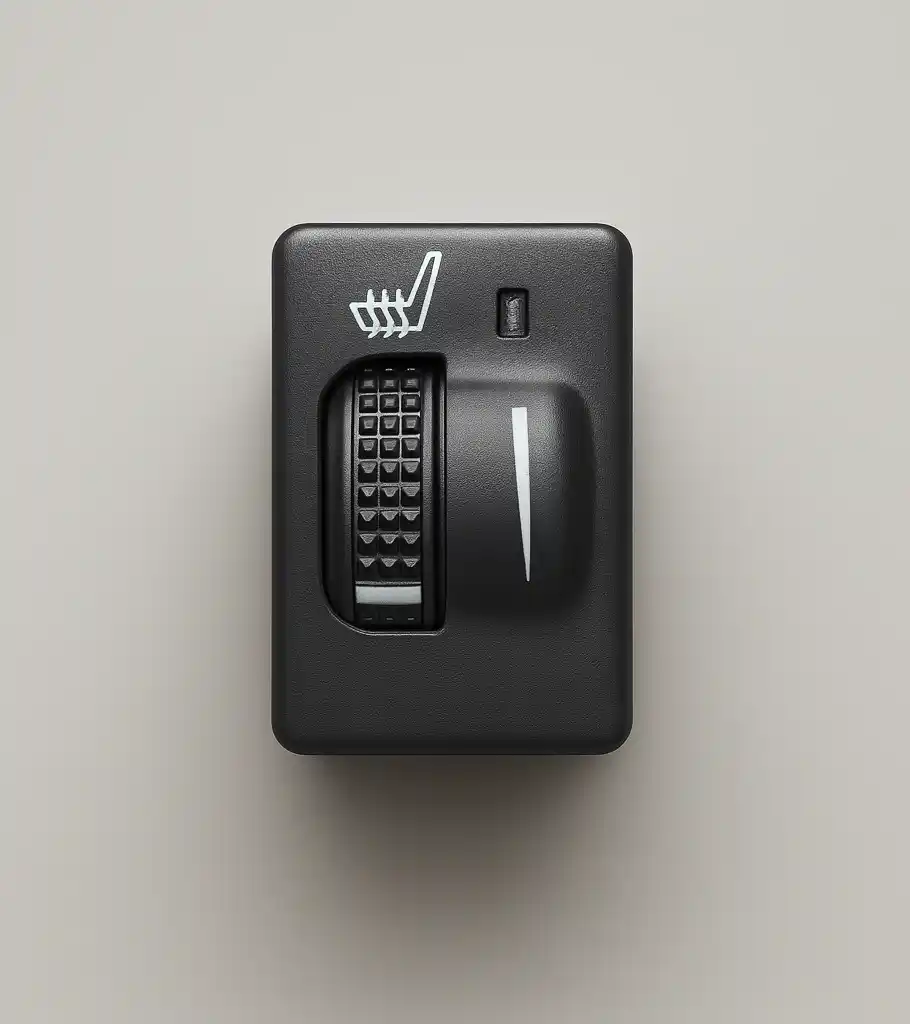
Good options include a large rocker or paddle switch mounted on the armrest, an inline controller with oversized buttons on a short lead, or integration with the power chair’s existing accessory controls where the manufacturer supports it. Multi-level switching (high/low/off) is worth having:
- a lower setting for all-day use
- a higher setting for initial warm-up. Backlit indicators matter too
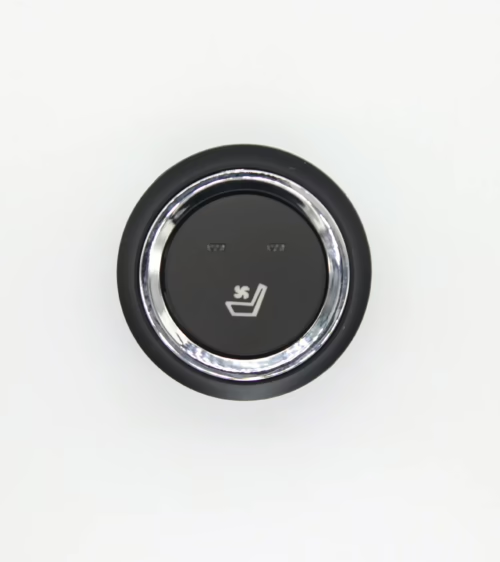
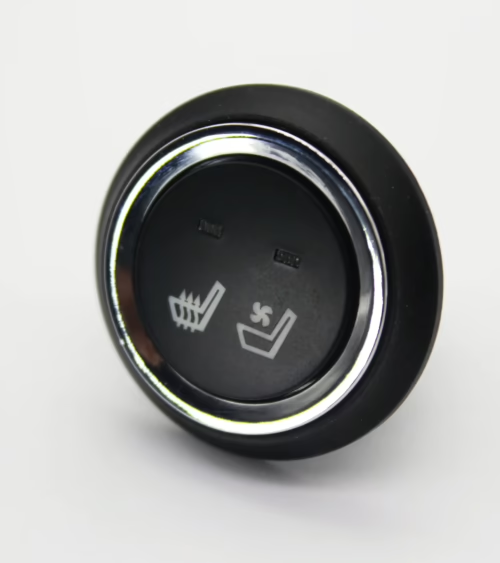
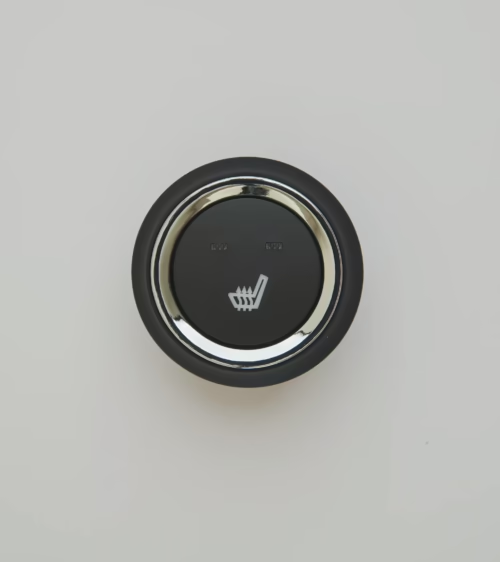
- because they are the only confirmation the heater is on when the user cannot feel it. OEM builders and dealers upgrading fleets can find suitable multi-level seat heater switches in round and rocker formats that mount cleanly into armrest panels.
6. Plan the Installation Around Daily Use
Wheelchairs get folded, transferred in and out of vehicles, rained on, and washed. The installation has to survive all of it.
- Pad placement: under the cushion cover, on top of the foam or air cells — never inside a sealed cushion where heat cannot dissipate, and never loose on the surface where it will wrinkle and crease.
- Wire routing: follow the frame tubes, leave a service loop at every pivot and folding point, and secure with cable ties rated for outdoor UV exposure. The lead exit from the pad is the most common failure point; route it so transfers do not snag it.
- Connectors: use a locking, polarized connector between the pad and the harness so the cushion can be removed for washing without cutting wires. The heating pad itself is typically not washable — it must disconnect and stay out of the laundry.
- Moisture: specify a pad with sealed element construction if the chair is used outdoors. Incontinence covers and heating pads can coexist, but the pad goes beneath the waterproof layer.
7. Do the Battery Math Before You Buy
Range anxiety is real for power chair users, so quantify the cost of heat. A 20W seat pad on a 24V system draws about 0.85A. Against a typical pair of Group 24 batteries (roughly 70Ah at 24V), one hour of continuous heating consumes just over 1 percent of capacity.
With a thermostat cycling the pad at a 30–50 percent duty cycle once it reaches temperature, a full day of heated use might cost 3–5 percent of range — noticeable, but far from crippling.
The math changes on smaller travel chairs with 20Ah lithium packs, where the same pad could consume 15 percent or more of capacity over a day.
In that case, drop to a 10–15W pad, use the timer aggressively, or run the heater from a separate power bank so mobility range is never at risk.
Manual wheelchair users running USB pads should expect roughly 2–4 hours of heat per 10,000mAh of power bank capacity at a 10W draw.
Frequently Asked Questions
Can I use a car seat heater pad on a wheelchair?
Electrically, only if the voltages match — a 12V automotive pad needs a 24V-to-12V converter on most power chairs. More importantly, automotive pads regulate to higher surface temperatures than are safe for users with reduced sensation.
If the user cannot reliably feel heat, use a pad and controller specified for skin-safe continuous contact, not an unmodified car pad.
Will a seat heater damage my pressure relief cushion?
A thin, flexible pad placed under the cushion cover generally preserves the cushion’s immersion and envelopment properties, but placement matters.
Never fold or bunch the pad, keep it off the direct load path under the sitting bones where possible, and confirm compatibility with the cushion manufacturer for air-cell cushions, since sustained heat can affect internal air pressure.
How warm should a wheelchair seat heater get?
For users with normal sensation, 40–42°C at the surface is a comfortable ceiling. For users with impaired sensation, hold the surface at 36–40°C — close to skin temperature — and pair it with an automatic shutoff timer.
Warmth for hours at a safe temperature beats short bursts of high heat in this application.
Lucky Driver Inc. supplies OEM-grade seat heating pads, switches, and control modules to seat manufacturers and mobility equipment builders across North America, with custom element sizing, voltage options, and temperature regulation tailored to wheelchair and mobility applications.
Whether you are prototyping a heated seating option or sourcing production volumes, you can browse our complete range of seat heating products or contact our engineering team to discuss your specification.
Related Articles
- Tractor Seat Heater: 7 Things to Know Before You Buy (2026)
- Golf Cart Heated Seats: 7 Things to Know Before You Buy (2026)
- UTV Heated Seat Kit: 5 Things to Know Before You Buy (2026)
- Boat Seat Heater: 5 Things to Know for 2026
- RV Heated Seats: 6 Things to Know Before You Upgrade (2026)
Frequently Asked Questions About wheelchair seat heater
Procurement engineers evaluating wheelchair seat heater for OEM programs regularly ask the following questions. Answers cover specification, compatibility, certification, and sourcing for wheelchair seat heater requirements.
What voltage ratings are available for wheelchair seat heater?
Standard wheelchair seat heater configurations support 12 V DC for passenger vehicles and 24 V DC for commercial trucks. Selecting the correct wheelchair seat heater voltage at the design stage eliminates harness rework later. Lucky Driver maintains wheelchair seat heater inventory in both ratings for same-week shipment.
Which certifications apply to wheelchair seat heater production?
wheelchair seat heater assemblies entering OEM programs typically require UL recognition, REACH compliance, and RoHS documentation. Lucky Driver holds certification records for every wheelchair seat heater variant and includes copies with sample and production shipments.
How is watt density specified for wheelchair seat heater?
Watt density for wheelchair seat heater is expressed in W/cm² and ranges from 0.04 to 0.12 depending on heat-up time requirements. Lower watt density wheelchair seat heater designs improve element longevity, while higher values suit cold-climate applications.
Lucky Driver engineering reviews wheelchair seat heater requirements and recommends watt density based on your seat platform.
What connector families are used with wheelchair seat heater?
wheelchair seat heater harnesses are available with Molex, TE Connectivity, and Delphi connector families. Matching the wheelchair seat heater connector to the vehicle harness reduces assembly time and eliminates adapter cables. Specify your harness format when requesting a wheelchair seat heater quote from Lucky Driver.
What is the lead time for wheelchair seat heater samples?
wheelchair seat heater samples from Lucky Driver’s North American warehouse ship within 3 to 5 business days for standard configurations. Custom wheelchair seat heater variants with modified pad geometry or connector pinouts require 4 to 6 weeks. Contact Lucky Driver to confirm wheelchair seat heater availability before submitting your engineering schedule.