Automotive resistance wires are the heating element in wire-based seat heater pads, converting electrical energy to heat through their ohmic resistance. Selecting the correct automotive resistance wires for a seat heater application requires specifying three independent properties: the resistive alloy which determines resistance per unit length and thermal stability, the wire gauge which determines current capacity and physical stiffness, and the insulation material which determines temperature rating and flex life at the design bend radius.
This guide covers the technical properties of automotive resistance wires used in seat heater elements and the supplier qualification criteria that define a production-grade material.
1. Resistive Alloy Selection for Automotive Resistance Wires
The resistive alloy determines the fundamental electrical properties of automotive resistance wires — resistance per meter, temperature coefficient of resistance, and oxidation resistance at operating temperature. Three alloy families dominate seat heater applications.
Nichrome (NiCr 80/20) is the most widely used alloy for automotive resistance wires in seat heaters. It offers resistivity of approximately 1.10 microohm-meters, a near-zero temperature coefficient of resistance in the operating range of 20 to 80 degrees C, and excellent oxidation resistance. Its resistance remains stable over the thermal cycling life of the vehicle, making it the preferred choice for programs requiring predictable watt output over time.
Kanthal (FeCrAl) automotive resistance wires offer higher maximum temperature ratings and lower cost than Nichrome, but higher temperature coefficient of resistance and lower tensile strength, making them more susceptible to breakage at fold points in highly contoured seat designs.
Copper-nickel automotive resistance wires — typically CuNi44 with 44 percent nickel content — offer the highest resistivity in the commercial alloy range and are used in low-resistance, high-watt-density applications where the wire length must be minimized to fit within the seat geometry constraints.
2. Wire Gauge and Resistance Calculation
The gauge of automotive resistance wires determines resistance per unit length and physical stiffness. Thinner gauge automotive resistance wires produce higher resistance per meter, requiring shorter total wire length for a given pad resistance target. Thicker gauge wires produce lower resistance per meter, requiring longer total wire length and adding weight and stiffness to the heater pad assembly.
Common gauges for seat heater automotive resistance wires are 34 to 40 AWG, corresponding to 0.08 to 0.16 mm diameter. At 36 AWG NiCr 80/20, resistance is approximately 26 Ohms per meter — a pad requiring 3.5 Ohms total resistance needs approximately 135 mm of wire, serpentine-routed across the pad area. At 38 AWG, resistance is approximately 40 Ohms per meter, requiring approximately 87.5 mm for the same 3.5 Ohm target in the automotive resistance wires pad design.
3. Insulation Material and Temperature Rating
The insulation on automotive resistance wires serves two functions: electrical isolation of the conductor from the non-woven substrate and adjacent wire traces, and mechanical protection of the conductor from abrasion during pad lamination and seat assembly. Insulation materials used in automotive resistance wires include polyimide (Kapton), PTFE (Teflon), and high-temperature PVC.
Polyimide insulation is the premium choice for automotive resistance wires in OEM programs, offering a continuous temperature rating of 220 degrees C, excellent chemical resistance, and minimal wall thickness — typically 0.012 to 0.025 mm — that preserves the flexibility of the wire at small bend radii. PTFE insulation offers similar temperature rating at lower cost with slightly larger wall thickness.
High-temperature PVC is used in price-sensitive aftermarket applications, rated to 105 degrees C continuous — adequate for normal seat operating temperatures but marginal if the control system fails to prevent thermal runaway in automotive resistance wires applications.
4. Flex Life Requirements for Automotive Resistance Wires
Flex life is the most critical durability specification for automotive resistance wires used in seat heater pads, because the heater element is subjected to millions of compression-and-release cycles as occupants sit down and stand up, and to repeated flexion at seat hinge and bolster zones.
Industry practice tests flex life by cycling the insulated automotive resistance wires over a mandrel at the minimum design bend radius of the application, to a minimum of 50,000 cycles without measurable resistance change or conductor fracture.
Automotive resistance wires that fail flex life testing almost always fail at the grain boundary level — repeated mechanical stress causes microcracking in the conductor material that progressively increases resistance until the wire eventually opens. Alloys with fine-grain microstructure, achieved through controlled drawing and annealing processes, outperform coarse-grain alternatives in flex life, particularly at bend radii below 5 mm.
This is a critical selection criterion when evaluating automotive resistance wires suppliers for seat programs with tight bolster geometry.
5. Supplier Qualification Criteria for Automotive Resistance Wires
Qualifying an automotive resistance wires supplier for a production seat heater program requires verifying six capabilities. First, the supplier must provide a chemical composition certificate for each production lot, confirming alloy content within specification. Second, resistance per meter must be reported with mean and standard deviation — typical OEM acceptance criteria is plus or minus 3 percent of the nominal value.
Third, insulation integrity must be verified by spark testing at 1,000 V DC across a defined length of automotive resistance wires.
Fourth, flex life test data must confirm the minimum cycle count at the design bend radius. Fifth, minimum tensile strength must be reported to verify conductor integrity for machine-wound pad manufacturing. Sixth, the supplier must operate under an IATF 16949-certified quality management system or equivalent automotive quality standard for automotive resistance wires production.
6. Automotive Resistance Wires in the Context of a Complete Heater Pad
Automotive resistance wires perform as specified only when the complete pad assembly — wire, substrate, adhesive, and thermistor — is designed as an integrated system. The substrate bonding adhesive must not wick into the insulation coating during lamination, as this increases effective insulation thickness and changes the thermal coupling between the automotive resistance wires and the pad surface.
The non-woven substrate must be bonded uniformly across the full pad area to prevent localized stress concentrations at adhesive voids that accelerate flex failure. The thermistor must be located to read a representative average of the temperature field created by the serpentine automotive resistance wires routing pattern.
Frequently Asked Questions About Automotive Resistance Wires
Can automotive resistance wires be repaired if a break occurs in a seat heater pad?
Field repair of automotive resistance wires is possible in some cases using a conductive epoxy bridge or a short splice of the same gauge wire soldered across the break. However, a repaired joint creates a localized resistance discontinuity and a potential mechanical weak point that will typically fail again within 6 to 12 months of normal use.
For OEM warranty repairs, full pad replacement is the recommended approach rather than attempting to repair the automotive resistance wires in place.
Do thinner automotive resistance wires produce more heat?
Thinner automotive resistance wires have higher resistance per meter, so a shorter length delivers the same total pad resistance as a longer length of thicker wire. Watt output depends on pad resistance and supply voltage, not wire diameter — thinner automotive resistance wires do not inherently produce more heat.
However, thinner wire does produce higher current density per cross-section, which can cause localized hot spots if the wire is poorly bonded to the substrate and loses direct thermal coupling to the pad surface.
What is the difference between NiCr and CuNi automotive resistance wires?
NiCr 80/20 automotive resistance wires offer lower and more stable resistance across the temperature range, making them the preferred choice for programs requiring predictable watt output. CuNi automotive resistance wires offer higher resistivity, which allows shorter wire runs in space-constrained pad designs, but the higher temperature coefficient of resistance means the control module must compensate for resistance drift as the pad heats up.
NiCr automotive resistance wires are the more common choice in OEM production for this reason.
Source Automotive Resistance Wires from Lucky Driver Inc.
Lucky Driver Inc. supplies automotive resistance wires in NiCr 80/20 and CuNi alloys to seat heater pad manufacturers and OEM seat suppliers across North America. Each lot of automotive resistance wires is supplied with a composition certificate, resistance-per-meter report, and insulation integrity test record. Custom gauge, alloy, and insulation combinations are available for programs with non-standard specifications. Contact Lucky Driver Inc. to request automotive resistance wires samples or a production quotation.
Automotive Resistance Wires: Summary
Specifying the right automotive resistance wires for a seat heater element requires matching the alloy, gauge, insulation type, and flex life rating to the pad design and the vehicle operating environment. Lucky Driver Inc. maintains automotive resistance wires inventory in standard configurations for immediate delivery, with engineering support for alloy selection and gauge calculation in new pad development programs. Contact us to begin your automotive resistance wires sourcing process.
Further Reading
Technical Glossary
NTC Thermistor: Negative Temperature Coefficient resistor used as the temperature feedback sensor in seat climate systems. Resistance decreases predictably as temperature rises, allowing the control module to calculate surface temperature and adjust duty cycle.
PWM (Pulse Width Modulation): The seat heater module switches the element circuit on and off at high frequency, varying the on-time ratio between 0% and 100% to achieve any intermediate power level without resistive loss in a series regulator.
LIN Bus: Low-speed serial protocol used in automotive seat climate systems for communication between the seat module and body control module. Operates at 20 kbit/s over a single wire, enabling infotainment-screen control and OBD-II fault code reporting.
IP54 Rating: Minimum ingress protection for seat climate components. The first digit (5) indicates dust protection; the second (4) indicates resistance to water splash from any direction — required for components exposed to beverage spills.
CISPR 25 Class 5: Most stringent automotive radiated and conducted emissions limit. Switching noise from heater PWM circuits must remain below defined limits from 0.15 MHz to 1 GHz to prevent audible AM radio interference.
PPAP: Production Part Approval Process. Requires dimensional reports, material certifications, and process capability data before a component enters production at an OEM facility. Most Tier-1 seat suppliers require full PPAP from upstream component suppliers before sourcing approval is granted.
Industry Standards and Compliance Reference
ISO 16750: Environmental conditions and testing for electrical and electronic equipment in road vehicles. Defines temperature cycling, humidity, vibration, and shock test profiles that seat climate components must survive without performance degradation or connector failure during a vehicle lifetime of 15 years or 240,000 kilometers.
SAE J1772: While primarily an EV charging standard, the 12 V auxiliary power architecture defined in SAE J1772 governs the operating voltage envelope that automotive seat accessories must tolerate — nominal 12 V, range 9–16 V, transient spikes to 24 V for 50 ms under load-dump conditions.
REACH and RoHS Compliance: European Union regulations restricting hazardous substances in electrical equipment. REACH limits 224 substances of very high concern (SVHCs). RoHS restricts lead, mercury, cadmium, hexavalent chromium, and four phthalates. OEM customers increasingly require full REACH and RoHS compliance declarations before approving suppliers.
IATF 16949:2016: Automotive quality management system standard derived from ISO 9001, adding automotive-specific requirements including control plans, process FMEA, production part approval, and customer-specific requirements. Tier-1 seat manufacturers typically require sub-tier component suppliers to hold IATF 16949 certification or to operate under an approved quality agreement.
UL 94 V-0 Flammability: Polymer components used in seat climate systems must meet UL 94 V-0 flammability classification — the specimen must self-extinguish within 10 seconds of flame removal, with no dripping of burning particles. This applies to connector housings, wire insulation jacketing, and control module enclosures.
Resistance Wire Failure Modes and Troubleshooting Reference
Open Circuit (No Heat): The most common field failure. Caused by mechanical fatigue at sharp bends, connector pin backout, or corrosion at crimped terminations. Diagnose with a continuity test across the element from connector to connector. An open will read infinite resistance or OL on a multimeter. Repair by replacing the element assembly rather than attempting splice repair, which creates a localized high-resistance hot spot.
Short Circuit (Immediate Fuse Blow): Occurs when element insulation fails and two conductors contact each other or the seat frame. Caused by insulation abrasion from seat mechanism contact, chemical degradation from spills, or manufacturing defects. Diagnose by isolating each zone and testing resistance to chassis ground — a short reads near zero ohms. Replace the element; do not bypass the fuse.
Partial Short (Erratic Heat): A partial insulation breakdown creates a high-resistance parallel path. The element heats unevenly and may blow fuses intermittently. Hard to locate without a thermal camera. Operate the element for 60 seconds and scan for hot spots with an IR thermometer or thermal imaging camera.
Connector Corrosion (Intermittent): Salt, moisture, and cycling temperatures cause oxidation at push-fit connector terminals. Presents as intermittent heat that resolves when the connector is wiggled. Clean contacts with electrical contact cleaner and dielectric grease. Replace connectors showing green oxide deposits on copper terminals.
Calibration Drift (Incorrect Temperature Regulation): NTC thermistors age over time as the thermistor bead composition changes with thermal cycling. A thermistor that reads higher resistance than its nominal value causes the controller to under-heat; one reading lower resistance causes over-heating. Replace the thermistor if measured resistance at ambient temperature deviates more than ±10% from the rated value specified on the datasheet.
Frequently Asked Questions
Q: How long does a well-made resistance element typically last?
A: In normal use, a properly designed element lasts 10–15 years or 200,000 thermal cycles. Premature failure usually traces to installation defects — sharp bends that create fatigue points, connector crimps that were not fully seated, or foam adhesives that trap moisture against bare conductor sections.
Q: Should I use a fuse between the power supply and the element?
A: Always. Install an inline fuse rated to 125–150% of the expected steady-state current within 45 cm of the positive supply connection. This protects the wiring harness in the event of an element short circuit and meets most OEM harness protection standards.
Q: Can elements be connected in parallel to increase heat output?
A: Yes, but total current must stay within the fuse and controller rating. Two 4 A elements in parallel draw 8 A. Ensure the feed wire gauge, fuse rating, and controller contact rating all accommodate the combined load before wiring in parallel.
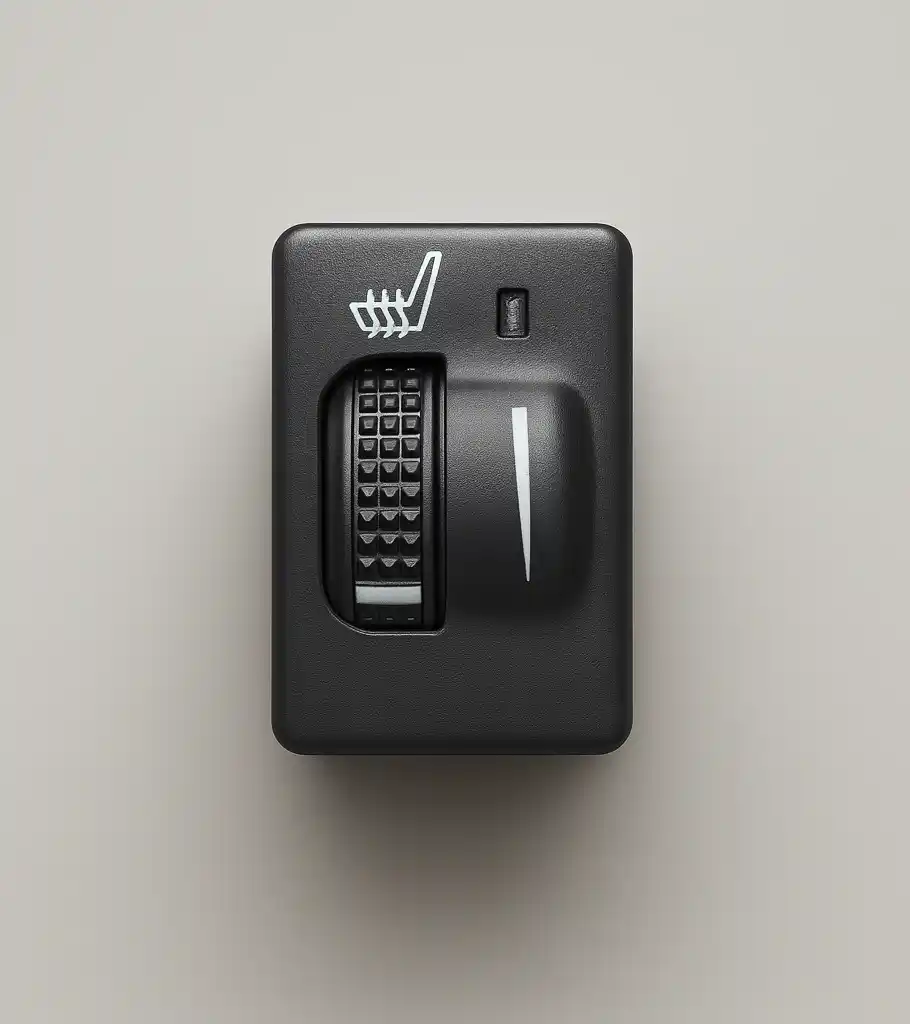
For sourcing, see our OEM-style seat heater switches available for immediate delivery.
Related Articles
- How to Add Heated Seats to Any Car: 5-Step Aftermarket Installation Guide
- Seat Heater Switch Replacement: Identification, Sourcing, and Installation Guide
- Seat Ventilation System: How It Works, Components, and OEM Sourcing Guide
- How to Choose an Automotive Seat Heater Supplier: 7 Qualification Criteria