A heated seat cushion 12V vehicles can run straight from the accessory socket is one of the cheapest comfort upgrades available, but spec sheets for these products are often vague and sometimes misleading.
Wattage, heating element type, control logic and safety cutoffs vary widely between cushions that look identical in a product photo.
This guide walks through the seven specifications that actually matter, whether you are an installer choosing a plug-in pad for a customer, a distributor qualifying a new supplier, or a fleet manager equipping work trucks for winter.
The same engineering principles apply to factory-fitted seat heaters and to portable cushions. The main differences are where the element sits in the seat stack and how the unit is powered, so understanding the fundamentals helps you judge both categories with the same yardstick.
1. Wattage and Current Draw
Most 12V cushions are rated between 30 W and 60 W per seat position, with a separate element for the seat base and the backrest. The rating on the label is usually stated at a nominal 12.0 V, but a running vehicle supplies 13.8 V to 14.4 V from the alternator.
Because resistive heat output scales with the square of the applied voltage, a 45 W cushion at 12 V delivers closer to 60 W at 14 V.
That is the physics of Joule heating, and it explains why a cushion that feels mild on a parked car with the engine off can feel noticeably hotter on the highway.
Current draw follows directly from the wattage. A 45 W element at 12 V has a cold resistance of roughly 3.2 ohms and draws about 3.75 A. Two cushions on a splitter, plus a dash camera and a phone charger, can approach the 10 A or 15 A fuse rating on a typical accessory circuit.
Before recommending a dual-cushion setup, confirm the socket fuse rating in the owner’s manual.
- Check the voltage at which wattage is stated. Ratings quoted at 13.5 V or 14 V inflate the number compared with a 12.0 V rating.
- Confirm whether the rating is per element or per cushion. A “45 W” label may mean 25 W in the seat and 20 W in the back.
- Ask for the maximum inrush current. Cold resistance wire draws more at switch-on than at steady state.
2. Heating Element Type
Three element technologies dominate the 12V cushion market, and the choice affects warm-up time, evenness, durability and cost.
- Alloy resistance wire. Nichrome or copper-nickel wire laid in a serpentine pattern and stitched or laminated to a fabric carrier. This is the lowest-cost option and heats quickly.
- The weaknesses are hot spots where the wire bunches at tight bends, and a single break anywhere in a series circuit kills the entire element.
- Carbon fiber bundles. Multiple carbon filaments bonded into a nonwoven substrate. Carbon fiber elements flex thousands of times without fatigue, spread heat more evenly across the surface, and tolerate a broken filament because the remaining strands carry the load.
- This is the construction most OEM seat heater pads use today.
- PTC film. Positive temperature coefficient polymer whose resistance rises sharply as it warms, so the element limits its own output. PTC cushions are the most forgiving if a thermostat fails, but they cost more and reach full temperature more slowly from a cold start.
Element layout also matters. A wire pitch of 15 mm to 25 mm gives even surface temperature without cold stripes, and the element should stop short of seams and bolster edges where the occupant’s weight concentrates pressure and bending.
3. Temperature Control and Switch Design
The simplest cushions use a single on/off switch and rely on the element’s fixed resistance to set a steady-state temperature. The next step up adds high and low settings, usually by switching a second resistance path or by pulse-width modulating the supply.
The best controllers use a negative temperature coefficient (NTC) thermistor embedded in the pad and hold the surface at a target of roughly 38 °C to 42 °C, which is warm enough to feel immediately but low enough to sit on for an hour without discomfort.
Bimetallic thermostats are still common in budget cushions. They cycle the element fully on and fully off around a fixed trip point, which produces a noticeable warm-cool rhythm and shortens the life of the contact.
An NTC closed loop with a microcontroller gives smoother regulation and makes timer and fault-detection logic possible.
On plug-in cushions the control is normally an inline module on the cord.
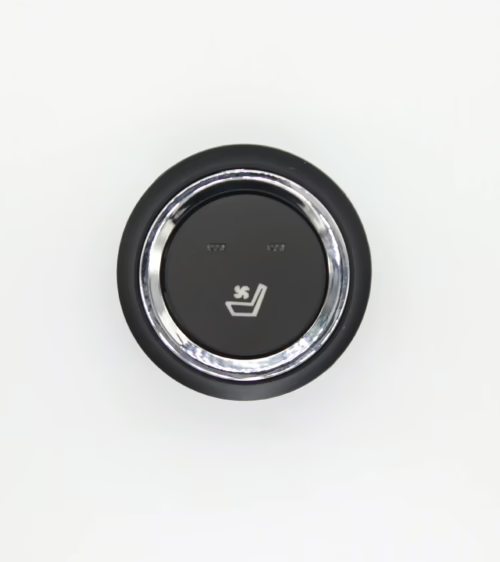
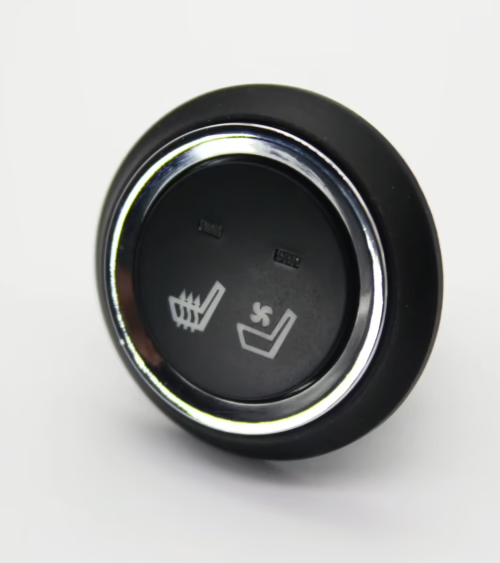
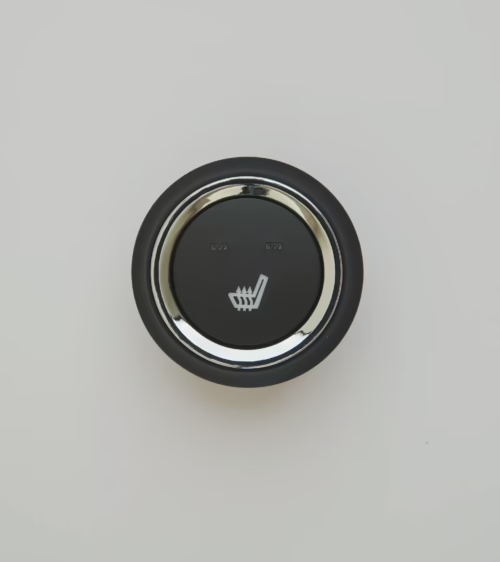
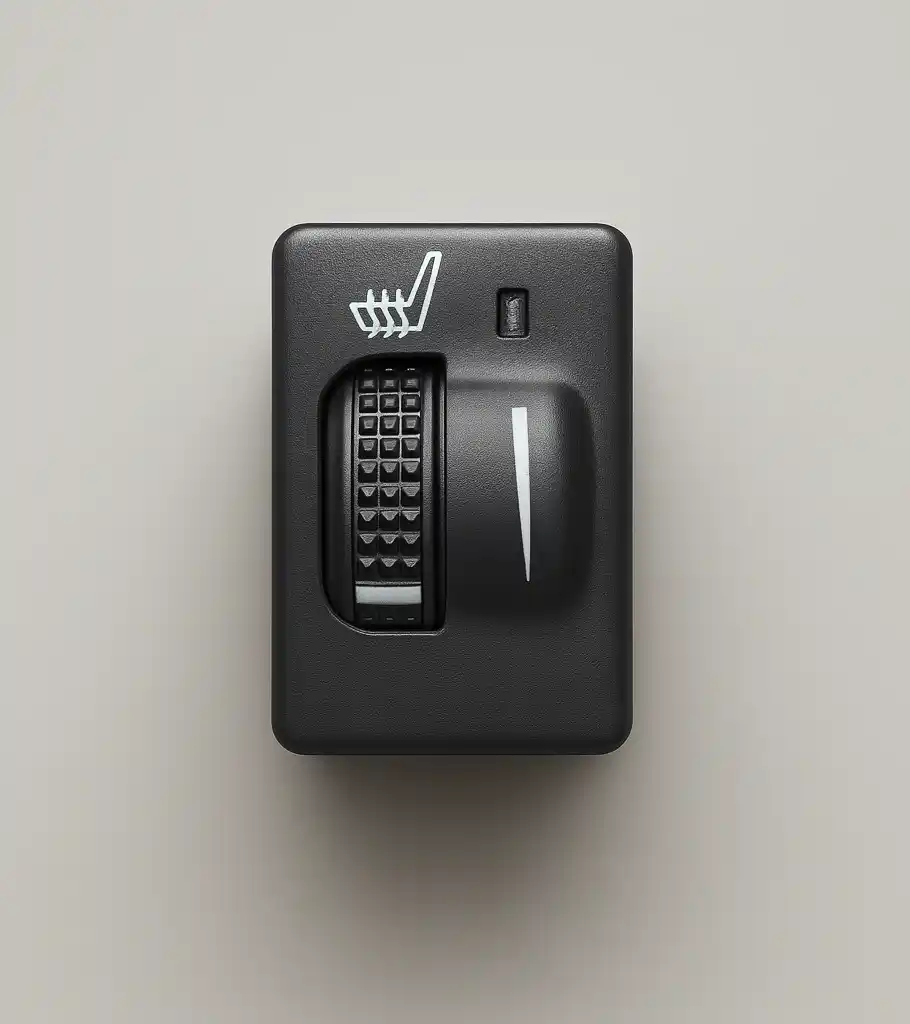
For permanent installations, where the cushion is replaced with a pad under the upholstery, a dash-mounted control from our seat heater switch catalog gives the driver OEM-style high/low selection with backlit indicators and a proper panel cutout.
When evaluating any controller, confirm that it returns to the off state after a power cycle rather than restarting at the last setting, since an unattended cushion that resumes heating when the ignition is turned on is a common source of complaints.
4. Overheat Protection and Auto Shutoff
A well-designed 12V cushion stacks several independent protections, each covering a different failure mode. Do not accept a product that lists only one of these.
- Resettable thermostat. A bimetallic disc in series with the element, typically opening at 55 °C to 65 °C and closing again once the pad cools. This handles everyday overshoot, such as a heavy blanket left on the seat.
- One-shot thermal fuse. A non-resettable link rated around 90 °C to 100 °C that permanently opens if the thermostat welds closed or the controller fails on. This is the last line of defense against fabric scorching.
- Inline blade fuse. Housed in the accessory plug tip, usually 5 A to 8 A, protecting the cord against a short circuit.
- Auto shutoff timer. A controller that turns the pad off after 30, 45 or 60 minutes. This matters more than most buyers realize: skin held against a 45 °C surface for an extended period can suffer a low-temperature burn even though the pad never feels dangerously hot.
- Low-voltage cutoff. Better controllers monitor supply voltage and shut down below about 11.5 V so a cushion left running with the engine off does not flatten the battery.
5. Power Connection: Plug-In vs Hardwired
The accessory socket is convenient, but it has real limitations. Many vehicles leave the socket live with the ignition off, which combined with a cushion that lacks a low-voltage cutoff is a recipe for a dead battery.
Socket contacts also wear, and a loose plug carrying 4 A develops contact resistance that heats the plug body and can melt the housing.
Cord gauge is the spec most listings omit. A single 45 W cushion needs at least 18 AWG conductors on a 2 m cord to keep voltage drop under 0.3 V. A dual-cushion harness should use 16 AWG.
If the cord feels thin and stiff, it is probably 20 AWG or smaller and will run warm.
For a permanent installation, the cushion should be fed from an ignition-switched circuit through a dedicated fuse, with a relay if the combined load exceeds 10 A.
Ground should go to a clean chassis point, not through the seat rail bolts, because paint and thread locker on those bolts create an unreliable return path.
Installers who want to go beyond a plug-in pad can browse our full range of seat heating products for under-upholstery pad kits, control modules and harnesses built for permanent fitment.
6. Cushion Construction and Seat Fit
A typical 12V cushion has four layers: a breathable top fabric such as polyester mesh or microfiber, the heating element on its carrier, 5 mm to 10 mm of open-cell foam to spread the heat and cushion the element from point loads, and a non-slip backing.
The backrest section is usually thinner than the seat section so it does not push the occupant forward.
Fit is more than a comfort issue. Modern vehicles place side airbags in the outboard seat bolster, and the airbag deploys by tearing a weakened seam in the upholstery. A cushion with side straps or wings that cross that seam can block or redirect deployment.
Reputable manufacturers mark their straps to avoid the bolster seam and state airbag compatibility explicitly. Passenger seats also carry an occupant classification sensor in the seat base, and a thick, stiff cushion can shift the sensor reading enough to disable the passenger airbag.
Keep passenger-side cushions thin and flexible, and check that the airbag status lamp behaves normally after installation.
Measure the seat before ordering. Most cushions are 450 mm to 500 mm wide and 450 mm to 480 mm deep in the base section. Sport seats with deep bolsters often need a narrower pad or one with a tapered front edge so the element does not fold over the bolster and bunch.
7. Durability and Compliance Testing
Ask the supplier what testing the cushion has passed. Serious manufacturers can produce reports for the following, and the absence of any of them is a warning sign.
- Thermal cycling. At least 10,000 on/off cycles at rated voltage with the element temperature logged, to prove the thermostat and element survive years of daily use.
- Flex and compression. Repeated loading with a weighted form to simulate entering and exiting the seat, typically 50,000 or more cycles, followed by a resistance check for broken conductors.
- Flammability. Interior materials in US vehicles must meet the horizontal burn rate limit in FMVSS 302.
- The rule applies to the vehicle as sold, not to aftermarket accessories, but a cushion built from compliant fabric and foam is far less likely to propagate a fire if the thermal fuse ever fails.
- Connector retention. Pull testing on the cord-to-pad joint, which is the most common failure point in field returns.
- Overvoltage. Operation at 16 V to confirm the thermostat still limits surface temperature when the vehicle’s charging system runs high.
For OEM and tier-one seat programs, the bar is higher: element pads are validated to the automaker’s own specification, which usually includes humidity, salt fog, and abrasion in addition to the items above.
Aftermarket cushion buyers do not need that depth, but the first three items on the list are a reasonable minimum.
Frequently Asked Questions
Can I leave a 12V heated seat cushion plugged in with the engine off? Only if the controller has a low-voltage cutoff or an auto shutoff timer. A 45 W cushion draws almost 4 A, which will drain a healthy 60 Ah battery to a no-start condition in a few hours.
Unplug the cushion or use an ignition-switched socket if you are unsure.
How hot does a 12V heated seat cushion get? A properly regulated cushion holds the surface at about 38 °C to 42 °C. Unregulated budget pads can exceed 50 °C at the element when the vehicle is running, which is why a thermostat and a thermal fuse are essential rather than optional.
Can I hardwire a plug-in cushion to avoid using the socket? Yes, provided you keep the inline fuse or replace it with a fuse of the same rating in the new circuit, feed the cushion from an ignition-switched source, and use wire of at least 18 AWG.
Cut the plug off only after confirming the cushion’s controller is in the cord and not in the plug body, as some models put the electronics in the plug.
Lucky Driver Inc. supplies carbon fiber and alloy wire seat heater pads, control modules, switches and wiring harnesses to OEM seat manufacturers and aftermarket distributors across North America.
If you are specifying a heated seat cushion 12V program for a vehicle line, a fleet, or a retail product, contact our engineering team for samples, test reports and volume pricing tailored to your application.
Related Articles
- US Automotive Seat Heater Market: 7 Trends Shaping 2026
- Seat Heater Pad Thickness: 7 Factors Engineers Must Check
- Heated Seat Pad Size Chart: 7 Dimensions to Measure First
- Aftermarket Seat Heater Pad: 7 Specs to Check Before You Buy
- Seat Heater Kit Wiring Harness: 7 Things Installers Must Know
Frequently Asked Questions About heated seat cushion 12v
Procurement engineers evaluating heated seat cushion 12v for OEM programs regularly ask the following questions. Answers cover specification, compatibility, certification, and sourcing for heated seat cushion 12v requirements.
What voltage ratings are available for heated seat cushion 12v?
Standard heated seat cushion 12v configurations support 12 V DC for passenger vehicles and 24 V DC for commercial trucks. Selecting the correct heated seat cushion 12v voltage at the design stage eliminates harness rework later. Lucky Driver maintains heated seat cushion 12v inventory in both ratings for same-week shipment.
Which certifications apply to heated seat cushion 12v production?
Heated seat cushion 12v assemblies entering OEM programs typically require UL recognition, REACH compliance, and RoHS documentation. Lucky Driver holds certification records for every heated seat cushion 12v variant and includes copies with sample and production shipments.
How is watt density specified for heated seat cushion 12v?
Watt density for heated seat cushion 12v is expressed in W/cm² and ranges from 0.04 to 0.12 depending on heat-up time requirements. Lower watt density heated seat cushion 12v designs improve element longevity, while higher values suit cold-climate applications.
Lucky Driver engineering reviews heated seat cushion 12v requirements and recommends watt density based on your seat platform.
What connector families are used with heated seat cushion 12v?
Heated seat cushion 12v harnesses are available with Molex, TE Connectivity, and Delphi connector families. Matching the heated seat cushion 12v connector to the vehicle harness reduces assembly time and eliminates adapter cables. Specify your harness format when requesting a heated seat cushion 12v quote from Lucky Driver.
What is the lead time for heated seat cushion 12v samples?
Heated seat cushion 12v samples from Lucky Driver’s North American warehouse ship within 3 to 5 business days for standard configurations. Custom heated seat cushion 12v variants with modified pad geometry or connector pinouts require 4 to 6 weeks.
Contact Lucky Driver to confirm heated seat cushion 12v availability before submitting your engineering schedule.