Launching a line of private label seat heaters is one of the fastest ways for an aftermarket distributor, upfitter, or accessory brand to move from reselling someone else’s box to owning a product category outright.
The engineering is mature, the tooling costs are modest compared to most automotive hard parts, and the demand curve is predictable:
- every cold-weather market replaces seat heating elements long before it replaces seats. What separates a profitable private label program from a warranty sinkhole is not branding — it is the dozen technical decisions you make before the first carton ships. This guide walks through seven steps
- in the order a serious program actually follows
- with the specifications you need to verify at each stage.
1. Define the Application Envelope Before You Talk Price
The single most common mistake in private label sourcing is requesting a quote before defining the vehicle envelope.
A seat heater pad built for a compact sedan bucket seat will not conform to a full-size truck bench, and a pad sized for a 12V passenger car circuit will fail prematurely on a 24V commercial chassis. Lock down these parameters first:
- Seat architecture: bucket, bench, split-bench, or captain’s chair; whether the cushion uses a sewn-in trench (listing wire channel) that the pad must avoid.
- Pad geometry: cushion and backrest pads are almost never the same size. Typical cushion pads run 250–320 mm wide; backrest pads run taller and narrower.
- System voltage: 12V for virtually all light vehicles, 24V for heavy truck, agricultural, and some marine applications.
- Trim interface: leather, vinyl, and perforated leather tolerate different surface temperatures than cloth, which insulates more and heats slower.
- Retrofit vs. OEM-replacement: a retrofit kit needs a universal pad plus harness and switch; an OEM-replacement SKU needs connector-level compatibility with the factory module.
Write this envelope into a one-page specification sheet. Every supplier conversation afterward becomes dramatically shorter and more honest.
2. Choose the Heating Element: Carbon Fiber vs. Alloy Wire
Two element technologies dominate the market, and the choice drives cost, feel, and failure mode.
- Alloy resistance wire (typically copper-nickel or nickel-chrome, stranded and insulated, stitched in a serpentine pattern onto a non-woven carrier). Advantages:
- extremely consistent resistance per unit length
- easy to tune wattage by adjusting pattern pitch
- decades of field history. The failure mode is a single break in the circuit — one fatigue point and the zone goes dead.
- Carbon fiber / carbon-coated film elements distribute current across many parallel paths. Advantages: tolerant of localized damage (a puncture kills only a fraction of the output), thinner stack-up, and better flex life in high-cycle seats. Disadvantages: higher unit cost and tighter process control required to hold resistance tolerance.
For a first private label program targeting aftermarket retrofit, stitched alloy wire on a non-woven carrier remains the best value-per-watt. For premium or OEM-adjacent SKUs where warranty exposure is the dominant cost, carbon-based elements justify the premium.
Specify resistance tolerance explicitly — ±8% is a reasonable production limit; suppliers who will not commit to a tolerance in writing are not measuring it.
3. Set Wattage, Current Draw, and Warm-Up Targets
Wattage is where marketing and engineering collide. Buyers want “fast,” and the lazy answer is to push wattage upward — which stresses the vehicle’s circuit and the trim surface. Reasonable 12V targets:
- Cushion pad: 35–50 W, roughly 3–4 A.
- Backrest pad: 25–40 W, roughly 2–3.5 A.
- Per-seat total: 60–90 W, or 5–7.5 A — which is why a two-seat kit needs a dedicated fused feed, typically 15 A per seat or 20–25 A for a shared circuit, and a relay rather than a switched accessory tap.
- Warm-up target: a perceptible rise at the trim surface within 60–90 seconds, and a steady-state surface temperature of 38–42 °C on high. Above roughly 45 °C you enter a zone where prolonged contact becomes a real burn and comfort complaint risk, particularly for occupants with reduced skin sensation.
The physics here is simply Joule heating — power dissipated equals current squared times resistance — which means resistance drift across your production lot translates directly into output variance your customers will feel. Hold the tolerance, and the perceived quality follows.
4. Specify Temperature Control and Protection
An unregulated heating pad is a liability. Every private label SKU should carry at least one, preferably two, independent control layers:
- NTC thermistor feedback embedded in the pad, read by a control module that modulates duty cycle to hold a setpoint. This is the OEM approach and gives genuine multi-level control rather than crude on/off cycling.
- PTC self-regulating elements, whose resistance rises with temperature, providing inherent output taper without any electronics. Elegant and cheap, but the setpoint is fixed at design time.
- Thermal cutoff (TCO) or bimetallic thermostat as a hard backstop, typically opening at 55–70 °C. Non-resettable TCOs are safer but create a dead-unit warranty claim; self-resetting bimetals are more forgiving in the field.
- Auto-off timer, commonly 30–45 minutes, which prevents a forgotten heater from draining a battery or cooking a leather cushion in a parked vehicle.
If your program includes an OEM-replacement line, verify that the control module’s thermistor curve matches the factory calibration — a mismatched curve produces a heater that technically works but either barely warms or trips a fault code.
5. Lock Down the Switch, Harness, and Human Interface
The switch is the only part of the system the customer actually touches, and it carries disproportionate weight in reviews.
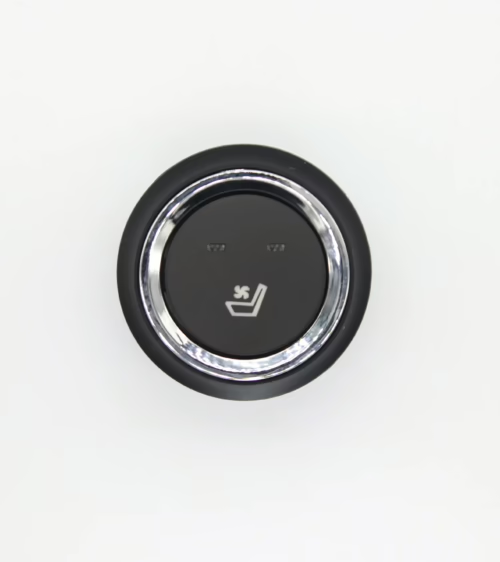
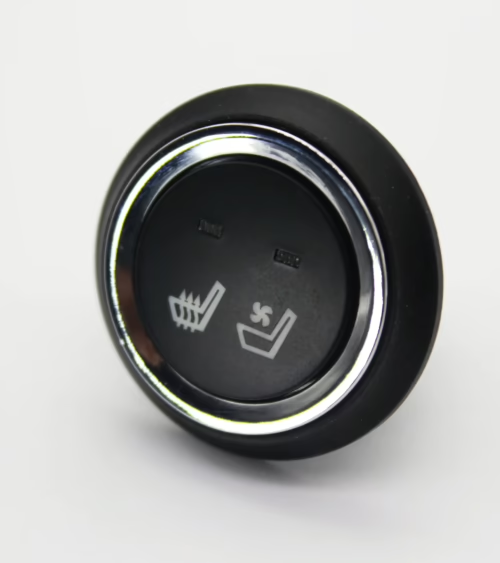
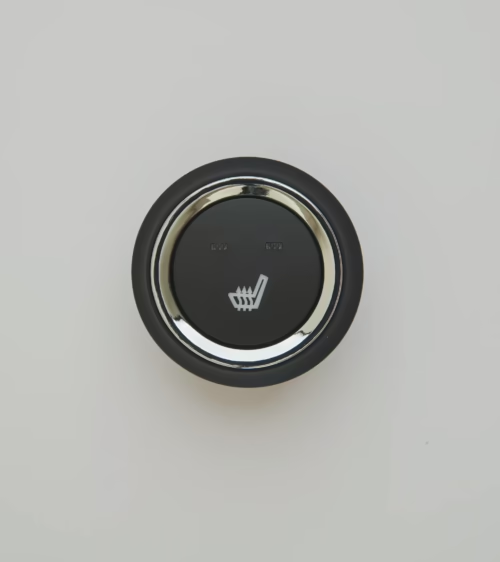
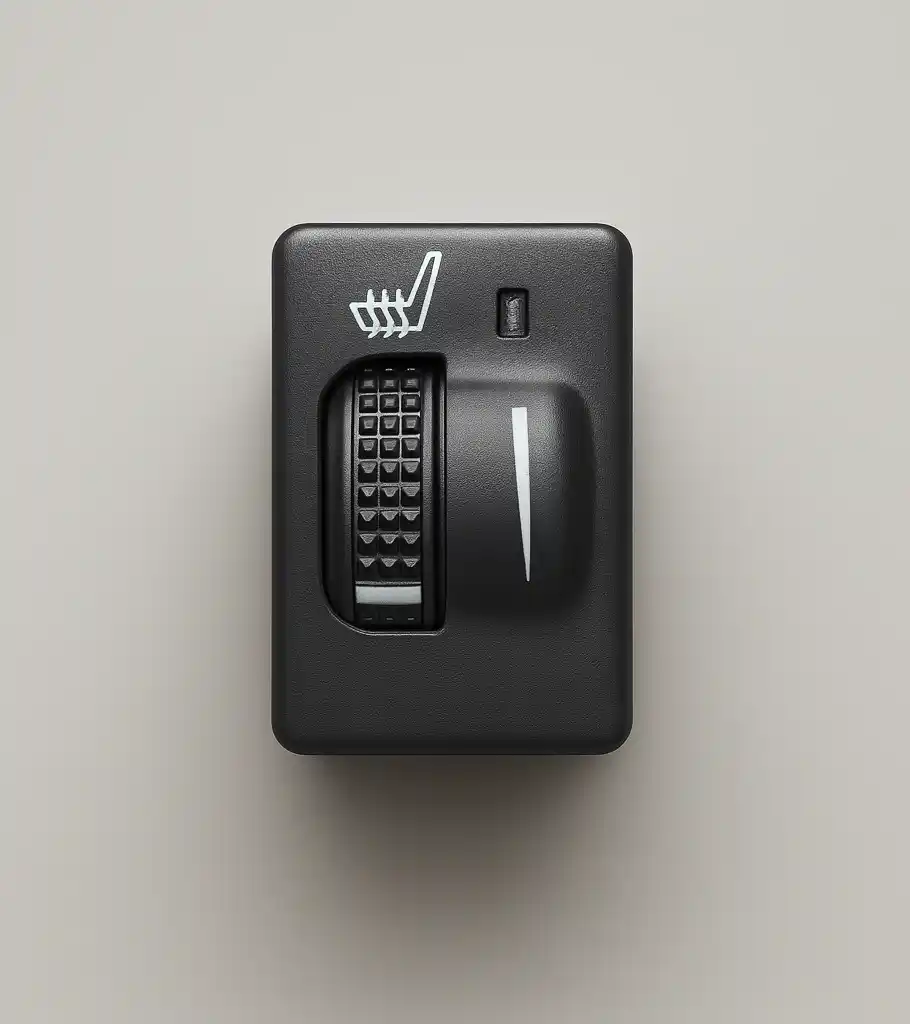
Decide early between a rocker switch with discrete high/medium/low positions, a momentary push-button that cycles levels with LED indication, or an OEM-form switch that drops into a factory blank.
Illumination color and intensity should match the vehicle’s instrument backlighting, and the switch rating must exceed the actual load with margin — a 10 A-rated switch on a 7 A circuit is cutting it close once contact resistance rises with age.
Distributors building kits around existing vehicle architecture frequently source pads from one program and pull OEM-style seat heater switches from a separate catalog to match specific interiors.
On the harness side, insist on these details in writing:
- wire gauge sized for the real current (18 AWG minimum for pad branches
- 14–16 AWG for feeds)
- crimped and sealed terminations rather than solder joints in a flexing zone
- inline fuse in the positive feed
- keyed connectors that cannot be cross-plugged between cushion and backrest
- strain relief where the harness exits the seat pan. Harness failures
- not element failures
- account for a large share of field returns.
6. Handle Compliance, Testing, and Documentation
There is no single federal standard that governs aftermarket seat heaters the way FMVSS governs seats and anchorages, which tempts shortcuts. Resist them — your brand name is on the box, which makes you the responsible party. A defensible compliance file includes:
- Flammability: testing to the FMVSS 302 horizontal burn method for the pad carrier and any added trim material.
- Electrical and environmental validation: thermal cycling, humidity exposure, and salt-spray on connectors for marine or truck applications.
- Durability: compression cycling of the pad to simulate occupant ingress and egress — 50,000 cycles is a common OEM-adjacent target — plus flex testing at the cushion front edge.
- Surface temperature mapping across the pad with a thermocouple grid, documenting both maximum and uniformity, because hot spots are what generate complaints.
- Documentation package: material declarations, RoHS/REACH statements, factory quality certification such as IATF 16949, and a signed first-article inspection report.
Request the actual test reports, not a summary email. A supplier running a real validation program will produce them without friction.
7. Negotiate MOQs, Tooling, and Branding Execution
Private label economics hinge on how much customization you demand. Each level adds cost and minimum order quantity:
- Packaging-only private label — your box, your instruction sheet, standard product inside. Lowest MOQ, often a few hundred kits, and the fastest path to market.
- Branded switch and components — logo on the switch bezel, custom LED color, your part numbers laser-marked. Moderate MOQ; usually requires a tooling or marking setup charge.
- Custom pad geometry — patterns cut to your vehicle list. Requires template development and a sample approval round; MOQ rises per SKU.
- Custom control module firmware — your own level logic, timer behavior, or CAN interface. Highest engineering investment, strongest competitive moat.
Build your SKU ladder deliberately. Most successful programs launch with three to five high-volume applications under packaging-only private label, prove sell-through, then reinvest margin into custom geometry for the applications that earned it.
Before committing to tooling, it is worth comparing your target specs against proven production parts — you can browse our full range of seat heating products to benchmark wattage, pad sizes, and control options against what is already validated in the field. Also negotiate warranty terms up front:
- who absorbs the cost of a field failure
- what the defect rate threshold is
- how long replacement stock is held.
Frequently Asked Questions
What is a realistic minimum order quantity for private label seat heaters?
For packaging-level private label with standard product inside, expect a few hundred kits per SKU.
Once you add branded switches or custom pad patterns, MOQs typically rise into the low thousands per SKU because setup, tooling, and first-article validation have to be amortized.
A supplier willing to start you low on packaging-only and scale up as volume proves itself is giving you the right structure for a first program.
How long does a private label program take from specification to first shipment?Packaging-only programs commonly run 6–10 weeks:
- artwork and instruction-sheet approval
- production
- transit. Programs with custom pad geometry or branded components add a sample and approval cycle
- pushing total lead time to 12–16 weeks. Custom firmware or a new control module extends that further
- since validation testing cannot be compressed without accepting real warranty risk.
Should I use carbon fiber or wire elements for an aftermarket retrofit line?
For most aftermarket retrofit kits, stitched alloy resistance wire delivers the best cost-to-performance ratio and has the longest field history.
Carbon-based elements make sense when you are selling into a premium segment, supplying an OEM seat builder, or targeting high-cycle applications such as commercial fleet and rideshare vehicles, where graceful degradation under localized damage is worth the higher unit cost.
Start Your Private Label Program
Lucky Driver Inc. supplies seat heating pads, switches, control modules, and ventilation systems to OEM seat manufacturers and aftermarket distributors across North America, and we build private label programs at every level — from your packaging around proven product to fully custom pad geometry and control logic.
Send us your application envelope, target wattage, and projected annual volume, and we will come back with a specification sheet, validated samples, and realistic MOQ and lead-time numbers you can actually plan around.
If you are still defining the program, our engineering team will help you narrow the specification before you commit to tooling.
Related Articles
- Wholesale Heated Seat Kits: 7 Specs to Verify in 2026
- Automotive Seat Heater Market: 7 Trends Shaping 2026
- Seat Heater OEM Supplier: 7 Criteria for 2026 Sourcing
- Seat Heater Manufacturer USA: 8 Factors to Check (2026)
- Heated and Cooled Seat Conversion: 7 Steps (2026)
Frequently Asked Questions About private label seat heaters
Procurement engineers evaluating private label seat heaters for OEM programs regularly ask the following questions. Answers cover specification, compatibility, certification, and sourcing for private label seat heaters requirements.
What voltage ratings are available for private label seat heaters?
Standard private label seat heaters configurations support 12 V DC for passenger vehicles and 24 V DC for commercial trucks. Selecting the correct private label seat heaters voltage at the design stage eliminates harness rework later. Lucky Driver maintains private label seat heaters inventory in both ratings for same-week shipment.
Which certifications apply to private label seat heaters production?
private label seat heaters assemblies entering OEM programs typically require UL recognition, REACH compliance, and RoHS documentation. Lucky Driver holds certification records for every private label seat heaters variant and includes copies with sample and production shipments.
How is watt density specified for private label seat heaters?
Watt density for private label seat heaters is expressed in W/cm² and ranges from 0.04 to 0.12 depending on heat-up time requirements. Lower watt density private label seat heaters designs improve element longevity, while higher values suit cold-climate applications.
Lucky Driver engineering reviews private label seat heaters requirements and recommends watt density based on your seat platform.
What connector families are used with private label seat heaters?
private label seat heaters harnesses are available with Molex, TE Connectivity, and Delphi connector families. Matching the private label seat heaters connector to the vehicle harness reduces assembly time and eliminates adapter cables. Specify your harness format when requesting a private label seat heaters quote from Lucky Driver.
What is the lead time for private label seat heaters samples?
private label seat heaters samples from Lucky Driver’s North American warehouse ship within 3 to 5 business days for standard configurations. Custom private label seat heaters variants with modified pad geometry or connector pinouts require 4 to 6 weeks.
Contact Lucky Driver to confirm private label seat heaters availability before submitting your engineering schedule.