Automotive comfort components in the seat climate category include every part that contributes to occupant thermal comfort — from heating elements and ventilation blowers to control modules, switches, thermistors, and wiring harnesses. Understanding how these automotive comfort components interact, what specifications define a production-grade part, and how to source them from qualified suppliers is foundational knowledge for vehicle seat engineers, fleet vehicle upfitters, and aftermarket kit distributors.
This guide covers the six core automotive comfort components in the seat climate chain and explains what each must deliver for a system to perform reliably in production.
1. Seat Heater Pads: The Primary Thermal Comfort Component
The seat heater pad is the central element of automotive comfort components for heated seat systems. It consists of a resistive heating element — carbon fiber traces or resistance wire — laminated between non-woven fabric substrates. In production OEM programs, seat heater pads are custom-engineered to match the cushion and backrest geometry of a specific seat platform, with resistance values calculated to deliver target watt output on the vehicle electrical system.
Watt density at the pad surface determines both warm-up speed and surface temperature ceiling. Premium automotive comfort components programs target 0.035 to 0.055 W per square centimeter for cushion zones. Below this range, warm-up time extends past the customer expectation of 3 minutes at 0 degrees C ambient. Above this range, overheat risk increases and requires more sophisticated thermal cutoff architecture to maintain safety margins in the automotive comfort components system.
2. Ventilation Blower Assemblies
Seat ventilation blowers are automotive comfort components that move air through perforated seat covers to reduce body-surface temperature and moisture in warm conditions. BLDC centrifugal blowers rated 12 V, 3 to 8 A are standard in OEM applications, with service life targets of 10,000 operating hours. The blower assembly includes a motor, impeller, housing, and a multi-pin connector stub that mates with the seat climate module harness.
Matching the blower to the distributor plate and cover perforation density is critical — these automotive comfort components must be co-specified for the system to deliver the airflow uniformity and surface temperature reduction stated in the customer specification. Mismatched blower-distributor pairs produce inconsistent comfort that triggers warranty complaints regardless of individual component quality.
3. Seat Climate Control Modules
The control module is the electronic brain of automotive comfort components systems, managing heater PWM duty cycle, blower speed, thermistor feedback, and fault detection in a single assembly. Automotive-grade modules use AEC-Q100 qualified ICs, conformal-coated PCBs, and connectors rated to IP67 for resistance to seat-environment humidity and vibration.
Two control architectures dominate production programs for automotive comfort components. Standalone modules receive switch commands on discrete input lines and manage the heater and blower outputs independently of the vehicle body control module. LIN-bus modules integrate with the BCM or climate control unit, enabling seat climate commands from the infotainment display and providing diagnostic fault codes accessible through the OBD-II port.
4. Seat Heater Switches and Control Buttons
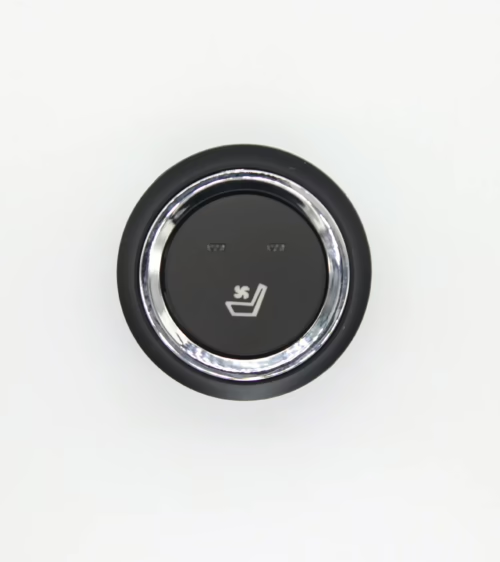
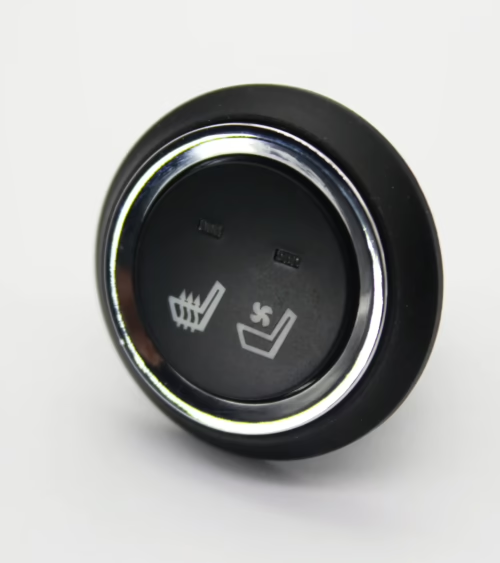
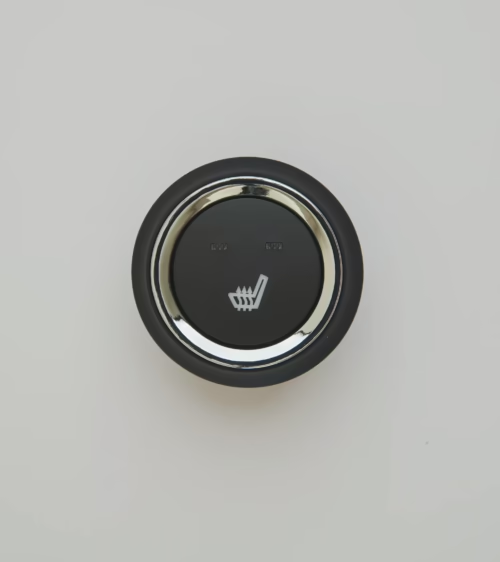
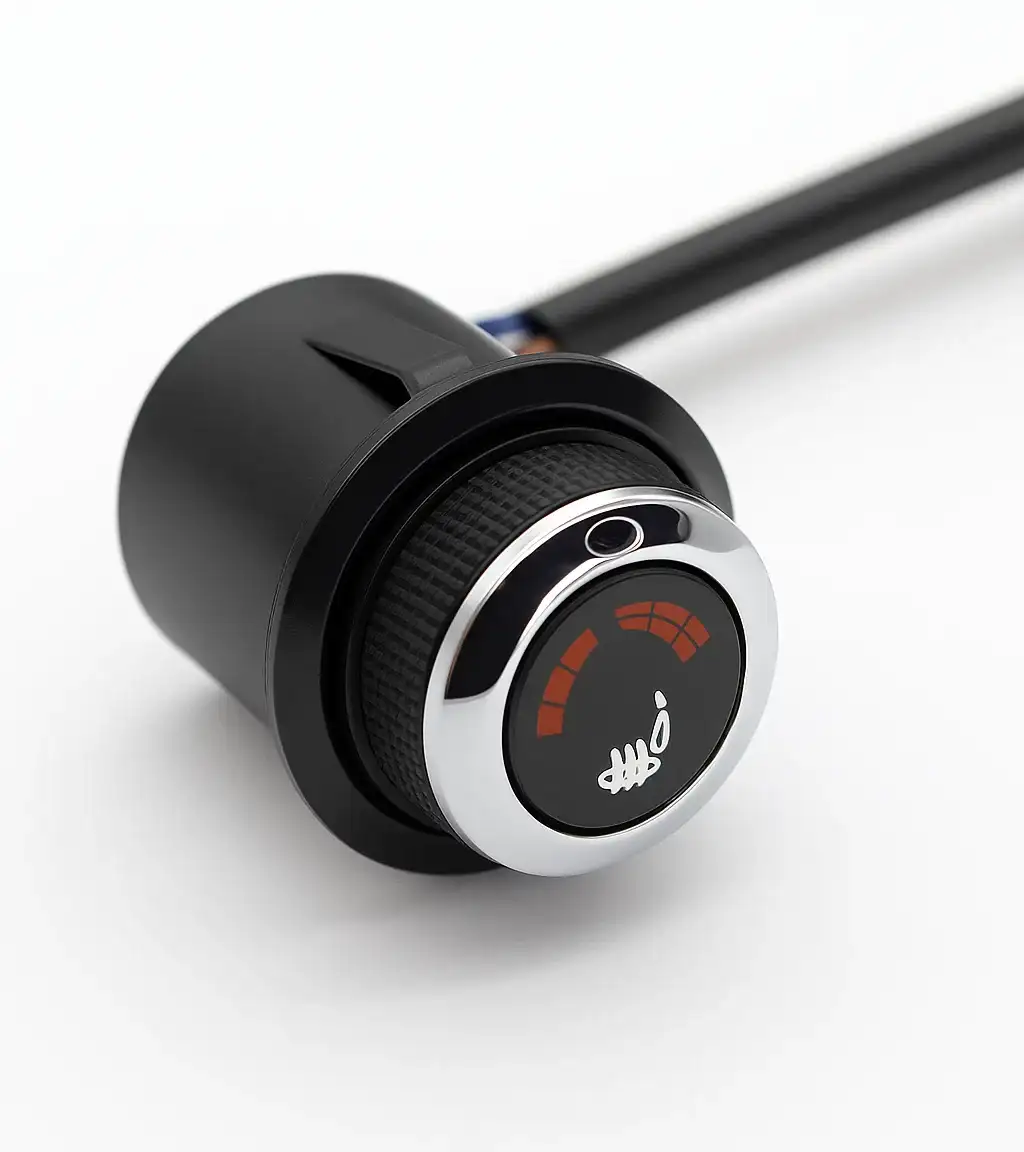
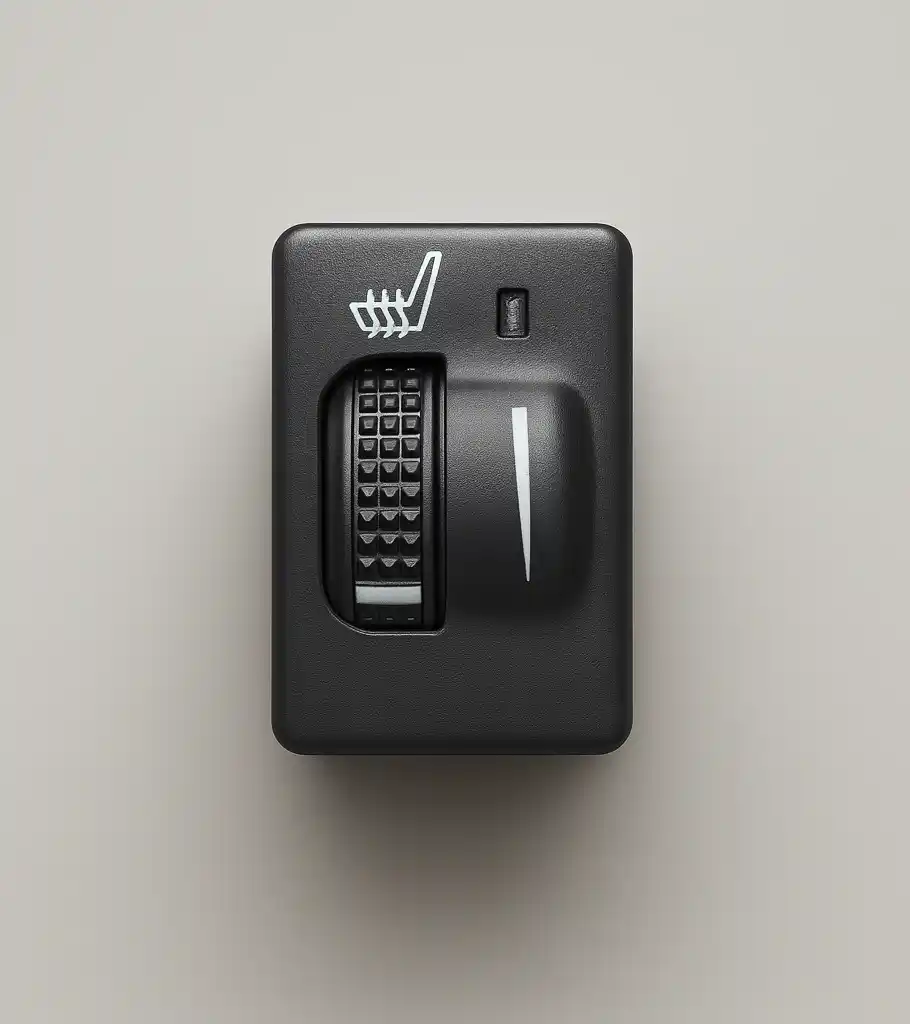
Switches and control buttons are the occupant-facing automotive comfort components — the interface through which the driver and passenger adjust heating level and ventilation speed. Switch format ranges from simple two-position rockers to multi-level push-button panels and LIN-bus capacitive touch assemblies.
Regardless of format, production switch assemblies for automotive programs must meet IP54 minimum sealing, 50,000 actuation mechanical life, and operating voltage compliance from 9 V to 16 V to qualify as production-grade automotive comfort components.
5. NTC Thermistors for Temperature Feedback
The NTC thermistor is the sensing element in automotive comfort components systems that closes the temperature control loop. Embedded in the heater pad near the cushion surface, the thermistor changes resistance predictably with temperature — typically 10 kilohms at 25 degrees C on a standard NTC curve — allowing the control module to calculate actual surface temperature and adjust PWM output to hold the selected setpoint.
Thermistor placement within automotive comfort components assemblies affects control accuracy significantly. A thermistor positioned directly above a resistive element trace will read higher than actual surface temperature, causing the module to under-drive the heater. Best practice in automotive comfort components design places the thermistor midway between element traces to read the averaged surface temperature.
6. Wiring Harnesses and Connector Assemblies
The wiring harness connects all other automotive comfort components in the seat climate system — routing power, ground, switch signals, thermistor sense lines, blower supply, and communication bus wires through the seat structure to the control module. Seat harnesses operate in a uniquely challenging environment: high humidity from occupant perspiration, mechanical stress from fore-aft seat adjustment, and repeated flexion at the seat hinge point.
Wire gauge for automotive comfort components harnesses follows current-carrying requirements — heater element feeds use 18 AWG minimum for 8 A loads, blower feeds use 20 AWG for 3 A loads, and thermistor sense lines use 24 AWG shielded pair to suppress switching noise from the heater PWM circuit. Connector sealing at the harness junction uses IP67-rated connectors with silicone perimeter seals to protect all automotive comfort components from seat-environment moisture.
Frequently Asked Questions About Automotive Comfort Components
Can automotive comfort components from different suppliers be mixed in one seat system?
Yes, with careful specification management. The control module, thermistor, heater pad, and switch must share compatible electrical interfaces — the same thermistor R-T curve, the same switch input voltage levels, and the same output driver ratings. Mixing automotive comfort components from multiple suppliers without verifying these interface parameters risks oscillating temperature control or incorrect fault detection.
What is the minimum order quantity for automotive comfort components samples?
Most automotive comfort components suppliers support sample programs with quantities of 5 to 25 pieces per part number for initial evaluation. Full production pricing typically activates at 1,000 or more pieces per part number per month. Some suppliers offer engineering sample programs at no charge for qualified OEM programs with identified production intent.
How do automotive comfort components get validated before production release?
Automotive comfort components validation follows a standard sequence: dimensional inspection against the approved drawing, electrical functional testing, thermal mapping, durability cycling at temperature extremes, EMC testing under CISPR 25, and environmental stress screening. The full qualification sequence for automotive comfort components typically takes 8 to 12 weeks from first engineering samples to production approval.
Source Automotive Comfort Components from Lucky Driver Inc.
Lucky Driver Inc. supplies a complete range of automotive comfort components for seat climate systems — heating pads, ventilation blowers, control modules, switches, thermistors, and wiring harnesses — to OEM seat manufacturers and aftermarket distributors across North America. Whether your program requires a validated single component or a complete matched system, Lucky Driver can support your specification, qualification, and production sourcing needs.
Contact Lucky Driver Inc. to request samples or a technical consultation for your automotive comfort components program.
Automotive Comfort Components: Summary
A reliable seat climate system depends on all six automotive comfort components — heater pad, ventilation blower, control module, switch assembly, thermistor, and wiring harness — being correctly specified and matched to each other. Lucky Driver Inc. maintains inventory across all six automotive comfort components categories with engineering support for OEM qualification and aftermarket kit development.
Further Reading
Technical Glossary
NTC Thermistor: Negative Temperature Coefficient resistor used as the temperature feedback sensor in seat climate systems. Resistance decreases predictably as temperature rises, allowing the control module to calculate surface temperature and adjust duty cycle.
PWM (Pulse Width Modulation): The seat heater module switches the element circuit on and off at high frequency, varying the on-time ratio between 0% and 100% to achieve any intermediate power level without resistive loss in a series regulator.
LIN Bus: Low-speed serial protocol used in automotive seat climate systems for communication between the seat module and body control module. Operates at 20 kbit/s over a single wire, enabling infotainment-screen control and OBD-II fault code reporting.
IP54 Rating: Minimum ingress protection for seat climate components. The first digit (5) indicates dust protection; the second (4) indicates resistance to water splash from any direction — required for components exposed to beverage spills.
CISPR 25 Class 5: Most stringent automotive radiated and conducted emissions limit. Switching noise from heater PWM circuits must remain below defined limits from 0.15 MHz to 1 GHz to prevent audible AM radio interference.
PPAP: Production Part Approval Process. Requires dimensional reports, material certifications, and process capability data before a component enters production at an OEM facility. Most Tier-1 seat suppliers require full PPAP from upstream component suppliers before sourcing approval is granted.
Industry Standards and Compliance Reference
ISO 16750: Environmental conditions and testing for electrical and electronic equipment in road vehicles. Defines temperature cycling, humidity, vibration, and shock test profiles that seat climate components must survive without performance degradation or connector failure during a vehicle lifetime of 15 years or 240,000 kilometers.
SAE J1772: While primarily an EV charging standard, the 12 V auxiliary power architecture defined in SAE J1772 governs the operating voltage envelope that automotive seat accessories must tolerate — nominal 12 V, range 9–16 V, transient spikes to 24 V for 50 ms under load-dump conditions.
REACH and RoHS Compliance: European Union regulations restricting hazardous substances in electrical equipment. REACH limits 224 substances of very high concern (SVHCs). RoHS restricts lead, mercury, cadmium, hexavalent chromium, and four phthalates. OEM customers increasingly require full REACH and RoHS compliance declarations before approving suppliers.
IATF 16949:2016: Automotive quality management system standard derived from ISO 9001, adding automotive-specific requirements including control plans, process FMEA, production part approval, and customer-specific requirements. Tier-1 seat manufacturers typically require sub-tier component suppliers to hold IATF 16949 certification or to operate under an approved quality agreement.
UL 94 V-0 Flammability: Polymer components used in seat climate systems must meet UL 94 V-0 flammability classification — the specimen must self-extinguish within 10 seconds of flame removal, with no dripping of burning particles. This applies to connector housings, wire insulation jacketing, and control module enclosures.
You can find compatible parts in our replacement seat heater switches.
Related Articles
- How to Add Heated Seats to Any Car: 5-Step Aftermarket Installation Guide
- Seat Heater Switch Replacement: Identification, Sourcing, and Installation Guide
- Seat Ventilation System: How It Works, Components, and OEM Sourcing Guide
- How to Choose an Automotive Seat Heater Supplier: 7 Qualification Criteria