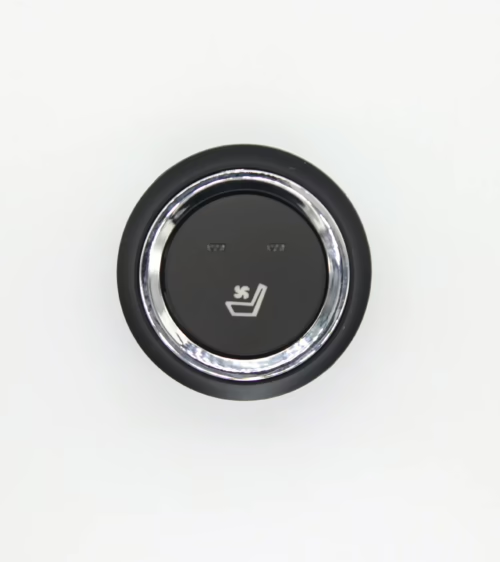
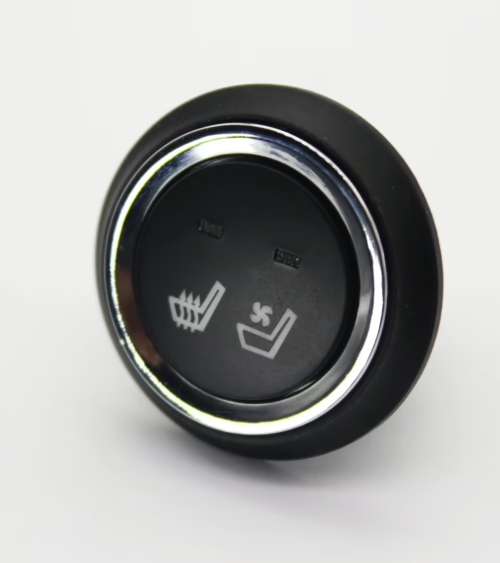
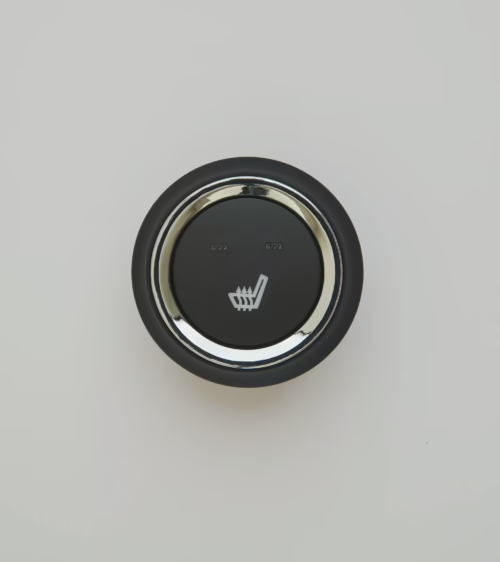
Lucky Driver’s seat heater products portfolio covers every component in the seat climate chain — from heating elements and control modules to ventilation blowers and switch assemblies.
This update reviews the latest additions to the Lucky Driver seat heater products lineup, including new SKUs, updated specifications, and expanded OEM compatibility across model years.
Whether you are sourcing for a fleet program or a single-vehicle retrofit, Lucky Driver seat heater products are available for immediate shipment from North American stock.
If you’ve been tracking the Lucky Driver latest product updates, 2024 has brought meaningful changes across the company’s core seat comfort lines. Lucky Driver Inc. supplies seat heating pads, seat heater switches, control modules, and seat ventilation systems to OEM seat manufacturers and aftermarket distributors throughout North America.
Rather than cosmetic refreshes, this year’s releases address documented installer pain points:
- tighter harness fitment tolerances
- broader 12V and 24V compatibility
- improved thermal uniformity across heating element surfaces. Whether you’re a seat manufacturer integrating heated comfort into a production run or an aftermarket shop building a custom install
- the updates below cover what changed and why it matters
Lucky Driver Seat Heater Products: Updated Carbon Fiber Heating Pads
Lucky Driver’s heating element pads have shifted to a denser carbon fiber weave in the 2024 revision. The updated substrate delivers more uniform surface temperature — measured at ±3°C variance across the active heating zone, compared to ±6°C in the previous generation.
That tighter spread matters for OEM customers because inconsistent heat distribution is one of the most common quality complaints on heated seat assemblies going into production vehicles.
The new elements are available in standard sizes covering most passenger and light commercial vehicle seat configurations:
- 10″ × 16″ for seat bases and 10″ × 12″ for seatbacks. Custom dimensions remain available for contract orders. All pads carry a nominal resistance of 3.5Ω on 12V circuits or 14Ω on 24V circuits
- the wiring pigtail has been extended to 18 inches to clear most seat frame mounting points without requiring an extension harness
The operating temperature ceiling is rated at 65°C surface temperature under normal thermostatic control, with a built-in thermal fuse at 85°C as a secondary safeguard.
The updated fuse rating replaces the 80°C fuse in earlier pads and reduces nuisance trips in high-draw multi-zone configurations where combined element current briefly spikes during cold startup .
Dual-Zone Control Modules With Independent Channel Management
The most significant control-side update in Lucky Driver’s 2024 catalog is the new dual-zone seat heater module. Previous modules managed a single seat — base and back combined — on a shared circuit.
The new dual-zone unit controls two independent seats from a single board, with separate PWM channels for driver and passenger positions.
Key specifications:
- the module accepts 12V or 24V input via auto-detection
- handles up to 8A per channel
- supports three heat levels through either a stepped resistor ladder for rocker-switch installs or a direct PWM signal from a CAN-enabled switch assembly. The board dimensions are 85mm × 55mm × 18mm
- making it compatible with most under-seat electronics trays in passenger vehicle applications
For OEM integrations, the module includes a diagnostic output pin that signals fault conditions — open circuit, overcurrent, or thermal cutoff — to a body control module or instrument cluster warning light.
This pin was absent on the previous single-zone module and has been a consistent request from seat manufacturer customers building vehicles with CAN-based fault monitoring systems. The pin outputs a 5V logic-high signal during normal operation and pulls low on any detected fault.
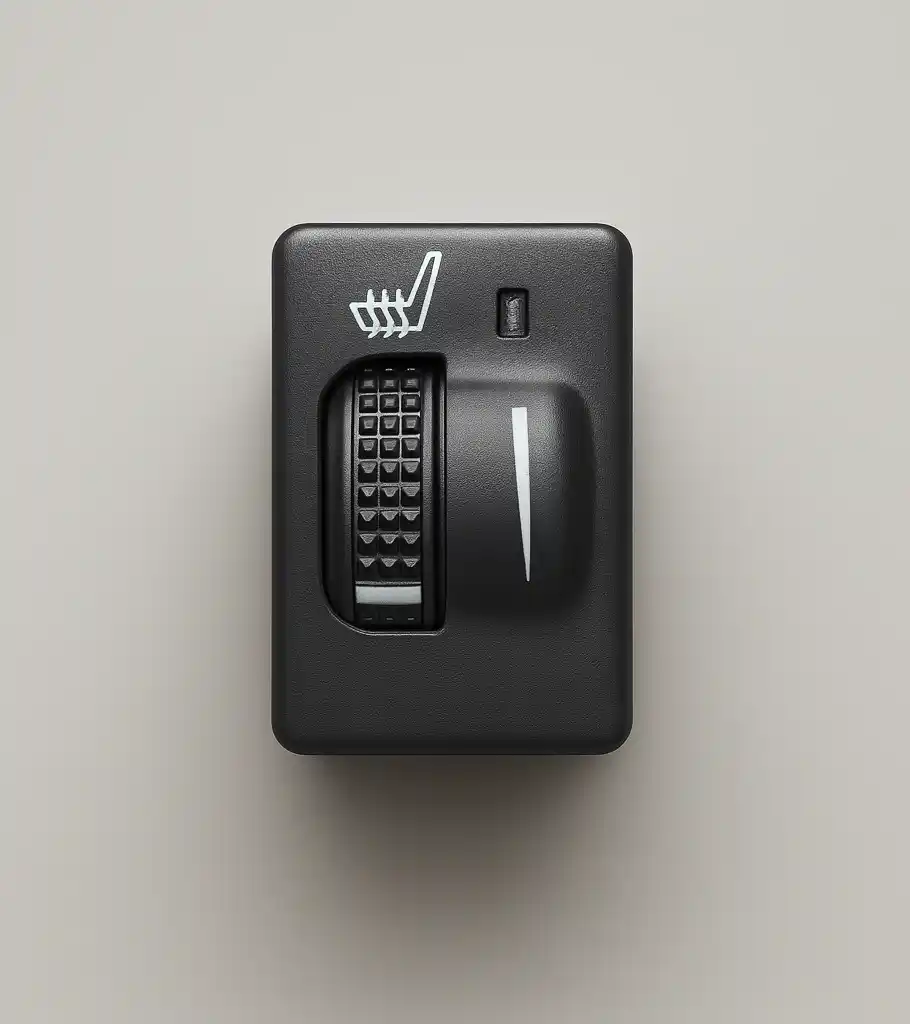
Expanded Switch Lineup: New SKUs for Flush-Mount and Panel Installs
Lucky Driver has added four new switch SKUs to its 2024 line, targeting two specific installation contexts: flush-mount dash panels and aftermarket center console builds where switch footprint and aesthetics are constrained.
- Rocker switch, illuminated, 22mm cutout: Three-position (off, low, high) with amber LED backlit actuation. Designed for aftermarket panels using standard 22mm rocker spacing.
- Rotary switch, 35mm diameter: Three-position detent rotary with a stainless bezel and a 12V illumination ring. Targeted at premium aftermarket builds where a flat rocker doesn’t match the interior trim.
- Push-button, momentary, 16mm: For installs using a dedicated controller with push-to-cycle logic. No built-in level indication — relies on an external LED bar or display to show current heat setting.
- OEM-style rocker, low-profile: A 28mm × 14mm low-profile rocker replicating the footprint of common factory switches. Intended for factory-location replacements and OEM seat manufacturer tooling that requires a fixed panel cutout dimension.
All four new switches are rated at 10A continuous and include a 250mm flying lead with a standard JST-PH 2.0mm connector pre-installed. The connector mates directly with Lucky Driver’s new dual-zone control module without an adapter harness.
Seat Ventilation System: Blower Motor and Spacer Mesh Updates
Lucky Driver’s seat ventilation line has seen two parallel updates in 2024: a revised blower motor assembly and an improved spacer mesh layer that addresses long-term compression under seated load.
The new blower motor runs at 12V DC, draws 1.2A at full speed — down from 1.6A in the prior unit — and produces a measured airflow of 8 CFM through a 1-inch seat foam cutout. The reduced current draw matters for multi-seat installs where total accessory load budgeting is tight.
Noise output is rated at 38 dB(A) at one meter, a meaningful improvement over the previous 44 dB(A) spec that generated complaints in quiet-cabin premium vehicle applications.
The spacer mesh, which sits between the seat surface upholstery and the heating or cooling element, has been updated to a 3D knit polyester construction with 4mm nominal depth. This replaces the earlier flat nonwoven mesh that compressed under body weight and partially blocked airflow channels after extended use.
The 3D knit construction maintains its loft under continuous seated load and resists the permanent compression that shortened service life in previous installations.
Harness Standardization and OEM Connector Compatibility
A recurring integration challenge for OEM customers has been harness termination consistency. Lucky Driver’s previous product generations used three different connector families depending on when components were sourced, creating compatibility headaches on mixed-vintage production lines where components from different model years needed to work together.
The 2024 catalog consolidates all seat heater components onto two connector standards:
- Molex Micro-Fit 3.0 for power circuits carrying up to 8A
- JST-PH 2.0mm for signal and control lines. This matches the connector ecosystem used by most North American and European seat manufacturers
- eliminating the need for custom pigtail adapters on new integrations from the factory floor
Pre-terminated harness assemblies are available in 300mm, 500mm, and 800mm lengths. Custom lengths are available on OEM orders above 500 units. All harnesses use 18 AWG GXL wire for power runs and 22 AWG TXL for signal lines, consistent with SAE J1128 specifications for automotive low-voltage wiring in temperature-cycling environments.
Seat Heater Products: Inventory Availability and 2024 Lead Times
Lucky Driver maintains North American stocking inventory for its standard SKUs, which means aftermarket distributors and small-volume OEM customers can typically ship same-day or next-day on standard orders.
The 2024 catalog expansion increased the stocked SKU count from 34 to 51 items, covering new switch variants and updated heating pads without requiring made-to-order lead times on the most common configurations.
For OEM customers ordering in volume, the minimum order quantity on custom-dimension heating pads has been reduced from 200 units to 100 units, reflecting improved production scheduling flexibility. Lead time on custom pad orders is currently quoted at three to four weeks from drawing approval, down from six weeks in 2023.
Distributors interested in stocking Lucky Driver’s ventilation and heating product line can request a wholesale pricing schedule and evaluation sample kit.
Sample kits include one heating pad at each voltage, one dual-zone control module, two switch variants, and one ventilation blower assembly — enough to run bench tests before committing to a stocking order.
Accessing Seat Heater Products Documentation and Specs
Lucky Driver publishes installation guides, wiring diagrams, and specification sheets for all current products. Technical documentation covers resistance testing procedures for field diagnosis, torque specs for bracket mounting hardware, and wiring schematics for both OEM integration and aftermarket retrofit configurations in a single vehicle.
For OEM customers with NDA-covered integration programs, Lucky Driver’s engineering team can provide CAD files in STEP format for heating pad dimensions, control module mounting footprints, and connector pin locations.
These files allow seat design engineers to route components into seat foam tooling drawings before physical samples arrive, reducing iterative sample cycles and compressing development timelines.
All technical documentation is versioned and date-stamped. If you have documents from a previous catalog generation, verify the revision date before use.
The 2024 wiring diagrams for the dual-zone module differ from the 2023 single-zone diagrams in pin assignments, and using the wrong diagram will produce incorrect fault signal behavior at the BCM diagnostic output.
Frequently Asked Questions
Q: Are Lucky Driver’s latest heating pads electrically compatible with older control modules?
Yes. The updated carbon fiber pads use the same resistance specification — 3.5Ω at 12V — as the previous generation, so they are electrically compatible with existing single-zone control modules. The only physical difference is the connector family.
If you’re using a pre-2024 module with a different connector, Lucky Driver supplies a short pigtail adapter at no charge when pad orders reference a pre-2024 module serial number.
Q: What is the correct procedure for testing a Lucky Driver heating element after installation?
Use a digital multimeter set to resistance mode. Disconnect the element from the control module and measure resistance across the two power leads. A 12V pad should read between 3.2Ω and 3.8Ω when cold.
A reading below 2Ω indicates an internal short, and an open-loop reading indicates a broken element trace or a triggered thermal fuse. Always disconnect the element from the circuit before measuring — never test resistance on a live circuit.
Q: Can Lucky Driver seat ventilation systems be added to a seat that already has a heater installed?
Yes. The ventilation blower and spacer mesh are mechanically independent of the heating element layer. In a typical retrofit, the spacer mesh installs between the upholstery and an existing heating pad, and the blower mounts to the seat base foam using an adhesive bracket.
The blower’s 12V supply connects to an independent circuit with its own switch and does not share a circuit with the heater. Lucky Driver’s installation guide includes a wiring schematic for combined heater-plus-ventilation configurations where both systems operate simultaneously.
If you’re evaluating the Lucky Driver latest product lineup for an OEM integration program or an aftermarket distribution arrangement, Lucky Driver Inc. is ready to support your project with technical data, custom specifications, and volume pricing.
From carbon fiber heating element dimensions tailored to your seat geometry to dual-zone control module samples and pre-terminated harness assemblies, the team works directly with seat manufacturers, upholstery shops, and automotive distributors across North America. Reach out to Lucky Driver Inc.
to request a current product catalog, engineering datasheets, or a wholesale sample kit.
Summary: Lucky Driver Seat Heater Products for 2024
Lucky Driver’s seat heater products represent one of the most complete seat climate component lineups available from a single North American supplier. Whether your program requires carbon fiber heating elements, dual-zone control modules, or ventilation-capable seat heater products, the 2024 catalog delivers validated specifications with consistent in-stock availability.
For distributors building out a heated seat accessory line, these seat heater products offer the combination of technical depth and shipping reliability that volume programs demand. Contact Lucky Driver to request samples, technical data sheets, or pricing for any seat heater products covered in this guide.
Further Reading
Need the hardware itself? Browse our seat heater switch catalog with US-based shipping.
Related Articles
- How a Car Seat Ventilation System Works and How to Add One Aftermarket
- How to Add Heated Seats to Any Car: Complete Aftermarket Installation Overview
- Heated Seat Switch Types: Rocker, Rotary, and Push-Button Compared
- Seat Warmer Switch Replacement: Signs of Failure and How to Replace It
- Universal Heated Seat Switch: How to Choose and Install the Right One
Seat Heater Products Buying Guide
Choosing the right seat heater products for your application starts with three questions: What is the operating voltage of the vehicle? What connector format does the existing harness use? And what certifications are required for the program?
Answering these before requesting quotes for seat heater products saves weeks of back-and-forth with suppliers and avoids costly sample iterations that do not fit the production design.
The seat heater products market includes both direct OEM manufacturers and distributors. OEM manufacturers of seat heater products typically require minimum order quantities of 500 to 1,000 units and lead times of 6 to 10 weeks for custom configurations.
Distributors of seat heater products stock standard configurations and can ship within one to five business days, making them the practical choice for prototype builds, replacement parts, and low-volume aftermarket programs.
When comparing seat heater products options across suppliers, request the following documentation with each sample submission:
- a material compliance declaration confirming RoHS and REACH compliance
- a dimensional report confirming the part meets the approved drawing
- a functional test report demonstrating correct operation across the full operating voltage range. Suppliers that cannot provide this documentation for their seat heater products should be deprioritized regardless of unit price
- since missing documentation creates compliance risk at the OEM customer level
Lucky Driver Inc. maintains North American inventory of seat heater products and can provide all required qualification documentation for OEM programs.
Whether you need a single sample of seat heater products for a prototype build or a production quantity with full PPAP documentation, Lucky Driver has the stock, the paperwork, and the engineering support to close your seat heater products requirement efficiently. Contact Lucky Driver Inc.
to request seat heater products samples, pricing, or technical specifications today.
For fleet procurement managers sourcing seat heater products in volume, Lucky Driver offers blanket order agreements that lock in unit pricing for 12 months with scheduled monthly releases — eliminating the need to reorder seat heater products on an ad hoc basis and reducing per-unit cost through volume commitment.
Contact Lucky Driver Inc. to discuss a blanket order for seat heater products that matches your program forecast.