Seat ventilation system supplier is the focus of this guide. Seat ventilation has moved from a luxury differentiator to a mainstream feature in mid-range and premium vehicles.
For seat manufacturers and vehicle OEMs sourcing ventilation systems, the supply chain involves airflow engineering, acoustic management, and integration with multiple seat subsystems.
1. Active vs. Passive Ventilation
Active seat ventilation uses a blower motor to push or draw air through the seat foam and trim. Passive ventilation relies on perforated trim and open-cell foam to allow natural airflow without a powered blower. For OEM programs targeting measurable comfort improvement, active ventilation is the baseline specification.
2. Blower Motor Selection and Noise Management
The blower motor is the primary acoustic source in a ventilated seat. Brushless DC motors are strongly preferred over brushed motors in premium applications because of their lower noise floor, longer service life, and more precise speed control.
Request A-weighted noise measurements at all speed settings under both free-air and installed conditions.
3. Airflow Path Engineering
Seat ventilation effectiveness depends as much on the airflow path through the seat structure as on blower output. The air distribution layer must distribute airflow evenly from the blower plenum to the trim surface without dead zones.
A ventilation supplier who cannot provide airflow simulation data is not equipped for OEM program support.
4. Combined Heating and Ventilation Modules
Many modern programs specify a combined heating and ventilation system using the same trim surface and foam layer. Integrated modules place the heating element and ventilation air channel in a single pad assembly, reducing seat assembly complexity. Lucky Driver Inc.
designs and manufactures integrated heating and ventilation seat modules for OEM programs.
5. Control Switch and System Integration
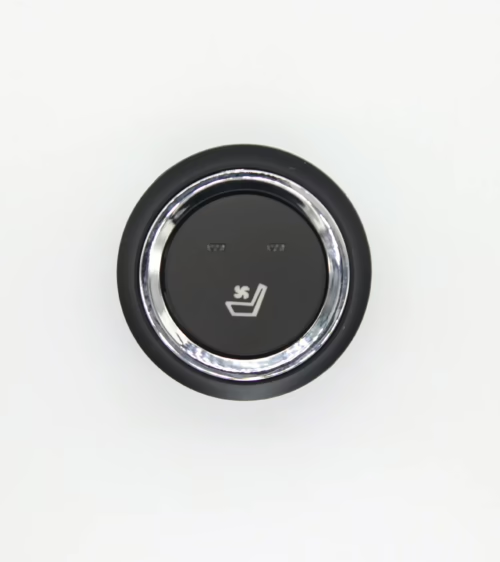
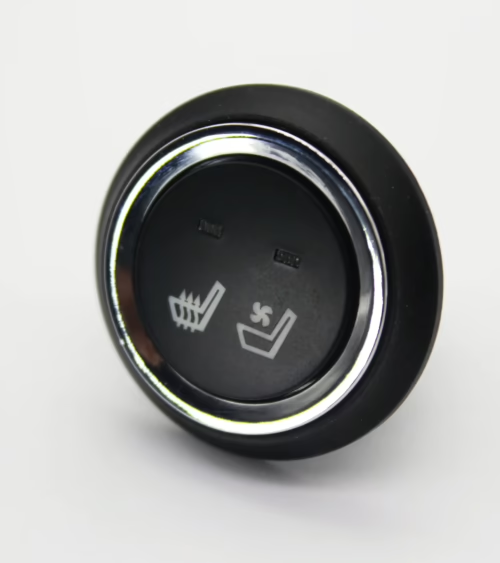
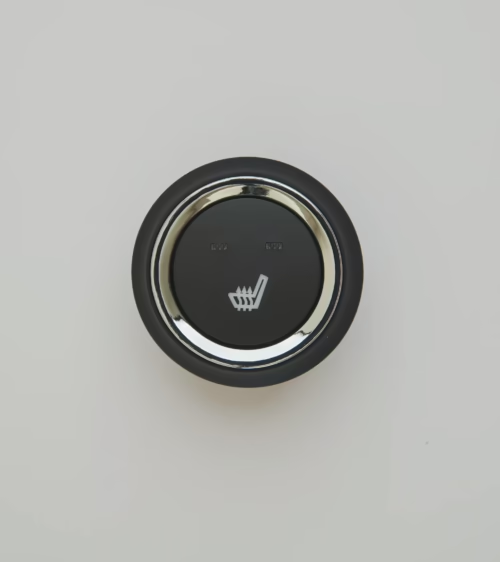
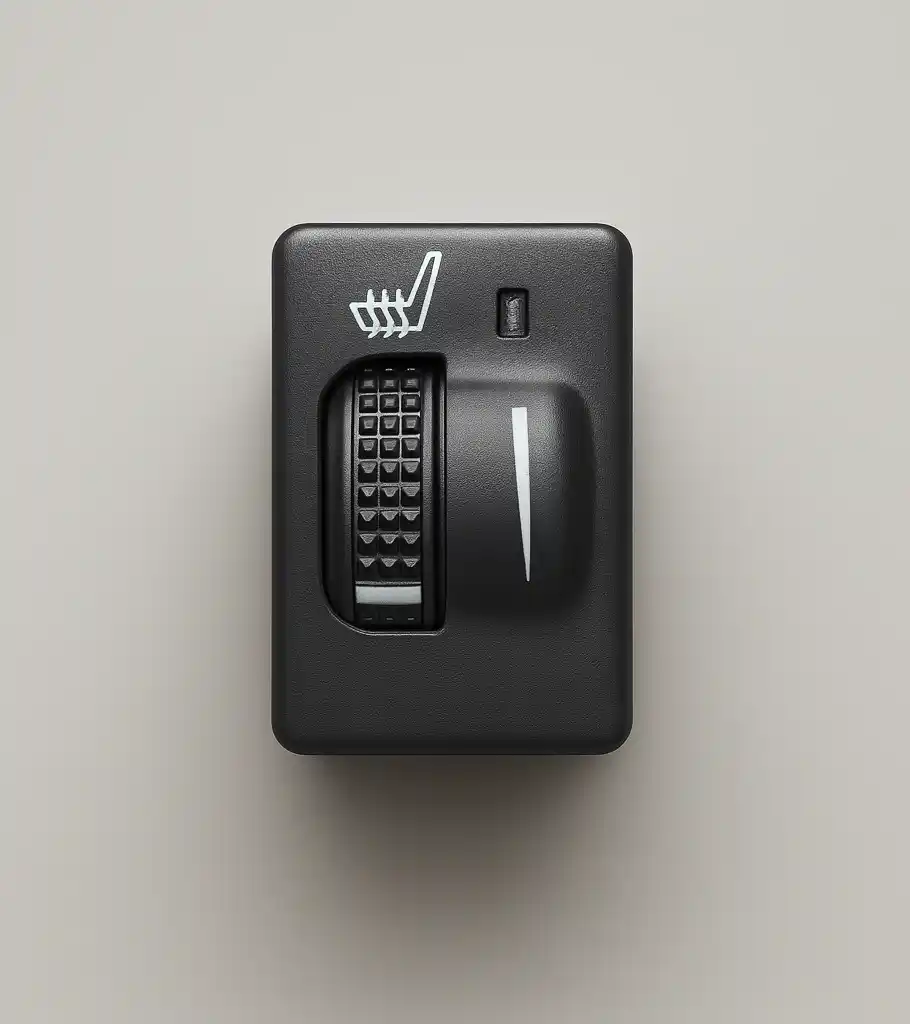
Ventilation systems require dedicated switch input. Confirm that the ventilation control switch matches your interior panel design language and that the blower speed steps align with your customer experience specification.
6. IATF 16949 Certification and Validation Testing
Seat ventilation modules supplied to OEM programs must be sourced from IATF 16949-certified manufacturers. Validation testing should include blower endurance (minimum 500 hours), vibration and shock resistance, and temperature performance across the full vehicle climate range.
Working with Lucky Driver Inc.
Lucky Driver Inc. supplies seat ventilation systems and integrated heating-ventilation modules to OEM seat manufacturers. Contact us to discuss your program specifications.
After-Sale Technical Support
Seat ventilation system integration involves multiple vehicle subsystems. Even well-designed systems require technical support during vehicle integration, particularly when acoustic targets are not met in the first prototype build or when airflow distribution requires tuning. Confirm that your seat ventilation supplier provides after-sale engineering support, not just component delivery.
A supplier who cannot provide application engineering resources for system-level integration problems is not suited for OEM program support. Lucky Driver Inc. provides dedicated technical support for ventilation system integration from first prototype through job one.
Acoustic Testing and NVH Targets for Seat Ventilation
Noise, vibration, and harshness (NVH) performance is often the most challenging aspect of seat ventilation system development. The blower motor generates broadband noise and, in many cases, a distinct tonal component at the motor commutation frequency.
OEM programs specify NVH targets in terms of both overall dBA level at a defined measurement position and psychoacoustic quality metrics.
Achieving these targets requires careful blower motor selection, motor mounting isolation design, and airflow path treatment to suppress turbulence noise at the trim surface perforations. Seat ventilation suppliers who design only to airflow output targets without addressing NVH frequently fail customer evaluation in prototype builds.
Durability Requirements for Seat Ventilation Blower Motors
The blower motor in a seat ventilation system must survive the vehicle service life, which typically requires demonstrating 2,000 hours of operational endurance in accelerated testing. Brushless DC motors are specified for premium applications because they achieve longer operational life without the contact wear that limits brushed motor life.
Motor qualification testing should include: electrical endurance at rated speed and voltage, vibration endurance per automotive standards, temperature cycling over the full operating range, and salt spray or humidity exposure testing for corrosion resistance.
Motors qualified only to consumer electronics standards are not appropriate for automotive seat ventilation programs.
Supplier Colocation and Tooling Investment
For high-volume seat ventilation programs, ventilation module suppliers sometimes establish local manufacturing presence near the seat assembly facility to reduce logistics complexity and support JIT delivery. This colocation model requires significant tooling investment from the ventilation supplier and a long-term supply commitment from the seat manufacturer.
Before requesting colocation proposals, confirm that the program volume and duration justify the investment. Lucky Driver Inc. evaluates colocation opportunities on a program-specific basis and can discuss supply chain models that balance cost efficiency with delivery reliability for high-volume seat ventilation programs.
Aftermarket Retrofit Complexity and Professional Installation
Retrofitting active seat ventilation into a vehicle that was not designed for it is significantly more complex than adding a seat heater. The key challenges are:
- sourcing or fabricating a compatible air distribution layer for the seat foam (the OEM foam geometry is designed for the specific ventilation module)
- modifying the trim cover to add air exit perforations without compromising the trim appearance
- integrating the blower motor into the seat frame without creating interference with seat adjustment mechanisms
- routing the wiring and air ducts cleanly through the seat structure.
Professional upholstery shops with seat ventilation installation experience are essential for aftermarket ventilation retrofits in vehicles that did not come with factory-installed systems.
Frequently Asked Questions: Seat Ventilation System Suppliers
What airflow rate is required for effective seat ventilation?
Effective seat ventilation typically requires 15 to 30 liters per minute of airflow through the seat surface perforations under the seated occupant. Lower flow rates provide limited cooling effect; higher flow rates increase noise and power consumption without proportional comfort improvement.
The required flow rate depends on the trim cover perforation area — a cover with larger total perforation area provides lower flow resistance and allows the target airflow to be achieved with a quieter, lower-power blower.
Can seat ventilation be retrofitted to a vehicle that did not come with it from the factory?
Aftermarket seat ventilation retrofit is possible but significantly more complex than adding seat heating.
The challenges are sourcing a compatible air distribution layer for the seat foam, adding perforations to the trim cover without damaging its appearance, integrating the blower motor into the seat structure, and routing the wiring and air ducts.
Professional upholstery shops experienced with seat ventilation retrofits are required for a quality result. Contact Lucky Driver Inc. for information on aftermarket ventilation kit availability for specific seat applications.
What power does a seat ventilation blower motor draw?
A typical single-zone seat ventilation blower draws 3 to 8 watts at the operating speed required for comfort airflow. A dual-zone system (cushion and backrest) draws 6 to 16 watts total.
This is significantly less than a seat heating element, which means the electrical load impact on the vehicle is minor.
Contact Lucky Driver Inc. for Seat Ventilation Program Support
Lucky Driver Inc. supports seat ventilation system development and supply for OEM seat programs and aftermarket retrofit applications. Our technical team can assist with blower motor selection, air distribution design, NVH evaluation, and integration with combined heating and ventilation systems.
Contact us to discuss your seat ventilation program requirements and receive engineering and commercial support for your application.
Specifying Seat Ventilation for Commercial Vehicle Applications
Commercial vehicle seat ventilation applications — long-haul truck driver seats, transit bus seats, construction equipment operator seats — have different requirements than passenger car applications. The operator occupies the seat for extended periods (8 to 12 hours or more), making thermal comfort directly linked to operator health and performance.
Ventilation airflow requirements in commercial applications are often higher than passenger car specifications to manage heat buildup during long duty cycles.
Vibration and shock requirements for off-road and heavy-duty applications are also more severe. Seat ventilation suppliers who only have passenger car application experience may underestimate the durability requirements for commercial vehicle programs. Confirm the supplier has relevant commercial vehicle program experience before committing to a supply relationship.
Summary: Seat Ventilation System Supplier Selection
Selecting a capable seat ventilation system supplier requires evaluating blower motor technology, NVH performance, air distribution design, and the supplier’s ability to integrate ventilation into your specific seat construction. Lucky Driver Inc.
provides technical support and product supply for seat ventilation programs across passenger car, commercial vehicle, and specialty seat applications.
Contact our technical team to discuss your ventilation program requirements and receive engineering and commercial guidance for your application.
Seat ventilation system development is a growing area of interest for both premium passenger vehicles and commercial vehicle applications. As driver comfort becomes an increasingly important differentiator in vehicle purchase decisions, seat ventilation capability is expanding from luxury segment exclusivity toward volume segment availability. Lucky Driver Inc.
is positioned to support seat ventilation programs at the OEM, Tier 1 supplier, and aftermarket distribution levels as this market continues to expand.
Qualifying a Seat Ventilation System Supplier: Final Notes
A reliable seat ventilation system supplier combines validated blower performance data with a quality management system capable of supporting PPAP documentation, first-article inspection, and field-failure analysis.
When reviewing any seat ventilation system supplier for a new program, request airflow uniformity data measured at the cover surface — not just at the blower outlet — to confirm the delivered experience matches the specification.
Lucky Driver Inc. provides seat ventilation system supplier capabilities for OEM programs and aftermarket distributors, with validated blower assemblies in stock for immediate sample evaluation.
Further Reading
Explore our universal seat heater switch options for direct-fit and universal applications.
Related Articles
- How Car Seat Ventilation Works
- Seat Heater vs Seat Warmer
- How to Choose an Automotive Seat Heater Supplier
- Car Seat Heating Pad OEM Guide
For more information about seat heater components, installation best practices, and OEM supply programs, contact Lucky Driver Inc. Our team supports customers from component selection through production, with IATF 16949-certified manufacturing and dedicated engineering support available for all program types and volumes.
More About Seat Warmer Kit
When sourcing seat warmer kit for a production or aftermarket seat program, the most important selection criteria are electrical compatibility, material certification, and supplier quality documentation. Reliable seat warmer kit components from a qualified supplier reduce warranty risk and simplify the qualification process for both OEM and aftermarket programs.
Lucky Driver Inc. maintains North American inventory of seat warmer kit in standard and custom configurations, with same-week shipping for evaluation orders and engineering support for new program development.
Whether your application requires a drop-in replacement seat warmer kit or a custom-specified solution, Lucky Driver has the stock and technical resources to support your requirements. Contact Lucky Driver Inc. today to request samples or pricing for seat warmer kit.
Seat Warmer Kit: Quick Reference Guide
This quick reference summarizes the most important facts about seat warmer kit for buyers and engineers evaluating options for a production or retrofit program. Every seat warmer kit program begins with a specification review — confirm the electrical interface, connector format, and temperature rating before requesting samples.
seat warmer kit components from Lucky Driver Inc. are tested to OEM standards and ship with full documentation. Whether you need a single evaluation unit or a production quantity of seat warmer kit assemblies, the Lucky Driver team can quote within one business day.
Common questions from buyers sourcing seat warmer kit for the first time: What certifications apply? What is the lead time? Can the seat warmer kit be customized for a specific vehicle platform? The answers depend on the exact configuration — contact Lucky Driver Inc.
with your application details to get a precise answer for your seat warmer kit requirement.
For aftermarket installers, seat warmer kit from Lucky Driver includes all mounting hardware and a wiring diagram. For OEM programs, seat warmer kit can be supplied with a custom connector, custom labeling, and a PPAP-ready quality package. Contact Lucky Driver Inc.
to request seat warmer kit samples or pricing today.
Seat Warmer Kit Buying Guide
Choosing the right seat warmer kit for your application starts with three questions: What is the operating voltage of the vehicle? What connector format does the existing harness use? And what certifications are required for the program?
Answering these before requesting quotes for seat warmer kit saves weeks of back-and-forth with suppliers and avoids costly sample iterations that do not fit the production design.
The seat warmer kit market includes both direct OEM manufacturers and distributors. OEM manufacturers of seat warmer kit typically require minimum order quantities of 500 to 1,000 units and lead times of 6 to 10 weeks for custom configurations.
Distributors of seat warmer kit stock standard configurations and can ship within one to five business days, making them the practical choice for prototype builds, replacement parts, and low-volume aftermarket programs.
When comparing seat warmer kit options across suppliers, request the following documentation with each sample submission: a material compliance declaration confirming RoHS and REACH compliance, a dimensional report confirming the part meets the approved drawing, and a functional test report demonstrating correct operation across the full operating voltage range.
Suppliers that cannot provide this documentation for their seat warmer kit should be deprioritized regardless of unit price, since missing documentation creates compliance risk at the OEM customer level.
Lucky Driver Inc. maintains North American inventory of seat warmer kit and can provide all required qualification documentation for OEM programs.
Whether you need a single sample of seat warmer kit for a prototype build or a production quantity with full PPAP documentation, Lucky Driver has the stock, the paperwork, and the engineering support to close your seat warmer kit requirement efficiently.
Contact Lucky Driver Inc. to request seat warmer kit samples, pricing, or technical specifications today.
Frequently Asked Questions About seat ventilation system supplier
Procurement engineers evaluating seat ventilation system supplier for OEM programs regularly ask the following questions. Answers cover specification, compatibility, certification, and sourcing for seat ventilation system supplier requirements.
What voltage ratings are available for seat ventilation system supplier?
Standard seat ventilation system supplier configurations support 12 V DC for passenger vehicles and 24 V DC for commercial trucks. Selecting the correct seat ventilation system supplier voltage at the design stage eliminates harness rework later. Lucky Driver maintains seat ventilation system supplier inventory in both ratings for same-week shipment.
Which certifications apply to seat ventilation system supplier production?
seat ventilation system supplier assemblies entering OEM programs typically require UL recognition, REACH compliance, and RoHS documentation. Lucky Driver holds certification records for every seat ventilation system supplier variant and includes copies with sample and production shipments.
How is watt density specified for seat ventilation system supplier?
Watt density for seat ventilation system supplier is expressed in W/cm² and ranges from 0.04 to 0.12 depending on heat-up time requirements. Lower watt density seat ventilation system supplier designs improve element longevity, while higher values suit cold-climate applications.
Lucky Driver’s engineering team reviews seat ventilation system supplier requirements and recommends watt density based on your seat platform.
What connector families are used with seat ventilation system supplier?
seat ventilation system supplier harnesses are available with Molex, TE Connectivity, and Delphi connector families. Matching the seat ventilation system supplier connector to the vehicle harness reduces assembly time and eliminates adapter cables. Specify your harness format when requesting a seat ventilation system supplier quote from Lucky Driver.
What is the lead time for seat ventilation system supplier samples?
seat ventilation system supplier samples from Lucky Driver’s North American warehouse ship within 3 to 5 business days for standard configurations. Custom seat ventilation system supplier variants with modified pad geometry or connector pinouts require 4 to 6 weeks.
Contact Lucky Driver to confirm seat ventilation system supplier availability before submitting your engineering schedule.