Every sourcing team that types “automotive seat heating supplier north america” into a search bar is really asking three questions at once:
- can this vendor hold a surface temperature within a few degrees across a full production run
- can it deliver into a Michigan or Ontario plant without a six-week ocean gap
- will it still answer the phone when a warranty claim comes back from the field. Those are engineering
- logistics and accountability questions
- most supplier directories answer none of them. The seven checks below are the ones that actually separate a trading company from a manufacturing partner
- written from the perspective of what an OEM seat builder or aftermarket distributor needs to see before releasing a purchase order.
1. Heating Element Construction: Carbon Fiber vs. Alloy Wire
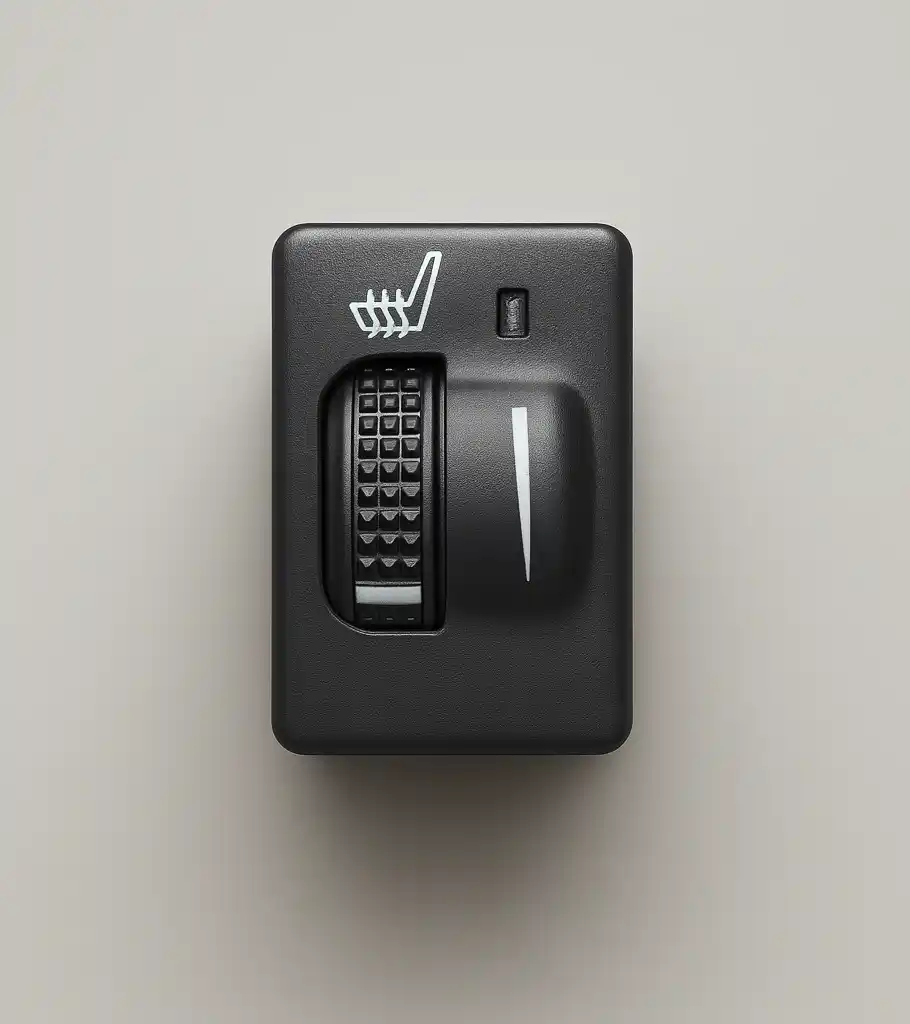
The heating element determines almost everything downstream — current draw, failure mode, and how the pad feels under a trim cover. Two constructions dominate North American programs.
Copper-nickel alloy wire pads use a fine stranded conductor, typically 0.3 to 0.5 mm diameter, sewn or bonded in a serpentine pattern onto a non-woven carrier. They warm quickly, tolerate high duty cycles, and are forgiving to repair, but a single break in the serpentine opens the whole circuit.
Carbon fiber elements distribute current across many parallel filament bundles, so a localized break degrades output rather than killing the pad outright. They are thinner, more flexible, and better suited to aggressive bolster contours and perforated leather.
The trade-off is a lower achievable watt density and tighter tolerance control during lamination. Ask any prospective supplier for the resistance tolerance band they actually hold in production — a credible answer is ±7% to ±10% on a finished pad, not a nominal design figure.
Also confirm the carrier material passes FMVSS 302 horizontal burn requirements, because the seat assembler will be asked for that data whether or not the pad supplier volunteered it.
2. Temperature Control Architecture and Thermal Cutoff
A seat heater is a resistive load sitting directly against a human body, so the control strategy is a safety feature, not a comfort feature. Entry-level pads rely on a bimetallic or PTC self-regulating thermostat bonded to the element, opening around 38 to 45 °C and reclosing with hysteresis.
This is simple and fails safe, but it cycles crudely and cannot report temperature upstream.
Higher-content programs run closed-loop control using NTC and PTC thermistors embedded at the cushion and backrest hot spots, with a module reading resistance and modulating duty cycle by PWM.
Closed loop gives you a stable setpoint across ambient swings from a −20 °C cold soak to a sun-loaded cabin, and it allows a true ramp-and-hold profile:
- high current for the first 90 to 120 seconds to reach perceived warmth
- then a reduced holding duty cycle. Whichever architecture you specify
- require redundant over-temperature protection — a secondary thermal fuse or independent cutoff that acts if the primary sensor circuit opens or shorts. A supplier that cannot describe its single-point-of-failure analysis has not done one.
3. Switch and Operator Interface Integration
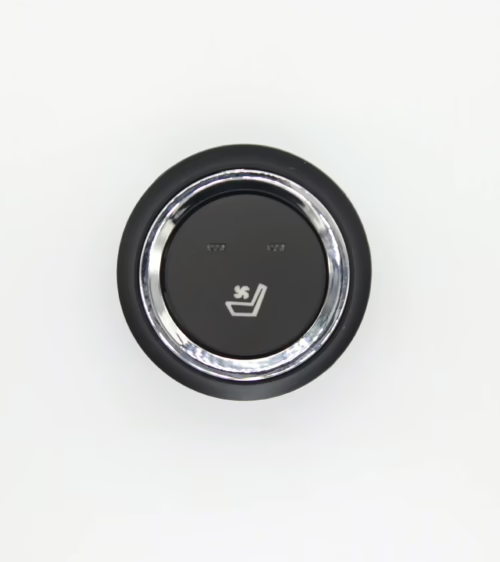
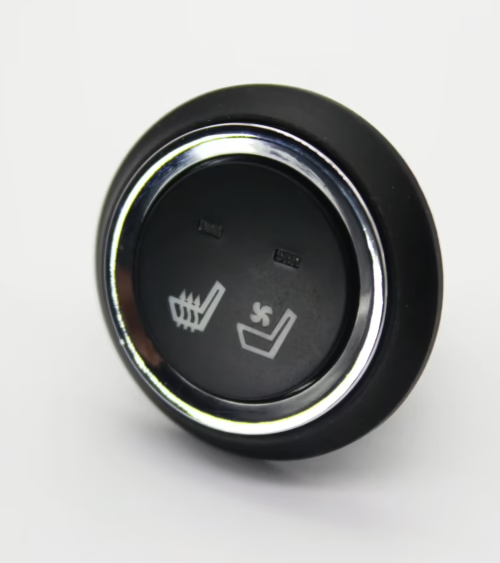
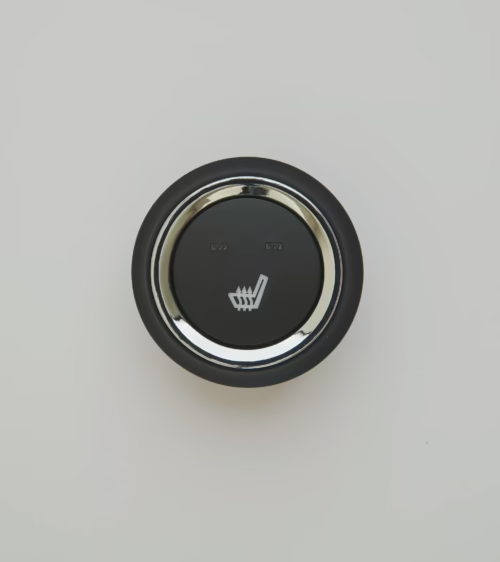
Switch selection is where retrofit and aftermarket programs most often stall. The pad is the easy part; matching a three-position HI/MID/LO control to the vehicle’s existing bezel cutout, backlight voltage, illumination color and connector family is the part that eats engineering weeks.
A rocker switch with a 12 V incandescent backlight will not color-match an LED instrument cluster, and a round-pin connector will not mate to a blade terminal harness without a splice that becomes a warranty exposure.
Practical guidance:
- lock the switch and connector decision before finalizing pad geometry
- because the switch dictates the number of harness conductors and therefore the pad’s pigtail design. Distributors serving repair channels should carry a few high-volume interface variants in stock rather than special-ordering each time
- our seat heater switch catalog is organized around the connector and illumination combinations that recur most often across North American platforms. Verify current rating honestly
- too — a switch directly carrying two pads at 12 V needs to handle 8 to 12 A continuous
- which is why relay-switched or module-switched designs are preferred above roughly 6 A.
4. Control Module Electronics and Vehicle Network Integration
Once a program moves beyond a standalone switch, the control module becomes the integration risk. The questions that matter are specific. Does the module support LIN bus command from a body control module, or is it discrete-input only?
What is its quiescent current with the ignition off — anything above roughly 100 µA will show up as a parasitic drain complaint. Does it implement load-shed behavior when system voltage sags during crank or under alternator fault, and does it recover automatically or require a key cycle?
Equally important is the module’s diagnostic coverage. A module that can distinguish an open element, a shorted element, a failed thermistor and an over-temperature event gives the service network four distinct repair paths instead of one ambiguous “heater inoperative” symptom. Ask for the fault code table.
Ask also about ISO 16750 electrical and environmental qualification — specifically load dump, reverse polarity, and thermal shock cycling — since these are the tests that expose cost-reduced power stages.
5. Validation Testing and Documentation Depth
Any supplier can send a sample that works. Validation tells you whether unit 10,000 will work after three winters. The test set a serious automotive seat heating supplier should already have on file includes:
- flex and fatigue cycling of the pad over a representative radius
- typically 10,000 to 50,000 cycles depending on whether the pad sits on a cushion or a folding backrest
- humidity and thermal cycling per a recognized profile
- surface temperature mapping showing uniformity across the heated zone with no hot spot exceeding the specified limit
- crush and point-load testing that simulates occupant ingress and egress.
On the quality-system side, confirm IATF 16949 certification for OEM-destined parts and ask whether the supplier can produce a full PPAP package — control plan, PFMEA, dimensional results, capability studies.
For aftermarket programs the bar is lower, but you still want lot traceability back to the element supplier, because a resistance drift problem traced to a single wire lot is a recall you can scope; the same problem with no traceability is a recall you cannot.
6. North American Supply Logistics, Tariffs and Lead Time
Technical capability means nothing if the parts sit in a container. The structural advantage of a North American supply position is inventory proximity:
- a US-stocked program can replenish a Tier 1 or a distribution center in days
- not the eight to twelve weeks that ocean freight plus customs plus domestic transit typically consumes. That difference changes how much safety stock the buyer has to finance.
Three commercial items deserve explicit discussion before quoting. First, duty classification and tariff exposure — seat heating assemblies and their switches fall under motor vehicle parts headings, and current Section 301 and related measures can move landed cost materially, so insist on a landed-cost quote rather than FOB.
Second, USMCA origin, which matters if your customer is tracking regional value content. Third, minimum order quantity and tooling amortization:
- a custom pad geometry generally requires a sewing or bonding fixture
- you want the amortization schedule in writing. For teams scoping a program or sampling across several configurations
- it is usually faster to browse available seat heating products and kits and start from an existing platform than to tool a clean-sheet design.
7. Ventilation and Climate Seat Capability
Heating alone is increasingly a partial specification. Ventilated and climate-controlled seats use low-profile 12 V axial or radial blowers, typically 2 to 6 W each, mounted in a cushion pan cavity and paired with a spacer mesh or molded air distribution layer that moves air through perforated trim.
The engineering problems are different from heating:
- airflow uniformity
- blower acoustics measured at the occupant’s ear
- condensation management when a cooled surface meets humid cabin air.
If your roadmap includes ventilation, qualify it now rather than later. A supplier that builds both heating pads and ventilation hardware can deliver a single integrated cushion assembly with one harness and one control module, which removes an entire interface from your bill of materials.
Splitting heating and ventilation across two vendors almost always pushes integration cost and warranty ambiguity onto the seat assembler.
Frequently Asked Questions
How much current does a typical 12 V seat heater draw? A single cushion or backrest pad generally draws 3 to 6 A at 12 V, so a complete seat with cushion and backrest runs roughly 6 to 12 A on initial high setting, dropping substantially once the control loop reaches setpoint.
Size the circuit protection and switch rating for the inrush condition, not the holding condition, and use a relay or control module above about 6 A rather than passing current through a panel switch.
Can carbon fiber pads be used with perforated leather and ventilation? Yes, and that combination is common. Carbon fiber’s thinner profile and parallel-filament construction let it sit over a spacer layer without blocking airflow, and it conforms better to perforation patterns than a serpentine wire pad.
Confirm the pad’s open area and perforation alignment with the trim supplier, because a wire pad laid across a perforated panel can create visible imprint lines.
What lead time should we plan for a custom pad geometry? Budget four to six weeks for first samples from a released pattern, then a validation window for flex, thermal and uniformity testing before production release. Standard platform pads already in inventory ship far faster.
The long pole is almost never the element itself — it is pattern approval and the switch or connector interface decision, which is why those should be locked first.
Ready to qualify a partner against these seven checks? Lucky Driver Inc.
manufactures and stocks seat heating pads, seat heater switches, control modules and seat ventilation systems for OEM seat manufacturers and aftermarket distributors across North America, with US inventory for fast replenishment and engineering support for custom pad geometry, switch interfaces and integrated heat-plus-ventilation assemblies.
Send us your seat pattern, target surface temperature, voltage and connector requirements, and we will come back with a landed-cost quote, a sample plan and the validation data your customer is going to ask for.
Related Articles
- Seat Heater Pads Bulk: 7 Specs to Verify in 2026
- Custom Seat Heating Elements: 7 Specs for 2026
- Private Label Seat Heaters: 7 Steps to Launch in 2026
- Wholesale Heated Seat Kits: 7 Specs to Verify in 2026
- Automotive Seat Heater Market: 7 Trends Shaping 2026
Frequently Asked Questions About automotive seat heating supplier north america
Procurement engineers evaluating automotive seat heating supplier north america for OEM programs regularly ask the following questions. Answers cover specification, compatibility, certification, and sourcing for automotive seat heating supplier north america requirements.
What voltage ratings are available for automotive seat heating supplier north america?
Standard automotive seat heating supplier north america configurations support 12 V DC for passenger vehicles and 24 V DC for commercial trucks. Selecting the correct automotive seat heating supplier north america voltage at the design stage eliminates harness rework later.
Lucky Driver maintains automotive seat heating supplier north america inventory in both ratings for same-week shipment.
Which certifications apply to automotive seat heating supplier north america production?
automotive seat heating supplier north america assemblies entering OEM programs typically require UL recognition, REACH compliance, and RoHS documentation. Lucky Driver holds certification records for every automotive seat heating supplier north america variant and includes copies with sample and production shipments.
How is watt density specified for automotive seat heating supplier north america?
Watt density for automotive seat heating supplier north america is expressed in W/cm² and ranges from 0.04 to 0.12 depending on heat-up time requirements. Lower watt density automotive seat heating supplier north america designs improve element longevity, while higher values suit cold-climate applications.
Lucky Driver engineering reviews automotive seat heating supplier north america requirements and recommends watt density based on your seat platform.
What connector families are used with automotive seat heating supplier north america?
automotive seat heating supplier north america harnesses are available with Molex, TE Connectivity, and Delphi connector families. Matching the automotive seat heating supplier north america connector to the vehicle harness reduces assembly time and eliminates adapter cables.
Specify your harness format when requesting a automotive seat heating supplier north america quote from Lucky Driver.
What is the lead time for automotive seat heating supplier north america samples?
automotive seat heating supplier north america samples from Lucky Driver’s North American warehouse ship within 3 to 5 business days for standard configurations. Custom automotive seat heating supplier north america variants with modified pad geometry or connector pinouts require 4 to 6 weeks.
Contact Lucky Driver to confirm automotive seat heating supplier north america availability before submitting your engineering schedule.