Toyota Corolla heated seats have become one of the most requested comfort features on North America’s best-selling sedan.
Whether you own a factory-equipped XLE, need to diagnose a failed element, or want to retrofit seat heat into a base LE trim that never had it, understanding how these systems work—and what fails—saves both money and cold mornings.
This guide covers trim availability, system operation, component diagnosis, aftermarket retrofit installation, and long-term maintenance practices.
Which Toyota Corolla Trims Include Heated Seats From the Factory?
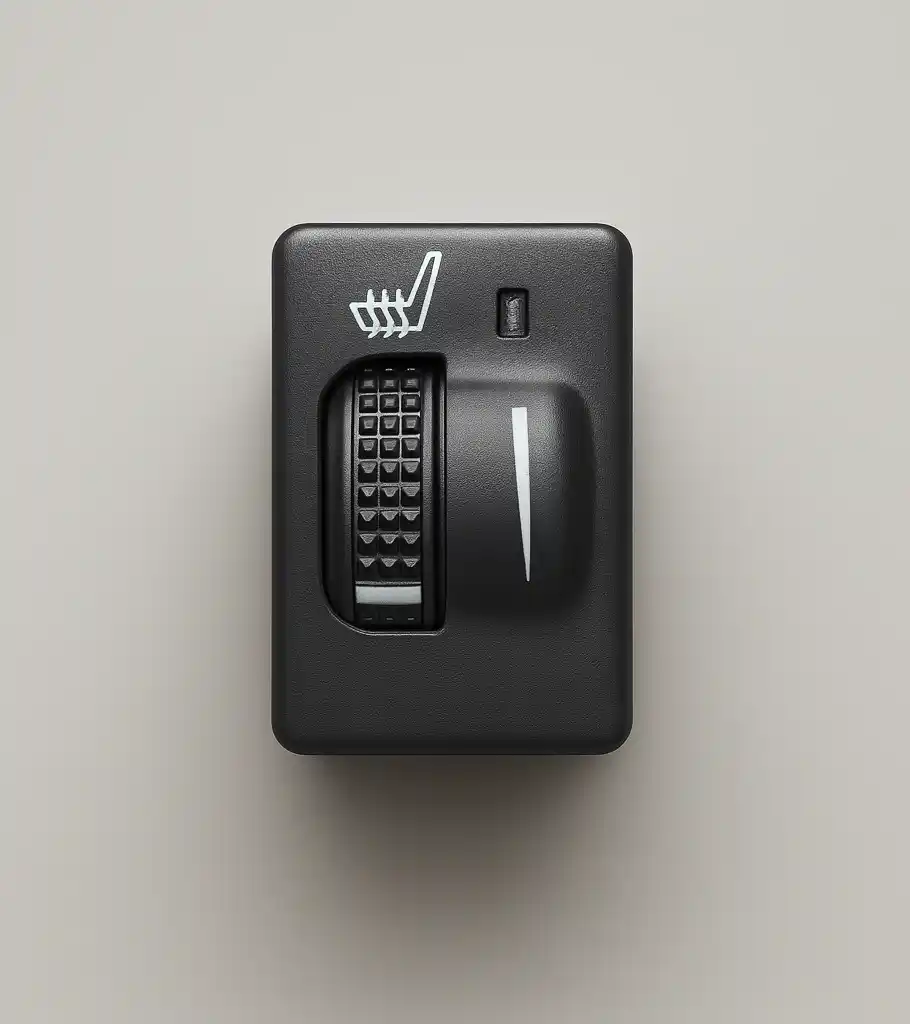
Toyota added heated front seats as a standard feature on the XLE and XSE trims of the 12th-generation Corolla (2020–present). Earlier 11th-generation models (2014–2019) offered heated seats only on the LE Eco and S Plus grades, typically bundled in a Cold Weather Package that also included a heated steering wheel.
On the 10th-generation Corolla (2009–2013), factory heated seats were absent from nearly all North American trims and appeared only as dealer-installed accessories on a small number of higher-grade variants.
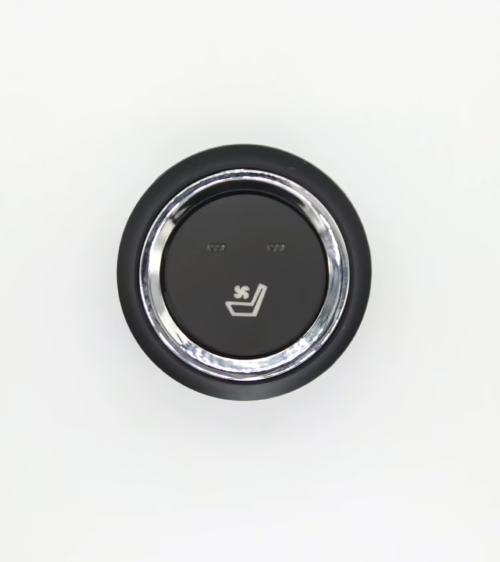
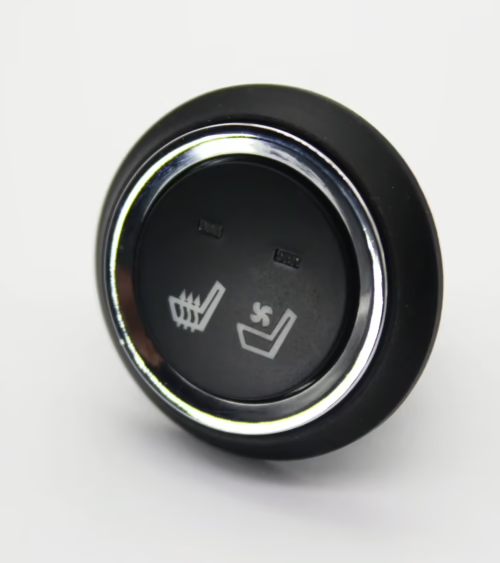
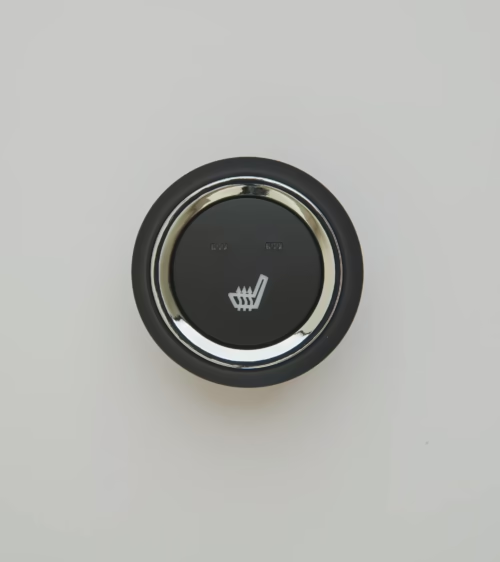
If you own a 2023 Corolla XSE, your seat has a factory carbon-fiber filament mat bonded beneath the cover and connected to a dedicated three-position switch on the center console.
If you own an LE or SE of any recent generation, you almost certainly do not—though on the 2020+ platform, the body wiring harness sometimes includes a partial pre-run for heated-seat options depending on build date and destination market.
Checking under the seat cushion for an unused harness stub before purchasing a retrofit kit can save a wiring step.
How Toyota Corolla Heated Seats Work
Factory Toyota Corolla heated seats use a resistance heating element—typically a carbon-fiber or nichrome wire mat—laminated directly to the seat foam or bonded to the underside of the seat cover fabric.
When you press the switch, the seat ECU closes a relay that routes 12 V DC through the mat. Current flow generates resistive heat, a principle formally described as Joule heating, raising the surface to a preset target temperature.
A thermistor embedded in the mat feeds temperature data back to the controller, which cycles the relay to maintain the selected level—typically high at around 40–42 °C surface temperature and low at around 36–38 °C.
The complete circuit draws between 3 and 7 amps per seat depending on element resistance and ambient temperature. Total heating mat resistance runs approximately 3–5 Ω across a standard Corolla-sized cushion element.
The backrest element runs in the same resistance range and is often wired in parallel with the cushion mat through a single relay output, so both surfaces heat simultaneously from one switch command.
OEM vs. Aftermarket Seat Heater Options for the Corolla
Toyota OEM seat heater components—available through dealerships under part numbers such as 87510-02100 (cushion heater assembly)—are designed to exact-fit tolerances but carry a significant price premium, often $180–$260 per seat for the element alone before labor.
Aftermarket kits offer carbon-fiber heating elements pre-cut to Corolla seat dimensions at substantially lower cost, with equivalent mat resistance specifications and compatible thermistors.
The primary practical difference is connector type:
- OEM replacements use factory plug-and-play connectors that drop straight into the existing harness
- while aftermarket kits typically require splicing into the vehicle wiring. For a DIY installer with basic electrical skills
- a clean splice using heat-shrink butt connectors takes under 20 minutes per seat. For shops billing flat-rate labor
- the OEM convenience can justify the cost difference. Either path produces the same end result—a stable 40 °C seat surface on demand with proper thermistor-controlled cycling.
Common Failures in Toyota Corolla Heated Seats
Three failure modes account for the vast majority of Toyota Corolla heated seat problems:
- Open circuit in the heating element:
- Carbon-fiber mats develop breaks most often at flex zones—the crease where the seat cushion meets the backrest hinge
- along the front edge of the cushion where it bends repeatedly under passenger weight. A multimeter in resistance mode will read OL (open loop) across the element terminals instead of the expected 3–5 Ω. The mat must be replaced
- individual wire repairs at the break point are rarely durable under continued flexing.
- Thermistor drift or failure:
- The NTC thermistor reads approximately 10 kΩ at 25 °C and drops toward 2–3 kΩ at normal operating temperature. If the thermistor drifts out of specification
- the controller either cuts power prematurely—the seat shuts off after only a minute or two—or runs the element continuously at maximum output because it never reads a high-enough temperature. If you are already pulling the seat cover to replace the mat
- replace the thermistor at the same time as preventive maintenance.
- Switch or control module fault:
- The switch sends a logic signal to the seat ECU
- if that signal fails to arrive
- the element never activates regardless of its own condition. Contact oxidation inside multi-position rockers is especially common on vehicles past 80,000 miles
- a failed illumination lamp in the switch face is often an early warning of deeper contact wear inside the same unit.
Before condemning any component, verify that battery voltage measures above 12.4 V with the engine off and above 13.8 V with it running. Low system voltage causes intermittent heated seat behavior that closely mimics hardware failure and is frequently misdiagnosed as an element or switch problem.
Diagnosing the Heated Seat Switch on a Toyota Corolla
Remove the switch from the center console panel—two plastic retention clips release it on most 2020+ Corollas. Unplug the connector and probe the switch terminals with a multimeter set to continuity mode.
On a functional switch, pressing to position 1 (low heat) should close continuity across a specific pin pair; pressing to position 2 (high heat) should close a different pair.
Consult the Corolla electrical wiring diagram in a factory service manual or a Toyota-licensed repair database for the exact pin assignments for your model year.
If the switch fails this bench test, replacement is the correct next step. Sourcing replacement seat heater switches that match the OEM connector pinout saves you from splicing or rewiring the console harness entirely.
If the switch passes the bench test, probe the relay coil circuit next—supply voltage on the coil input side, ground on the return—then measure voltage directly at the element connector with the switch engaged.
This three-step sequence narrows the fault to either the relay, the wiring run between the relay and element, or the element itself.
Installing Aftermarket Heated Seats in a Base-Trim Corolla
Adding heated seats to a Corolla LE or SE requires four components per seat: a heating element mat set (cushion and backrest), a relay or controller harness, a thermistor, and a switch or switch bracket. The process for each front seat:
- Remove the seat from the vehicle. On 2020+ Corollas, four 14 mm bolts secure the seat track to the floor—two at the front, two at the rear.
- Disconnect the side airbag and seat belt pretensioner connectors before lifting the seat; disturbing these connectors in the wrong sequence can store fault codes that require a scan tool to clear.
- Partially remove the seat cover. Most Corolla covers attach to the foam frame with hog rings along the perimeter. A hog ring plier set removes them cleanly without tearing the cover fabric.
- You do not need to strip the cover completely—pull it back only far enough to expose the foam cushion surface.
- Adhesive-bond the heating mat to the top surface of the cushion foam and the front face of the backrest foam, centering the element and keeping it at least 25 mm from any seat frame rail to prevent localized hot spots near metal.
- Secure the thermistor lead to the mat surface using the adhesive pad included in the kit, and route the wire out to the harness exit point at the seat frame hinge.
- Reinstall the cover with new hog rings, reinstall the seat onto the floor tracks, and route the harness wiring under the door sill trim to an ignition-switched 12 V fuse slot in the interior fuse box.
The complete job takes 3–4 hours for both front seats using basic hand tools. For a factory-style finish, you can browse our full seat heating product catalog to find switch blanks, console insert panels, and relay harness kits sized to fit the 2020+ Corolla center console cutout profile without custom fabrication.
Maintaining Toyota Corolla Heated Seats for Long-Term Reliability
Heated seat elements degrade faster when exposed to sharp objects in pockets, moisture infiltration from wet clothing, and thermal cycling stress caused by non-breathable seat covers. Practical steps to extend element service life:
- Avoid placing keys or hard tools in back pockets while seated. Even small rigid objects concentrate mechanical stress on the mat surface and can puncture the thin element layer bonded to the foam.
- Do not install aftermarket seat covers made from non-breathable vinyl or thick neoprene over a heated seat. These materials trap radiant heat between the cover and the mat, push surface temperature beyond the thermistor’s calibration range, and accelerate wire fatigue at flex points.
- Inspect the wire harness routing once a year for abrasion, particularly where the seat wire loom passes through the seat track slider area. Repeated seat fore-aft adjustment gradually chafes poorly routed cables against the track rail, eventually cutting through the insulation.
- If the vehicle is stored for the off-season, test element resistance cold before the first use of the heating season. An open-circuit mat is far easier to identify and replace in a warm garage than on the first sub-freezing morning when you actually need the heat.
Frequently Asked Questions
Does a 2022 Toyota Corolla LE have heated seats?
No. The 2022 Corolla LE does not include heated seats from the factory. Heated front seats are standard on the XLE and XSE trims only.
Owners of the LE can add aftermarket heating elements, but the factory center console does not include a pre-cut switch opening, so a switch panel adapter or an auxiliary mounting bracket is required to maintain a clean finished appearance.
Why does my Toyota Corolla heated seat only work on the high setting and not the low setting?
This symptom points to a switch fault rather than the heating element. Each heat position routes a signal through a separate contact set inside the switch housing.
If position 1 (low heat) produces no output but position 2 (high heat) activates the element normally, the contact for the low-heat circuit has oxidized or fractured internally. Replacing the switch resolves this in most cases without any work on the mat, thermistor, or controller.
How long does a Toyota Corolla heated seat take to warm up?
On the high setting in cold ambient conditions around 0 °C (32 °F), a factory Corolla heated seat reaches noticeable warmth within 60–90 seconds and achieves its target surface temperature of 40–42 °C within 3–5 minutes.
Aftermarket elements with equivalent resistance ratings produce essentially the same warm-up curve under the same ambient conditions, because warm-up time is determined by element resistance and input voltage rather than by brand.
For Toyota Corolla owners needing to repair, replace, or add a heated seat system, Lucky Driver Inc. supplies OEM-equivalent heating element mats, thermistor assemblies, relay kits, and switch components tested to match factory resistance and connector specifications.
Whether you are replacing a single failed mat or building a complete retrofit for a base-trim vehicle, our technical team can confirm compatibility for your specific model year, trim, and build date. Contact us or visit our store to get the right parts the first time.
Related Articles
- Toyota Highlander Seat Heater Switch: 2026 Repair Guide
- Seat Heater Guide: How They Work, Types, and Buying Advice
- Toyota Tacoma Heated Seat Switch: Diagnosis and Replacement
- Heated Seat Rocker Switch: Wiring, Types, and Selection Guide
- Ventilated Seats Button: Complete Guide to Controls
Frequently Asked Questions About toyota corolla heated seats
Procurement engineers evaluating toyota corolla heated seats for OEM programs regularly ask the following questions. Answers cover specification, compatibility, certification, and sourcing for toyota corolla heated seats requirements.
What voltage ratings are available for toyota corolla heated seats?
Standard toyota corolla heated seats configurations support 12 V DC for passenger vehicles and 24 V DC for commercial trucks. Selecting the correct toyota corolla heated seats voltage at the design stage eliminates harness rework later. Lucky Driver maintains toyota corolla heated seats inventory in both ratings for same-week shipment.
Which certifications apply to toyota corolla heated seats production?
toyota corolla heated seats assemblies entering OEM programs typically require UL recognition, REACH compliance, and RoHS documentation. Lucky Driver holds certification records for every toyota corolla heated seats variant and includes copies with sample and production shipments.
How is watt density specified for toyota corolla heated seats?
Watt density for toyota corolla heated seats is expressed in W/cm² and ranges from 0.04 to 0.12 depending on heat-up time requirements. Lower watt density toyota corolla heated seats designs improve element longevity, while higher values suit cold-climate applications.
Lucky Driver engineering reviews toyota corolla heated seats requirements and recommends watt density based on your seat platform.
What connector families are used with toyota corolla heated seats?
toyota corolla heated seats harnesses are available with Molex, TE Connectivity, and Delphi connector families. Matching the toyota corolla heated seats connector to the vehicle harness reduces assembly time and eliminates adapter cables. Specify your harness format when requesting a toyota corolla heated seats quote from Lucky Driver.
What is the lead time for toyota corolla heated seats samples?
toyota corolla heated seats samples from Lucky Driver’s North American warehouse ship within 3 to 5 business days for standard configurations. Custom toyota corolla heated seats variants with modified pad geometry or connector pinouts require 4 to 6 weeks.
Contact Lucky Driver to confirm toyota corolla heated seats availability before submitting your engineering schedule.